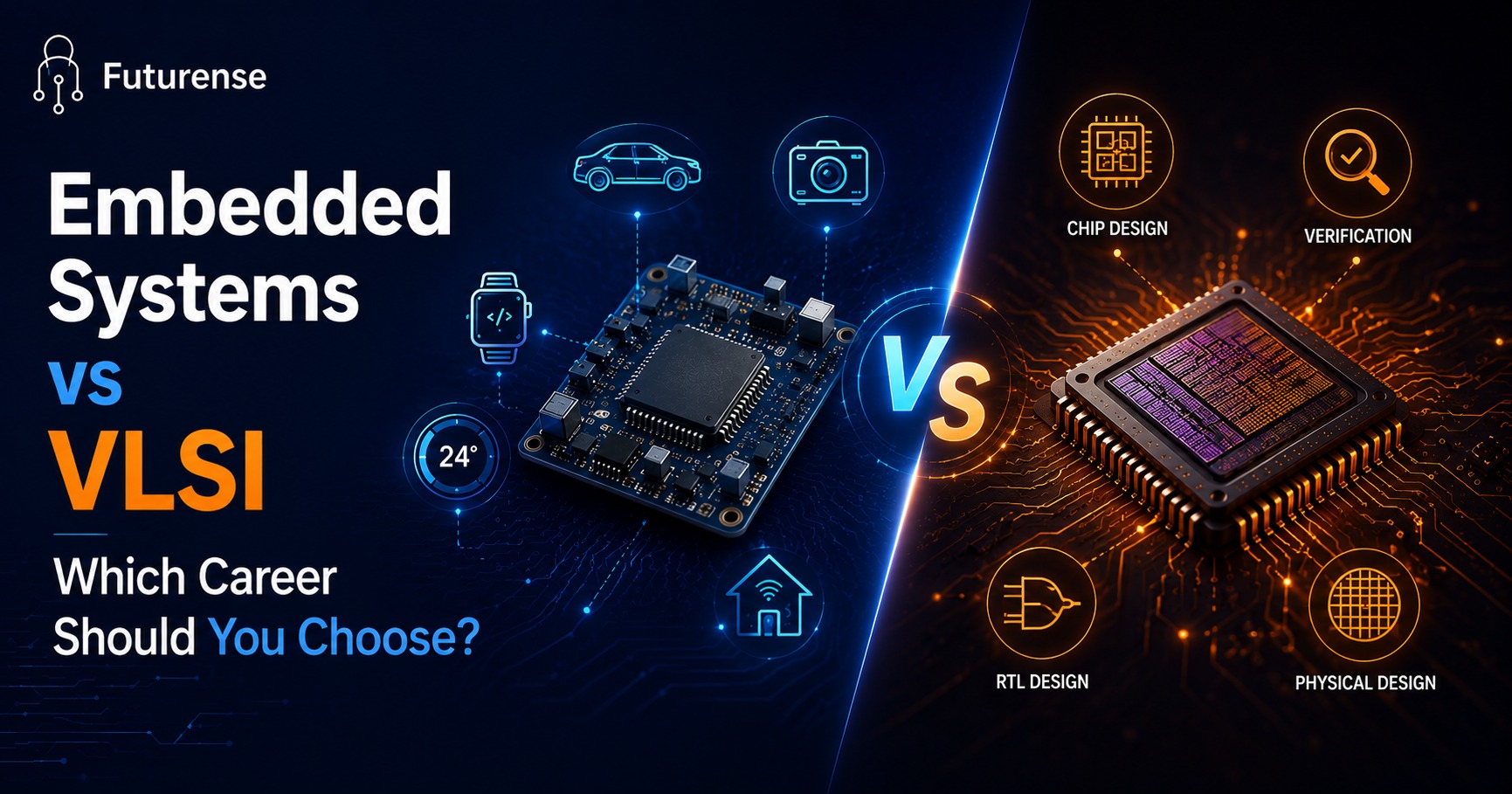


Embedded systems vs VLSI is one of the most common career forks electronics engineering students face, and the honest answer is that you're not choosing between a good and a bad option, you're choosing between two different layers of how electronic devices actually work. VLSI (Very Large Scale Integration) is the discipline of designing the chip itself, the transistors, circuits, and physical layout that make a processor function.
Embedded systems is the discipline of building the software and firmware that runs on that chip to make a device do something useful, control a motor, read a sensor, run a display.
This guide breaks down what each field actually involves, how they compare on salary, skills, and learning curve, what a real day at work looks like in each, and how to decide which one fits you, without pretending one is universally superior to the other.
What Is VLSI?
VLSI stands for Very Large Scale Integration, the process of designing integrated circuits by combining millions or billions of transistors onto a single chip.
VLSI engineers work across the VLSI design flow, from RTL design and verification through physical design and tapeout, using specialized EDA tools like Cadence and Synopsys. This is deep, hardware-first work: you're designing the actual silicon that everything else runs on.
What Is Embedded Systems?
Embedded systems engineering focuses on building the software (firmware) that runs directly on hardware to control a specific function, think of the software inside a washing machine, a car's anti-lock braking system, or a fitness tracker.
Embedded engineers work close to hardware, often in C or C++, dealing with microcontrollers, real-time operating systems, and hardware interfacing, but they're generally not designing the chip itself, they're programming it to do something specific.
Embedded Systems vs VLSI: Key Differences at a Glance
A Day in the Life: Embedded Systems vs VLSI
Titles and skill lists only tell you so much. Here's what the actual day-to-day work tends to look like in each field, since this is often where people realize which one genuinely appeals to them.
A typical day for an embedded systems engineer might involve writing and debugging C code that reads sensor data, working with a debugger attached to real hardware to trace why a motor isn't responding correctly, integrating a real-time operating system task scheduler, or working closely with mechanical and electrical teams to get firmware talking correctly to a physical prototype.
The feedback loop is often fast and tangible, you flash new code, plug in the board, and immediately see whether the device behaves correctly.
A typical day for a VLSI engineer looks different depending on specialization. A design engineer might spend the day writing and refining RTL code, running simulations, and debugging timing violations.
A verification engineer spends significant time writing testbenches and analyzing coverage reports to make sure a design behaves correctly across thousands of scenarios before it ever reaches silicon. A physical design engineer works with floorplanning and place-and-route tools, iterating on layouts to close timing and meet power targets.
The feedback loop here is often slower and more abstract, you're frequently working entirely in simulation, since a real chip doesn't exist yet to test against; tapeout, when a design actually goes to fabrication, might happen only once or twice a year on a given project.
If you're the kind of person who wants to see immediate, physical results from your work, embedded systems' faster feedback loop may appeal more.
If you're comfortable with longer development cycles in exchange for working on something that becomes the literal foundation every other layer runs on, VLSI's pace may suit you better.
VLSI vs Embedded Systems Salary
This is the single most-searched angle on this comparison, and the honest answer is that VLSI generally has a higher long-term salary ceiling, but embedded systems often have a gentler, faster on-ramp.
Fresher embedded systems roles typically start around ₹3.5-6 LPA, while fresher VLSI roles, particularly at semiconductor companies, often start slightly higher, ₹4-7 LPA, given the specialized skill requirement.
The gap widens with experience: senior VLSI engineers, especially in physical design and verification, frequently out-earn embedded engineers at comparable seniority, since VLSI engineer salary in India data consistently shows steep pay growth for specialized, hard-to-replace chip design skills.
Embedded systems salaries grow steadily too, but the ceiling is generally a notch lower unless you move into embedded systems architecture or safety-critical domains like automotive.
Which Is Easier to Learn: VLSI or Embedded Systems?
Embedded systems are generally considered the more accessible starting point. If you're already comfortable with C or C++ and basic microcontroller concepts, you can become productive in embedded roles relatively quickly, and the learning curve scales gradually as you take on more complex real-time or hardware-interfacing challenges.
VLSI has a steeper initial learning curve. Understanding RTL design, verification methodology, and physical design concepts requires more focused, often formal coursework, and the tools themselves (Cadence, Synopsys) have a real learning investment before you're productive.
That said, once the fundamentals click, VLSI's specialization tends to compound into a stronger, harder-to-replicate skill set than a general embedded background.
Job Scope and Industry Demand
Embedded systems has broader industry applicability, nearly every electronics-adjacent industry (automotive, consumer devices, industrial automation, medical devices, IoT) needs embedded engineers, which means more total job openings and more geographic and company-size flexibility.
VLSI is narrower but arguably deeper right now. Demand is concentrated in semiconductor and chip design companies specifically, but that demand is accelerating fast.
Government-backed investment through the India Semiconductor Mission is actively funding new fab and design capacity in India, which is measurably expanding VLSI hiring, a trend embedded systems, while stable, isn't seeing at the same accelerating pace domestically.
Can You Switch From Embedded Systems to VLSI (or Vice Versa)?
Yes, and it happens often enough that it's worth knowing the direction that's more common. Movement from embedded systems into VLSI is fairly common, engineers with strong C/C++ and hardware-interfacing backgrounds often transition into digital design or verification roles, since verification work in particular benefits from strong programming fundamentals, writing testbenches and verification environments genuinely resembles software engineering more than classical circuit design does.
The reverse, VLSI embedded, is less common but not rare, particularly for engineers moving into roles that blend chip-level knowledge with system integration, like bring-up engineering, where a newly fabricated chip is validated on real hardware for the first time.
A realistic transition path from embedded into VLSI usually starts with picking up a hardware description language (Verilog or VHDL), building a few personal or academic projects that demonstrate RTL design or basic verification skills, and specifically targeting verification roles first, since they're generally the most accessible entry point for someone with a strong software background rather than years of analog circuit design experience.
If you're exploring broader VLSI career paths in India after starting in embedded systems, this is a well-worn path, not a risky pivot; many successful VLSI verification engineers started with an embedded or software-adjacent background before specializing.
How to Decide: Embedded Systems or VLSI?
A few honest questions to ask yourself:
- Do you enjoy writing code more than designing circuits?
If yes, lean embedded systems. If you're more drawn to how a chip is physically built and optimized, lean VLSI.
- Do you want a faster path to your first job, or are you willing to specialize deeply first?
Embedded systems generally get you employable faster. VLSI asks for more upfront specialization but can pay off with a stronger long-term ceiling.
- Are you drawn to a specific end product (cars, medical devices, consumer electronics) or to chip design as a discipline itself?
Product-focused interest points toward embedded systems, since you'll be building the brains of a specific device. Pure fascination with how chips themselves work points toward VLSI. - Does your city or target companies have strong VLSI hiring, or mostly embedded/product companies?
Location and company access genuinely matter here, VLSI roles cluster more tightly around semiconductor hubs than embedded roles do. - How do you feel about the feedback loop difference described above?
Fast, tangible results favor embedded systems. Longer, more abstract development cycles in exchange for foundational-level work favor VLSI.
Organizations like IEEE offer solid foundational resources if you're still exploring either field before committing, worth a look through IEEE's overview of embedded systems if you want a broader technical grounding before choosing a direction.
TL;DR
Embedded systems and VLSI are both hardware-adjacent electronics careers, but they sit at different layers of the same stack. Embedded systems engineers build the software and firmware that runs on a chip, while VLSI engineers design the chip itself.
VLSI generally offers a higher salary ceiling and deeper specialization, embedded systems offers a faster, more accessible entry point and broader industry applicability.
Neither is objectively "better," the right choice depends on whether you're drawn to hardware-level chip design or software-adjacent systems work.
Is VLSI better than embedded systems?
Neither is universally better. VLSI generally offers a higher long-term salary ceiling and deeper specialization, while embedded systems offers a faster, more accessible entry point and broader industry applicability. The right choice depends on your interests and career goals.
Which pays more, VLSI or embedded systems?
VLSI generally has a higher salary ceiling, especially in senior physical design and verification roles, though embedded systems fresher salaries are often comparable to VLSI at the entry level.
Is VLSI harder to learn than embedded systems?
Generally yes. VLSI has a steeper initial learning curve, requiring more focused coursework in RTL design, verification, and EDA tools, while embedded systems are often more accessible if you already have solid C/C++ programming skills.
Can an embedded systems engineer switch to VLSI?
Yes, this is a fairly common transition, particularly into verification roles, since strong programming fundamentals from embedded work transfer well. Picking up a hardware description language and targeting verification roles specifically is the most realistic entry path.
Does VLSI require coding?
Yes, VLSI engineers regularly use hardware description languages like Verilog or VHDL, along with scripting languages like Python or Tcl for automation, so coding skills matter in VLSI too, just applied differently than in embedded software development.


M.Tech. in VLSI Design (Executive)
IIT Jammu
Backed by India’s Semiconductor Mission. Built for Long-Term Career Growth.