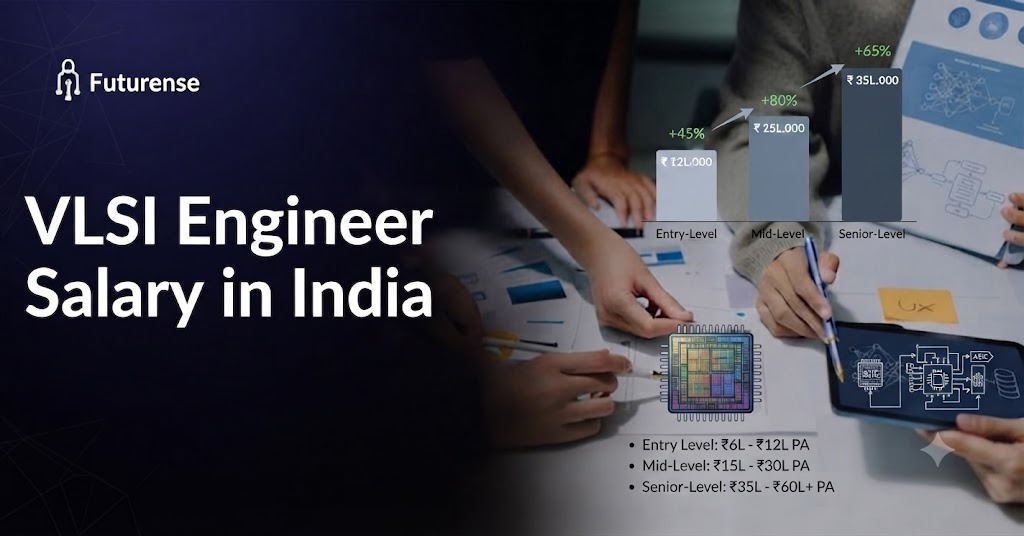


VLSI engineer salary in India ranges from about ₹4-6 LPA for freshers to ₹18-35 LPA for engineers with 8-plus years of experience, with senior physical design and architecture leads at top semiconductor companies crossing ₹40 LPA. Pay depends heavily on which part of the chip design flow you work in, whether you're at an MNC or a domestic design house, and which city you're based in.
VLSI stands for Very Large Scale Integration, the process of designing integrated circuits by combining millions of transistors onto a single chip. The VLSI job market spans several distinct roles, design engineer, verification engineer, physical design engineer, and DFT engineer, and it helps to understand what VLSI design actually involves before comparing pay across these specializations.
India is one of the largest global hubs for VLSI talent, second only to the US, because most major chipmakers run design centers out of Bangalore, Hyderabad, Noida, and Pune. That demand is exactly why VLSI salaries have climbed steadily over the last five years, and why this guide breaks down pay by experience level, role, company, and city instead of giving you one flat number.
Average VLSI Engineer Salary in India by Experience Level
Experience is the single biggest lever on VLSI pay. A fresher and a 10-year verification lead are effectively in different salary universes, even at the same company.
These ranges hold up against public salary data. AmbitionBox's aggregated VLSI engineer salary data for India shows pay scaling meaningfully with tenure and seniority, and the jump between the 5-8 year and 8-12 year bands is usually where engineers move from execution to ownership of a full design block or verification plan. That's also the point where an internal move to a principal or lead title, rather than a company switch, often produces the biggest single jump in pay.
VLSI Engineer Salary for Freshers: What to Realistically Expect
Fresh graduates entering VLSI in India typically start between ₹4 LPA and ₹7 LPA, with the wide spread driven almost entirely by employer type. Product companies and semiconductor giants pay meaningfully more than services-heavy VLSI companies for the same fresher batch.
A few patterns freshers should know before negotiating an offer:
- IIT and top-tier NIT graduates with a specialization in VLSI or microelectronics often land offers at the higher end of this band, sometimes ₹8-10 LPA at product companies during campus placements.
- Design verification roles tend to pay slightly more than physical design or layout roles at the fresher level, because verification skills (SystemVerilog, UVM) are in tighter supply.
- A relevant M.Tech or PG certification in VLSI design is one of the fastest ways to move from a services-track offer to a product-company offer, since most VLSI teams filter hard on hands-on tool exposure at the interview stage.
If you're weighing whether a postgraduate VLSI program is worth it before you enter the job market, it's worth reading up on broader VLSI career paths in India, since the fresher salary band is really a starting point that specialization choices shift quickly.
VLSI Engineer Salary After 5 Years and After 10 Years
The five-year mark is where VLSI compensation starts to diverge sharply based on specialization, not just tenure.
VLSI engineer salary after 5 years typically lands between ₹12 LPA and ₹20 LPA. At this stage, engineers are usually leading a sub-module of a design or verification effort, mentoring juniors, and are expected to close timing or coverage closure independently rather than under close supervision.
VLSI engineer salary after 10 years typically ranges from ₹25 LPA to ₹45 LPA, though this varies more than any other band in this guide. Engineers who've stayed in hands-on technical roles (principal engineer, architect) often out-earn peers who moved into pure people-management, because deep physical design and architecture expertise is scarcer than management bandwidth in most Indian VLSI teams.
VLSI Salary by Role: Design, Verification, and Physical Design
VLSI isn't one job. It's a design flow with distinct specializations, and each one commands a different pay band even at the same experience level.
VLSI design engineer salary (RTL design, front-end design): Generally the baseline against which other VLSI roles are compared, ranging from ₹6 LPA at entry level to ₹30+ LPA for senior architects. RTL designers write the register-transfer-level code that defines chip behavior before it goes to synthesis.
VLSI verification engineer salary: Often 5-10% higher than design engineer pay at comparable experience, because verification (using UVM, SystemVerilog) is the bottleneck skill most fabless semiconductor companies are short on. Verification engineers who also understand combinational and sequential circuits deeply, not just the verification tooling, tend to progress faster into lead roles.
VLSI physical design engineer salary: Physical design (place-and-route, timing closure, physical verification) pays competitively with design roles and often overtakes them at the senior level, because physical design engineers are the ones who actually get a chip to tape-out. Senior physical design leads at top companies are among the highest earners in the entire VLSI stack.
DFT (Design for Testability) engineer salary: Typically tracks close to verification pay, slightly narrower band, because DFT is a smaller but consistently in-demand specialization tied to yield and test-cost outcomes.
VLSI Salary by Company: MNCs vs. Domestic Design Houses
Where you work changes VLSI pay more than almost any other single factor besides experience.
Global semiconductor and product companies (Qualcomm, Intel, Nvidia, AMD, Texas Instruments, Broadcom) generally pay 20-40% above the market average at every experience band. These companies run full-scale India design centers, not just support functions, so compensation reflects real chip-design ownership, not offshore cost arbitrage.
Qualcomm VLSI engineer salaries in India and Intel VLSI engineer salaries in India are consistently cited among the highest in the sector for both fresher and mid-level bands, largely because both companies run flagship SoC design work out of their India centers rather than routine support tasks.
Domestic design houses and semiconductor services firms typically pay lower base salaries but can offer faster growth into lead roles for engineers willing to take on broader scope earlier in their careers. These firms are also where many freshers get their first hands-on tapeout experience, which becomes the credential that unlocks an MNC move two or three years later.
VLSI Engineer Salary in India vs. Abroad
VLSI engineers who move abroad, particularly to the US, typically see a 3-5x jump in absolute pay, though cost of living erodes a meaningful chunk of that gap. A senior VLSI engineer earning ₹30 LPA in India might earn $130,000-$160,000 in the US for a comparable role, which is a real increase in purchasing power even after adjusting for expenses.
That said, India's VLSI salary growth has outpaced most other engineering disciplines domestically over the last three years, largely because India's Semiconductor Mission is reshaping VLSI hiring by pulling fresh fab and design investment into the country. Engineers who stay in India are no longer trading pay growth for career growth the way they were a decade ago.
How to Increase Your VLSI Engineer Salary in India
A few moves consistently correlate with above-average VLSI pay growth, based on patterns visible across job postings and salary aggregators.
- Specialize in a scarce sub-skill. Low-power design, advanced node physical design (5nm and below), and UVM-based verification are consistently the highest-paid specializations because supply hasn't caught up with demand.
- Get real tapeout experience, not just simulation experience. Engineers who've taken a design through to actual silicon tapeout are valued far above those with only academic or simulation-only exposure.
- Move to a product company from a services firm once you have 2-3 years in. This single move often produces a larger salary jump than staying at the same firm for five years.
- Add an AI-adjacent skill to your VLSI toolkit. Chip design is increasingly using ML-assisted EDA tools, and engineers who can bridge classical VLSI work with AI-driven design automation are commanding a premium.
If you're early in your career and want to build these specializations deliberately rather than by accident, structured postgraduate programs like IIT Jammu's M.Tech in VLSI Design or IIT Kharagpur's PG Certification in AI-Enabled VLSI Design are built specifically around the skill gaps that show up in the salary data above: advanced node design, verification depth, and now, AI-assisted chip design tooling.
TL;DR
VLSI engineer salaries in India range from ₹4–7 LPA for freshers to ₹35–60+ LPA for experienced architects and engineering managers, with the biggest salary jumps coming from specialization and experience.
- Freshers: ₹4–7 LPA (up to ₹8–10 LPA at top product companies).
- 5 years: ₹12–20 LPA.
- 10 years: ₹25–45 LPA, with senior architects earning even more.
- Highest-paying roles: Physical Design, Verification, and DFT engineers, especially in advanced-node chip development.
- Top-paying companies: Qualcomm, Intel, Nvidia, AMD, Texas Instruments, and Broadcom typically offer 20–40% higher salaries than the market average.
- Best ways to increase salary: Gain tapeout experience, specialize in UVM verification or advanced physical design, move to a product company, and build AI-assisted chip design skills.
What is the average VLSI engineer salary in India?
The average VLSI engineer salary in India is roughly ₹8-10 LPA across all experience levels combined, though this masks a wide range from ₹4 LPA for freshers to ₹40+ LPA for senior architects and principal engineers at top semiconductor companies.
What is the starting salary for a VLSI engineer in India?
Starting salaries for VLSI engineers in India typically range from ₹4 LPA to ₹7 LPA, with product companies and semiconductor MNCs paying at the higher end and services-oriented VLSI firms paying closer to the lower end.
Which VLSI role pays the highest salary in India?
Senior physical design engineers and verification leads typically command the highest pay within the VLSI stack, especially at companies working on advanced process nodes, because both skills are direct bottlenecks to getting a chip to tapeout.
Is VLSI a good career in India in terms of salary growth?
Yes. VLSI salary growth in India has accelerated over the last three years, driven by India's Semiconductor Mission and new fab and design investments, and engineers with specialized skills in verification or physical design are seeing faster pay progression than in many adjacent engineering fields.
Do VLSI engineers earn more than software engineers in India?
At the fresher and mid-level bands, software engineer salaries are often slightly higher on average due to a larger pool of high-paying product company roles. At the senior level, specialized VLSI roles (particularly physical design and verification leads at top semiconductor firms) can match or exceed comparable software engineering pay.


Executive PG Certification in AI-Enabled VLSI Design
IIT Kharagpur
Architect the Silicon of Tomorrow: From Low-Power RTL to AI-Optimized GDSII.