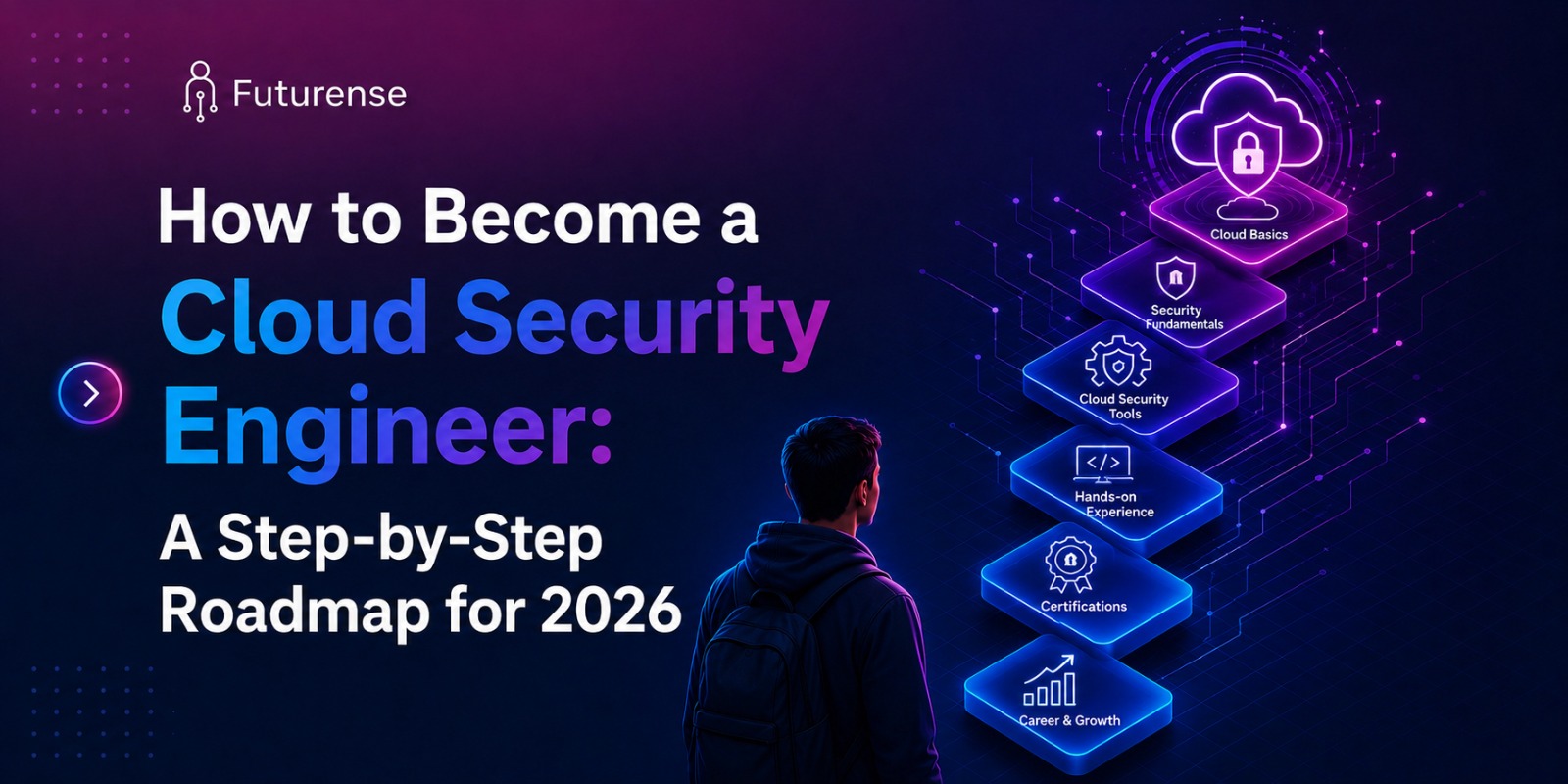


Every enterprise migrating to the cloud faces the same uncomfortable truth: speed and security don't naturally go together. As companies push more workloads onto AWS, Azure, and Google Cloud, they need people who can keep that infrastructure locked down without slowing the business. That's the job of a cloud security engineer and it's quickly become one of the most in-demand, best-paying roles in tech.
If you're wondering how to become a cloud security engineer, the good news is that the path is well-defined, even if it isn't short. This guide breaks the journey into a clear, step-by-step roadmap covering the skills, certifications, tools, and real-world experience you need to land the job and grow in it.
Who Is a Cloud Security Engineer?
A cloud security engineer is a specialist who designs, implements, and maintains the security controls that protect an organization's cloud infrastructure, its servers, storage, networks, applications, and data.
Unlike a traditional IT security professional who might focus on on-premise firewalls and physical servers, a cloud security engineer works within platforms like AWS, Microsoft Azure, and Google Cloud Platform (GCP), configuring identity and access management (IAM), encryption, network segmentation, and continuous monitoring across distributed, often multi-cloud environments.
Their day-to-day work can include hardening cloud configurations, responding to security incidents, automating compliance checks, reviewing infrastructure-as-code for vulnerabilities, and working closely with DevOps teams to embed security into every stage of deployment, an approach commonly known as DevSecOps.
Why Cloud Security Is One of the Fastest-Growing Careers in Tech
Three forces are driving demand for this role. First, cloud adoption itself: most mid-to-large enterprises now run a significant share of their infrastructure on public or hybrid cloud, which means the attack surface has moved from data centers to cloud consoles. Second, regulatory pressure data protection laws and industry-specific compliance frameworks now require documented, auditable cloud security controls, not just good intentions. Third, a persistent global talent shortage in cybersecurity, with cloud-specific skills representing one of the widest gaps within that shortage.
The result is a job market where cloud security engineers are hired faster, paid more, and given broader responsibility than many adjacent IT roles. It also means the entry bar has risen employers want candidates who can demonstrate hands-on cloud security experience, not just theoretical cybersecurity knowledge.
Cloud Security Engineer vs. Cloud Engineer vs. Cybersecurity Analyst
It helps to separate three roles people often confuse:
- A cloud engineer builds and manages cloud infrastructure provisioning servers, setting up networks, and deploying applications. Security is one consideration among many.
- A cybersecurity analyst typically monitors for threats and investigates incidents across an organization's broader IT environment, which may or may not be cloud-heavy.
- A cloud security engineer sits at the intersection of both the infrastructure fluency of a cloud engineer and the threat-modeling mindset of a security analyst, applied specifically to cloud-native environments.
If you're also comparing this path to becoming a cloud architect or a broader DevOps engineer, know that all three roles share a technical core but diverge in focus: architects design systems at scale, DevOps engineers optimize delivery pipelines, and security engineers protect what's been built and deployed.
Key Skills You Need to Become a Cloud Security Engineer
Technical Skills
At a baseline, you'll need a solid grip on networking fundamentals (TCP/IP, DNS, VPNs, firewalls), operating systems (Linux especially), and scripting (Python or Bash for automation). On top of that, cloud security specifically demands:
- Identity and Access Management (IAM) least-privilege design, role-based access
- Encryption data at rest and in transit, key management services
- Network security VPCs, security groups, segmentation, zero-trust architecture
- Security monitoring and logging SIEM tools, cloud-native logging services
- Infrastructure-as-Code (IaC) security scanning Terraform/CloudFormation templates for misconfigurations
- Compliance frameworks ISO 27001, SOC 2, GDPR, and other data protection standards
- Incident response detecting, containing, and remediating cloud breaches
Understanding foundational security models like the CIA triad confidentiality, integrity, and availability will give you the conceptual backbone that every practical control maps back to.
Cloud Platform Knowledge (AWS, Azure, GCP)
You don't need to master every cloud provider, but you should go deep on at least one. AWS remains the most widely deployed platform, so AWS security services (IAM, GuardDuty, Security Hub, KMS) are a strong starting point.
Azure and GCP each have their own equivalents, and many organizations run multi-cloud or hybrid environments, so cross-platform fluency becomes more valuable as you advance. Understanding the different cloud computing models IaaS, PaaS, and SaaS will also help you reason about where security responsibility shifts between the provider and your organization (the shared responsibility model).
Soft Skills
Cloud security engineers rarely work in isolation. You'll need to communicate risk clearly to non-technical stakeholders, document controls for audits, and collaborate constantly with DevOps and engineering teams often under time pressure during an active incident. Curiosity, attention to detail, and calm decision-making under pressure matter just as much as technical depth.
Step-by-Step Roadmap to Becoming a Cloud Security Engineer
Step 1 Build a Foundation in IT and Networking
Start with the fundamentals: how networks communicate, how operating systems manage permissions, and how the web actually works. A degree in computer science, IT, or a related field helps, but isn't mandatory.
Many successful cloud security engineers come from self-taught or bootcamp backgrounds, provided they can demonstrate real skills.
Step 2 Learn Core Cybersecurity Concepts
Before specializing in cloud, understand general security principles: threat modeling, common attack vectors, encryption basics, and access control models. Exploring what cybersecurity actually involves at a foundational level, and comparing paths like ethical hacking versus broader cybersecurity roles, can help you decide where cloud security fits within the wider field.
Step 3 Get Hands-On With a Cloud Platform
Theory only goes so far. Open a free-tier AWS, Azure, or GCP account and start building and deploying a small application, configuring a VPC, setting up IAM roles, and breaking things (safely) so you understand how they fail. This hands-on comfort is what separates candidates who can talk about cloud security from those who can actually do it.
Step 4 Specialize in Cloud Security Tools and Practices
Once you're comfortable navigating a cloud console, move into security-specific practice: configure cloud-native security monitoring, run vulnerability scans, set up logging and alerting, and study cloud-native security patterns like container security and serverless security. This is also where you should start exploring DevSecOps practices, understanding why and how security gets embedded directly into CI/CD pipelines rather than bolted on at the end.
Step 5 Earn Industry-Recognized Certifications
Certifications won't replace hands-on skill, but they signal credibility to recruiters and often clear automated resume filters. See the dedicated section below for the certifications worth prioritizing.
Step 6 Build Real Projects and a Portfolio
Recruiters and hiring managers increasingly want proof, not just credentials. Document a home lab, contribute to open-source security tooling, write up how you secured a sample cloud deployment, or complete a capstone-style project.
If you're exploring structured capstone project ideas, cloud security offers excellent options such as building a secure multi-tier application or automating compliance checks with IaC scanning.
Step 7 Apply for Entry-Level Roles and Internships
Look for titles like Junior Cloud Security Engineer, Security Analyst (Cloud), or Associate DevSecOps Engineer. Many professionals also enter cloud security laterally starting as a cloud engineer or general cybersecurity analyst and moving into a security-focused cloud role after 1–2 years of experience.
Reviewing a general cloud engineer roadmap can be useful if you're starting from an infrastructure-first angle.
Best Certifications for Cloud Security Engineers
- AWS Certified Security – Specialty (SCS-C02): The strongest credential if you're focused on AWS environments; validates deep knowledge of IAM, encryption, and incident response on AWS.
- Microsoft Certified: Azure Security Engineer Associate (AZ-500): The Azure equivalent, widely requested by organizations running Microsoft-centric infrastructure.
- ISC2 Certified Cloud Security Professional (CCSP): A vendor-neutral, advanced certification that's especially valuable once you're targeting senior or architect-level roles.
- CompTIA Security+ / Cloud+: Solid entry points if you're building foundational cybersecurity and cloud credibility before specializing.
- Certified Ethical Hacker (CEH): Useful if your career path leans toward offensive security or cloud penetration testing.
For a broader comparison of options beyond cloud-specific certs, this roundup of best cybersecurity courses and certifications is a useful reference point when mapping out your learning sequence.
Tools and Technologies Cloud Security Engineers Use
On the job, expect to work with: IAM consoles and policy editors, SIEM platforms (Splunk, Microsoft Sentinel), cloud-native security services (AWS GuardDuty, Azure Defender, GCP Security Command Center), vulnerability scanners, container security tools (for Docker/Kubernetes environments), Infrastructure-as-Code scanners (Checkov, tfsec), and CI/CD pipeline security integrations.
Familiarity with common DevOps tools will also help, since cloud security engineers frequently work inside the same pipelines as DevOps teams rather than around them.
Cloud Security Engineer Salary in India and Globally
Compensation for cloud security engineers has climbed steadily as demand has outpaced the supply of qualified professionals. In India, entry-level cloud security engineers with a foundational cloud security certification typically start in the range of ₹5-9 LPA. With three to five years of experience and a recognized cloud-platform certification such as AWS SCS-C02 or AZ-500, mid-level professionals commonly earn between ₹12-22 LPA.
Senior cloud security architects with eight or more years of experience particularly those holding the CCSP often reach ₹28–50 LPA, with principal-level or global-capability-center roles going higher still. Metro hubs like Bengaluru tend to command a noticeable premium over other Indian cities, reflecting concentrated enterprise and GCC demand.
Globally, cloud security remains one of the highest-paid subfields within cybersecurity, and salaries in markets like the US and Western Europe are proportionally higher, reflecting the same acute talent shortage seen in India.
For a comparative view, it's worth checking the cloud engineer salary in India and AWS cloud architect salary benchmarks alongside cybersecurity-specific data like the average cybersecurity salary in India, since compensation bands often overlap across these adjacent roles.
Career Path and Growth Opportunities
A typical progression looks like: Security Analyst or Junior Cloud Security Engineer → Cloud Security Engineer → Senior Cloud Security Engineer → Cloud Security Architect or Lead → Head of Cloud Security / CISO track.
Many professionals also branch laterally into related specializations such as DevSecOps engineering, cloud compliance and governance, or AI-driven cybersecurity roles, as artificial intelligence increasingly shapes how threats are detected and mitigated at cloud scale.
Common Mistakes to Avoid
- Chasing certifications without hands-on practice: Certifications open doors, but interviewers will quickly spot a lack of practical experience.
- Ignoring compliance and governance: Technical skill alone isn't enough, enterprises need engineers who understand regulatory context.
- Staying single-cloud too long: Depth in one platform is a great starting point, but multi-cloud familiarity becomes increasingly valuable as you advance.
- Underestimating soft skills: The ability to explain risk to a non-technical stakeholder is often what separates a good engineer from a promotable one.
- Treating security as a final step, not a continuous process: The strongest cloud security engineers build monitoring, testing, and remediation into every stage of development not just at deployment.
TL;DR Quick Summary
Becoming a cloud security engineer means combining core IT and networking fundamentals with cloud platform expertise and security-specific skills like IAM, encryption, and threat monitoring.
Start by learning networking and cybersecurity basics, then get hands-on with AWS, Azure, or GCP, specialize in cloud-native security tools and DevSecOps practices, earn a recognized certification (AWS SCS-C02, AZ-500, or CCSP), build a portfolio of real projects, and apply for entry-level cloud security or DevSecOps roles.
In India, salaries typically range from ₹5–9 LPA at entry level to ₹28–50 LPA and beyond at the senior/architect level, making this one of the most rewarding specializations in tech today.
Is coding required to become a cloud security engineer?
Not extensive software development, but scripting knowledge particularly Python or Bash is important for automating security checks and working with Infrastructure-as-Code.
Which certification should I get first: AWS, Azure, or CCSP?
Start with the cloud platform certification that matches the environment you're most likely to work in (AWS SCS-C02 or AZ-500 are common entry points). CCSP is better suited once you have some practical experience and are targeting senior roles.
How long does it take to become a cloud security engineer?
With consistent effort, most people can reach entry-level readiness in 8–14 months, combining foundational learning, hands-on cloud practice, and one certification. Career-changers with prior IT experience often move faster.
Do I need a computer science degree?
No while a relevant degree helps, many cloud security engineers build their careers through certifications, hands-on labs, and demonstrable project experience instead.
What's the difference between a cloud security engineer and a DevSecOps engineer?
A cloud security engineer focuses primarily on securing cloud infrastructure and data, while a DevSecOps engineer focuses on embedding security practices directly into the software development and deployment pipeline. In practice, the roles overlap significantly and often report into the same team.


Advanced PG Certificate in AI Engineering on Cloud and AIOps
IIT Roorkee
Engineer AI Systems for Top Enterprises, with the Most Critical Skills of the Decade.