

My cousin asked me this exact question last year, right after her boards, and I gave her the honest answer instead of the inspirational one: there's no single, guaranteed path on how to become a data scientist after 12th.
There's a realistic one, though, and it looks less like a checklist and more like a sequence of decisions that compound over four or five years. Most articles on this topic hand you a degree name and call it done. That's not actually useful when you're seventeen and trying to figure out what to do next.
So here's the version I'd actually tell a younger sibling. What degree makes sense, what to learn alongside it (because the degree alone won't cut it), how long this realistically takes, and where people commonly waste a year or two without meaning to.
Why "After 12th" Is Actually the Right Time to Start Thinking About This
Data science isn't a subject you bolt onto your resume in your final year of college. It's built on a foundation, math, statistics, and programming logic that's genuinely easier to absorb early, before you've locked into a completely unrelated academic track. If you're asking how to become a data scientist after 12th rather than after graduation, you're actually asking the question at the right moment, when your degree choice can be built around this goal instead of retrofitted to it.
That said, "right time" doesn't mean "only time." Plenty of working data scientists came from mechanical engineering, economics, even biology. But starting right after 12th does give you a real head start, mainly because you get four full years instead of a rushed eighteen-month pivot later.
Step 1: Pick the Right Degree (This Matters More Than People Admit)
You've got three realistic degree paths after 12th if data science is the goal.
Here's the part people skip: the degree name matters less than what you actually study and build during it. A computer science degree with zero self-directed data projects gets you nowhere close to a dedicated data science program where you're doing real projects from year one.
If you're weighing a dedicated program, it's worth looking at the real subjects covered in a BSc data science program before assuming any "data science" label means the same thing everywhere, because it genuinely doesn't. Some programs are rigorous and project-heavy. Others are a computer science curriculum with two extra electives and a rebranded name.
Step 2: Build the Actual Skills, Not Just the Credential
This is where most people quietly go wrong. They finish a data science degree and still can't build anything real, because the degree taught theory without enough hands-on practice.
Programming: Python is the practical starting point, not because it's trendy, but because the entire data science tooling ecosystem, Pandas, NumPy, scikit-learn, is built around it. Learn this in year one, not year three.
Statistics and probability: This is the part people underestimate the most. Machine learning is applied statistics with better tooling. If you can't explain what a p-value actually means, you're going to struggle to understand why a model is behaving the way it is later on.
SQL and databases: Unglamorous, genuinely essential. Real data lives in databases, not clean CSV files someone handed you for a tutorial.
Communication: This one surprises people. A data scientist who can't explain a model's findings to someone non-technical is only doing half the job. The best ones translate numbers into decisions.
Step 3: Build Projects That Actually Prove Something
A degree certificate proves you showed up. A portfolio proves you can do the work. Employers, and honestly most internship recruiters too, care far more about the second one.
Start small and genuinely finish things rather than starting five ambitious projects and abandoning all of them halfway. A cleanly finished analysis of a public dataset, something with a real question, real cleaning work, and an honest conclusion, beats a half-built "AI system" that never actually runs. By your third year, aim for two or three projects you can talk through in real depth for ten minutes straight, not just list on a resume.
Step 4: Internships Are Not Optional, Even If They Feel Optional
If you're wondering how to become a data scientist after 12th and you skip internships entirely until final year, you're making this harder than it needs to be. Even an unpaid or poorly-paid data internship in your second or third year does two things a classroom never will: it shows you what messy, real-world data actually looks like, and it gives you a genuine reference for your first full-time application.
Don't wait for the "perfect" internship. A small startup letting you touch real data is worth more at this stage than a prestigious-sounding but purely observational role at a big company.
A Realistic Timeline
This isn't a rigid formula, plenty of people move faster or slower depending on how much they're juggling alongside coursework. But if you're starting from zero right after 12th, this is a genuinely achievable pace without burning out by year two.
Is a Master's Degree Necessary?
Not immediately, and definitely not automatically. A strong bachelor's with real projects and at least one solid internship can land an entry-level data analyst or junior data scientist role directly.
A master's makes more sense if you want to move into research-heavy roles, or if your undergraduate program was weak on the technical depth and you need to catch up. Before committing four more years and real money to any degree path, it's worth honestly asking whether that degree is genuinely worth the time and money, since the answer depends heavily on the specific program's quality, not the degree title alone.
What This Actually Looks Like Day to Day
If you're picturing a data scientist as someone who builds flashy AI models all day, it's worth resetting that expectation early. A large chunk of the actual job is cleaning messy data, checking your assumptions, and explaining results to people who don't care about your model architecture, only what it means for their decision.
Understanding what a data scientist's actual day-to-day work looks like before you commit four years to this path is a genuinely good use of an afternoon, since a fair number of students discover halfway through their degree that they pictured a different job entirely.
Common Mistakes Students Make on This Path
Chasing tools instead of fundamentals: Jumping straight to deep learning frameworks before understanding basic statistics is like learning to drift before you can parallel park. It looks impressive in a video, it doesn't hold up under a real interview question.
Collecting certificates instead of building things: A stack of course completion certificates with zero actual projects behind them signals very little to an employer. One real project beats five certificates every time.
Waiting until final year to think about internships: Covered above, but worth repeating, since it's the single most common regret people mention looking back.
Picking a "trendy" specialization too early: NLP and computer vision are exciting, but jumping there before you're solid on fundamentals just means you're building on sand.
What If You're Reading This on the 11th, Not Right After 12th?
If you're a year early, even better, you've got extra runway. Use it to actually get comfortable with basic Python and light statistics before the pressure of board exams and college applications hits. You don't need to be building machine learning models at sixteen. You just need to not be completely starting from zero the day your first semester begins. That head start compounds more than people expect over four years.
And if you're reading this after 12th results are already out and you haven't picked a college yet, don't panic about the "perfect" choice. The honest reality of how to become a data scientist after 12th is that your first degree decision matters less than what you do with the next four years inside it. A slightly-less-prestigious program with genuine hustle beats a prestigious one coasted through.
Where Futurense Fits Into This Path
If you're looking at IIT-affiliated undergraduate options specifically as part of figuring out how to become a data scientist after 12th, it's worth knowing that pathways combining a recognized institute's academic rigor with industry-oriented, project-heavy learning exist without requiring a JEE score, a real option for students who are strong candidates on merit but didn't crack the traditional entrance route.
The degree label matters less than whether the program actually forces you to build things, so evaluate any option, including this one, against that bar specifically.
TL;DR
Becoming a data scientist after 12th doesn’t follow one fixed path. A practical route is to choose a strong degree in Data Science, AI, Computer Science, Statistics, or Mathematics, while building skills in Python, statistics, SQL, machine learning, and communication alongside your studies.
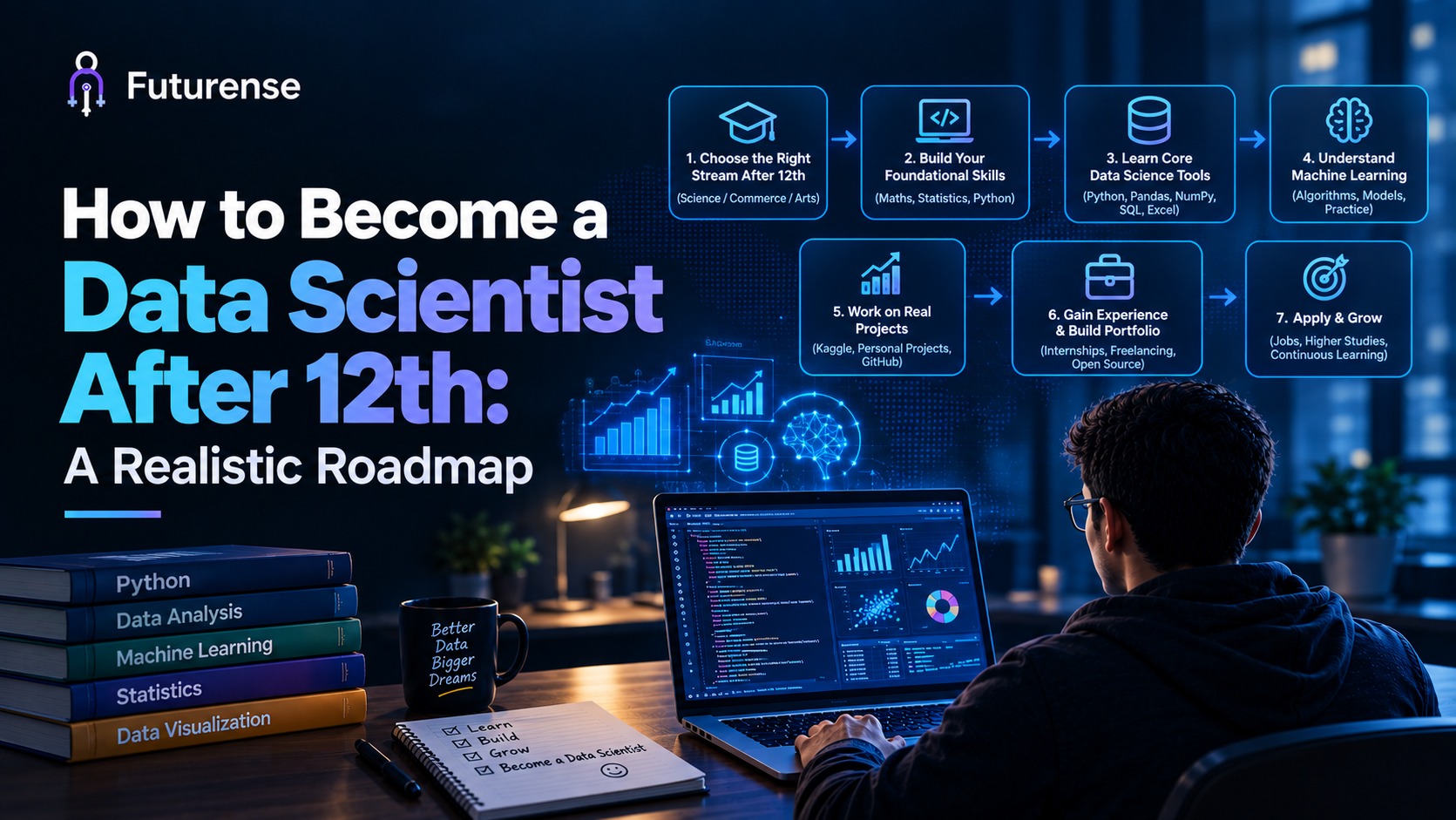
Focus on completing real projects and getting internships instead of collecting certificates. A realistic 3 to 4 year roadmap is: Year 1: Python and statistics; Year 2: SQL, projects and ML basics; Year 3: advanced ML, specialization and internships; Year 4: capstone project and placement preparation.
A master’s degree isn’t always necessary, and students from different academic backgrounds can enter data science by developing the right technical skills and experience.
What is the best course to become a data scientist after 12th?
A dedicated BSc or BTech in Data Science or AI is the most direct route, though a strong Computer Science, Statistics, or Mathematics degree paired with self-directed projects and internships works just as well, since actual skill-building matters more than the degree title alone.
What subjects are needed in 12th to pursue data science?
Most data science degree programs require Physics, Chemistry, and Mathematics (PCM) in 12th, along with a minimum aggregate percentage that varies by institute. Strong mathematics specifically is non-negotiable regardless of which stream you came from.
How many years does it take to become a data scientist after 12th?
A realistic timeline is 3-4 years for a bachelor's degree, plus ongoing project work and at least one meaningful internship along the way. Some students land entry-level roles right after their degree, others take an additional year or two building skills before their first full role.
Can I become a data scientist without a data science degree?
Yes. Many working data scientists come from computer science, statistics, mathematics, or even unrelated fields, and build the specific skills afterward through projects, certifications, and hands-on work. The degree helps, but it's not the only path in.
Is coding necessary to become a data scientist?
Yes, in practice. Python specifically is close to essential, since the majority of data science tools and libraries are built around it. You don't need to be a software engineer, but genuine coding comfort is not optional.


B.S/B.Sc in Applied AI & Data Science
IIT Jodhpur
Be a Part of India’s First Advanced AI Regular Degree with the Best Minds at IIT