


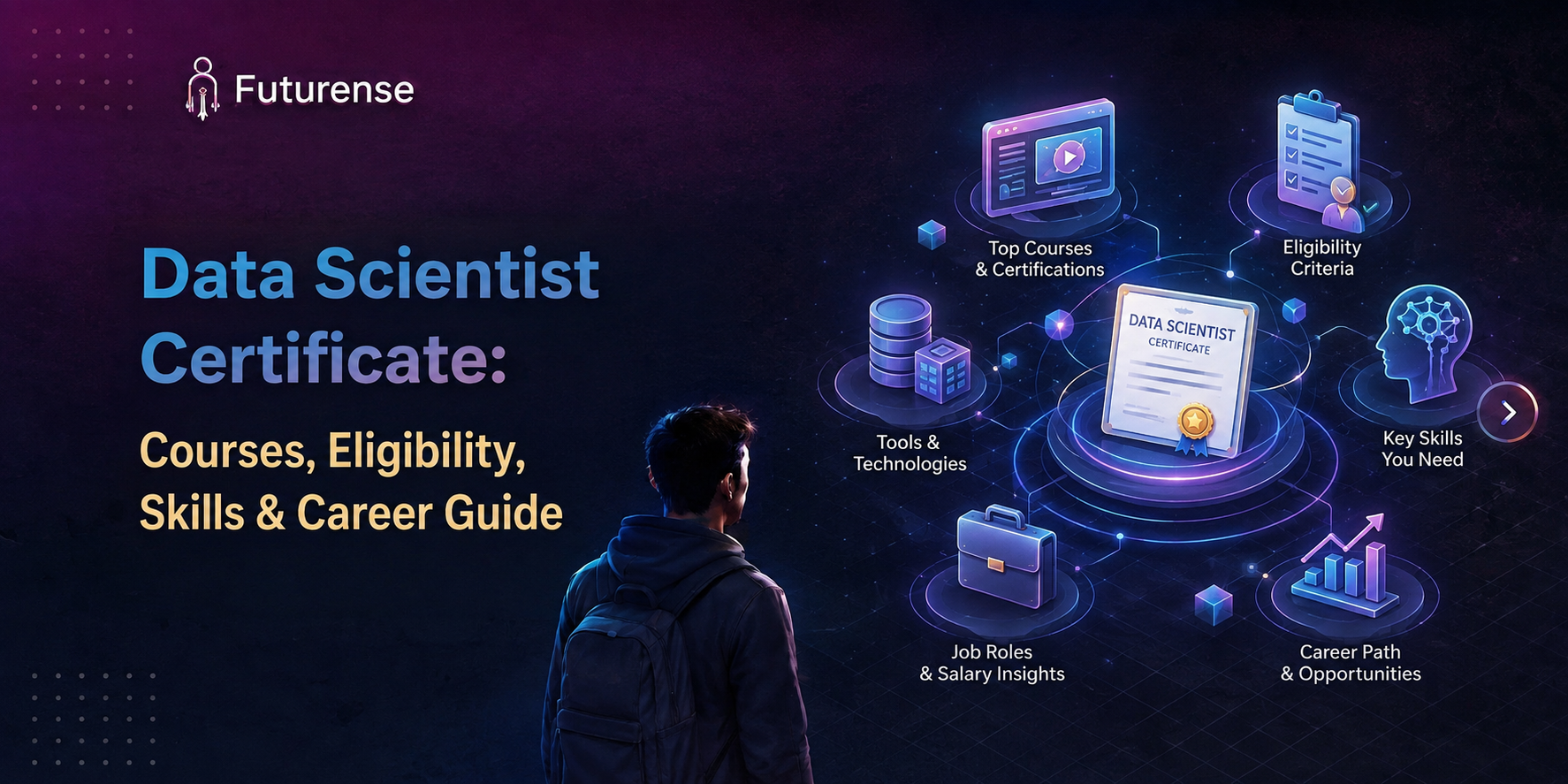


Data Scientist Certificate: Courses, Eligibility, Skills & Career Guide
A Data Scientist Certificate is a short, credential-focused program that trains you in the practical skills of data science, statistics, Python, machine learning, and data visualization, without the multi-year commitment of a full degree. It's built for people who need job-ready skills fast: recent graduates, working professionals switching careers, or engineers adding data science to an existing skill set. Certificates range from a few weeks of self-paced online study to 12-month, mentor-led postgraduate programs.
What Is a Data Scientist Certificate? A Clear Definition
A Data Scientist Certificate is a structured credential that verifies you can perform core data science tasks, cleaning and analyzing data, building machine learning models, and communicating insights, without requiring a full bachelor's or master's degree. It sits between a single online course and a full academic degree: more rigorous and comprehensive than a single course, but faster and narrower in scope than a degree.
Certificates fall into three broad categories, and knowing which one you're looking at matters more than the word "certificate" itself:
- Foundational certificates (IBM Data Science Professional Certificate, Google Data Analytics Certificate) — entry-level, self-paced, no prerequisites, typically 3–6 months.
- Professional/PG certificates (university- or institute-backed programs) — structured curriculum, cohort-based, mentorship, often 6–12 months, sometimes with a capstone project.
- Experience-based or exam certifications (DASCA, Open CDS) — designed for practitioners who already have years of experience and want to formalize it; these typically require prior work history, not just coursework.
Data Scientist Certificate vs Degree: Which Path Fits You
The honest answer is that it depends on where you're starting from, not which credential sounds more impressive.
A certificate makes sense if you already have a bachelor's degree in any field and need targeted, job-ready skills without spending another one to two years in a classroom. A degree makes more sense if you're starting from scratch, want deeper theoretical grounding in statistics and computer science, or are targeting research-heavy or highly specialized roles where academic pedigree carries more weight.
For a deeper look at the degree side of this decision, see Post Graduation in Data Science, which covers what a full postgraduate program adds beyond certificate-level training. Many professionals also combine both: a certificate to break in quickly, followed by a part-time or executive degree once they're established in the field.
Types of Data Scientist Certificate Programs Available Today
The certificate market has grown crowded, and not every program is built for the same learner. Here's how the main formats compare
Foundational certificates are useful for testing genuine interest before committing time or money. Cohort-based PG certificates, like the ones offered through Futurense's IIT partnerships, add structured mentorship and peer accountability, which self-paced courses can't replicate. For a closer comparison of program formats specifically, see online vs offline PG diploma in data science.
Eligibility Criteria for a Data Scientist Certificate Program
Most data scientist certificate programs share a common baseline, though specifics vary by institute:
- Educational background: A bachelor's degree in any discipline is usually sufficient for foundational and PG certificates. Programs with a stronger technical bent (executive AI/ML certificates, for instance) prefer a background in engineering, computer science, statistics, or mathematics, but rarely make it mandatory.
- Mathematical comfort: You don't need an advanced math degree, but basic statistics, probability, and linear algebra concepts make the curriculum far easier to absorb. Programs that skip this prerequisite usually build a short refresher module into the first few weeks.
- Programming exposure: Prior coding experience helps but isn't always required. Most PG certificates assume zero Python background and teach it from the ground up as part of the curriculum.
- Work experience: Foundational and PG certificates rarely require prior work experience. Executive and exam-based certifications almost always do, typically 2 or more years for executive programs and considerably more for advanced exam-based tracks like DASCA's senior tiers.
If you're unsure whether your background qualifies, most institutes run a short screening call or aptitude check rather than a hard cutoff, so it's worth applying rather than self-selecting out.
What You'll Actually Study: Core Skills a Data Scientist Certificate Should Cover
A certificate is only as good as the skills it actually builds. Look for these core areas in any program you're evaluating:
- Statistics and probability fundamentals — the mathematical backbone behind every model you'll build later.
- Python and SQL — the two languages that show up in nearly every data science job description, used for data manipulation and database querying respectively.
- Data cleaning and preprocessing — the unglamorous work that consumes most of a real data scientist's time, and the skill hiring managers check for most carefully.
- Machine learning fundamentals — regression, classification, clustering, and enough model-evaluation knowledge to know when a model is actually working.
- Data visualization and storytelling — turning analysis into something a non-technical stakeholder can act on, often the difference between an insight that gets used and one that gets ignored.
- A capstone or portfolio project — real-world project work you can show in interviews. Programs without this component leave you with a certificate but no proof of applied skill.
For a subject-by-subject breakdown of what a full curriculum typically covers, see Data Science Course Syllabus & Subjects.
How to Choose the Right Data Scientist Certificate
Three questions cut through most of the noise when comparing programs:
- Does it include a capstone project? A certificate without applied project work is a credential with no evidence behind it. Employers increasingly ask to see a GitHub portfolio alongside, or instead of, the certificate itself.
- Is there mentorship or is it fully self-paced? Self-paced programs are cheaper and more flexible, but cohort-based programs with mentor access consistently show better completion rates, because a fixed cohort and deadline structure counters the natural drop-off of solo online learning.
- Does the institute have placement support or industry partnerships? A certificate that ends at course completion, with no bridge to actual hiring, puts the entire job-search burden back on you. Programs backed by institutional partnerships and employer relationships close that gap.
Programs built with IIT partnerships, like Futurense's data science and applied AI tracks, are designed around exactly this structure: cohort-based learning, mentorship from industry practitioners, and a direct pipeline into hiring partner conversations, rather than a certificate that ends the moment the coursework does.
Data Scientist Salary in India After Certification
Certification alone doesn't set your salary, but it does change which roles you're eligible for and how quickly you can move past entry-level pay bands. According to Data Scientist Salary in India, the average data scientist salary in India in 2026 sits at roughly ₹11–12 LPA, with entry-level roles starting around ₹6 LPA and senior AI-specialized positions at top product companies exceeding ₹60 LPA.
Certification tends to move the needle most at the entry point: candidates with a completed certificate, a portfolio of real projects, and demonstrable Python and SQL skills are more competitive for the ₹6–9 LPA fresher band than those applying on academic credentials alone, and graduates from more rigorous, mentor-led programs are often positioned closer to the ₹12–20 LPA range typically reserved for top-institute graduates.
Career Paths After a Data Scientist Certificate
A completed certificate typically opens the door to one of several adjacent roles, not just a single job title:
- Data Scientist — the core role: building models, running analysis, translating data into business decisions.
- Data Analyst — a common entry point for certificate holders with less programming depth, focused more on reporting and dashboarding than model-building.
- Machine Learning Engineer — for certificate holders who lean more technical, focused on deploying and maintaining models in production rather than exploratory analysis.
- Business Intelligence Analyst — a business-facing variant, common in finance and retail, that uses data science skills for reporting and forecasting rather than research.
Data Scientist and Data Engineer often get confused because job postings use the titles loosely. See Data Engineer vs Data Scientist for a clearer breakdown of where the two roles actually diverge. Once you've completed a certificate and built a portfolio, the next practical step is interview preparation. How to crack a data science interview covers what hiring panels actually test for beyond the certificate itself.
Is a Data Scientist Certificate Worth It in 2026?
For most career switchers and early-career professionals, yes, provided the certificate includes real project work and isn't treated as a substitute for building an actual portfolio. Employers increasingly evaluate candidates on demonstrated skill, GitHub repositories, case studies, and interview performance, rather than the certificate name alone. A certificate's real value is in structuring your learning and proving you can finish what you start; the credential itself rarely does the hiring work on its own.
It's less clearly worth it if you're already deep into a data science career and considering an exam-based senior certification purely for the credential, or if you're choosing a certificate specifically to avoid learning the underlying math and programming fundamentals it's supposed to teach. For a broader look at whether the field itself is worth entering, see Is Data Science a Good Career?
If you're evaluating a structured, mentor-led path into data science, Futurense's IIT-partnered data science and applied AI programs are built around the same principles this guide recommends looking for: cohort-based learning, real project work, and a direct line into hiring conversations rather than a certificate that ends the day the coursework does.
What is a data engineering certificate?
A data engineering certificate is a structured, credential-based training program that teaches the skills to design and manage data pipelines, databases, and cloud data infrastructure, typically in a few weeks to 12 months depending on the certificate type, without requiring a full engineering degree.
Is a data engineering certificate enough to get a job?
A certificate alone rarely is; what matters most is the project portfolio built alongside it. Certificates with a real, deployable capstone project and hands-on cloud platform exposure consistently produce more hireable candidates than exam-only or theory-only programs.
What is the eligibility for a data engineering certificate program?
Foundational and professional certificates typically require no prior experience and accept a bachelor's degree in any discipline. Vendor exam certifications, by contrast, usually require real hands-on experience with that specific cloud platform, often 1 to 3 years or more.
How long does it take to complete a data engineering certificate?
Vendor exam certifications can be prepared for in a few weeks if you already have platform experience. Foundational professional certificates typically run 3 to 6 months self-paced, or 6 to 12 months in a structured, cohort-based format.
What is the difference between a data engineering certificate and a data science certificate?
A data engineering certificate focuses on building and maintaining the infrastructure, pipelines, warehouses, and cloud systems, that moves and stores data. A data science certificate focuses on analyzing that data and building models from it. The two are complementary rather than competing, and many professionals eventually build skills across both.
Does a data engineering certificate guarantee a salary increase?
No certificate guarantees a specific outcome, but certification combined with a real project portfolio meaningfully improves competitiveness for higher entry-level bands and for moving from IT-services to product-company salary tiers.


B.S/B.Sc in Applied AI & Data Science
IIT Jodhpur
Be a Part of India’s First Advanced AI Regular Degree with the Best Minds at IIT