


What "A Real Career Path" Should Mean
A field is a real career path when three things are true: people are paid to do the work now, there are several distinct entry routes, and a person can move between employers without starting over. Quantum computing meets the first test and partly meets the other two.
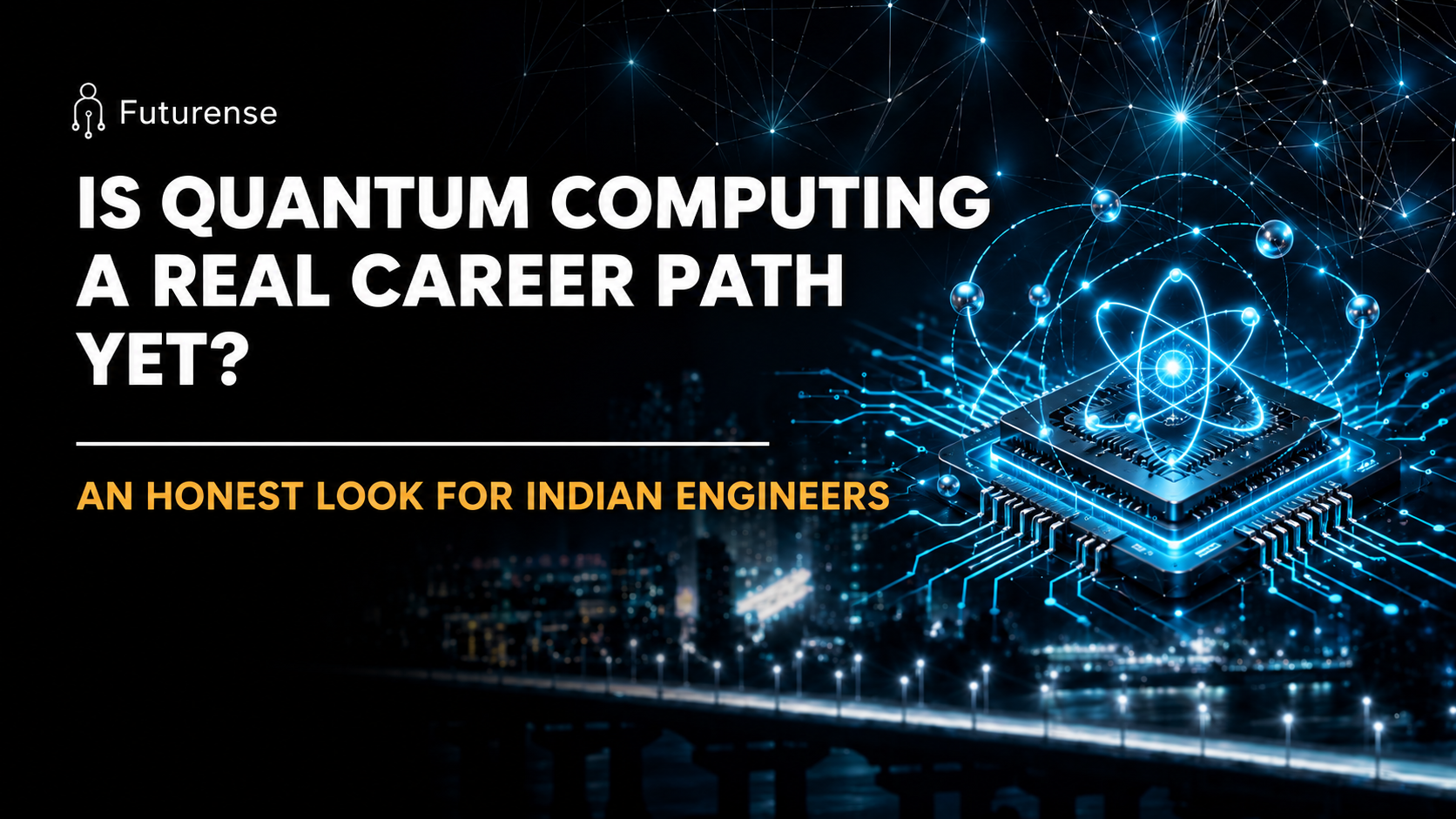
Quantum computing is a field of computing that uses qubits, which can hold combinations of states, to attack certain problems that are impractical for classical computers, such as simulating molecules or some optimisation tasks. Today's machines are still limited and error-prone. That matters for careers: most quantum employers are funded by research budgets, investors, or government programmes, not by products that already pay for themselves at scale.
So the answer is "yes, with conditions": a young field with real jobs, not a mature job market.
How Big Is the Quantum Job Market Today?
The numbers below come from The Quantum Insider's July 2026 career guide, which draws on industry reports. Treat them as indicators, not precise counts.
Two reading notes. First, 16,500 is tiny next to the global software industry, which shows how early this is. Second, the 250,000 figure is a projection by a publication that covers the industry, and it depends on hardware progress arriving on schedule.
The gap between today's headcount and projected need is the real argument for the field. If the projections come even partly true, people with the right skills will be scarce. If progress slows, hiring slows with it.
Which Jobs Actually Exist?
Quantum employers hire for more than physicists. Based on the roles described in The Quantum Insider guide, here is how the main tracks differ.
Research and hardware roles gate on advanced degrees. Software, applications, product and business roles are the doors that open without a PhD. For a typical Indian engineering graduate, the quantum software track is the most reachable. Our guide to how to become a machine learning engineer covers a foundation that transfers well to this track.
What Is Happening in India?
India has put public money behind the field. According to The Quantum Insider's overview of the ecosystem, the Union Cabinet approved the National Quantum Mission on 19 April 2023, with an allocated budget of about ₹6,000 crore for 2023 to 2031. The mission funds work in quantum computing, communication and sensing, and plans four thematic hubs: quantum computing, quantum communication, quantum sensing and metrology, and quantum materials and devices.
Institutions named in that overview include IISc Bangalore, IISER Pune's I-Hub Quantum Technology Foundation, TIFR, which has been testing a 6-qubit processor with DRDO and Tata Consultancy Services, and IIT Madras. Several institutes also offer advanced degree programmes in quantum technology.
For job seekers, early Indian opportunities lean toward research, academic and national-lab positions, plus a small set of startups. A funded mission does not automatically create thousands of private-sector openings, so check company career pages, not just news coverage.
What About Pay?
Pay is where hype and reality diverge most, so here is what can and cannot be said.
The Quantum Insider guide reports US entry-level ranges compiled from Glassdoor, ZipRecruiter and LinkedIn Salary Insights as of early 2026. For example, it lists quantum software engineers at roughly $130,000 to $170,000 and applications scientists at roughly $115,000 to $150,000. The guide itself calls these "directional benchmarks, not definitive figures." They are US figures and vary by employer, city and equity.
I have not found a reliable, sourced salary dataset for quantum roles in India, so this article does not quote one. For a rough sense of how research-type roles are paid locally, see our breakdown of AI research engineer salary in India. Do not copy US numbers onto India-based roles. Compare against real, current job postings.
Who Should Consider Quantum Computing?
Quantum is a good fit if most of these describe you:
- You are comfortable with linear algebra, probability and abstract thinking, and you enjoy them.
- You are willing to build skills for six to twelve months before a first role is realistic.
- You can tolerate uncertainty about timelines and a small job market.
- You have a classical engineering skill, such as software, ML or electronics, to fall back on.
Who Should Wait or Choose Something Else?
It is not a fit if you need a job within a few months, need predictable salary growth, or want a role with thousands of openings in your city. The Quantum Insider guide is direct on this: QEC is a poor fit for anyone seeking quantum employment within 12 to 18 months from a standing start, and hardware and QEC tracks take longer regardless of effort.
If your goal is a stable, well-paid tech career soon, nearer-term fields have far more openings. Compare options in our guides to AI skills in demand and whether data science is a good career. If you like hardware-heavy work with a clearer hiring horizon in India, read about the India Semiconductor Mission and VLSI careers.
Skills That Matter
A realistic skill stack, in the order to learn it:
Notice how much of the list is classical. That is why a strong classical base is the best insurance. If you are drawn to the machine learning side, our page on quantum machine learning explains where that specialisation fits.
A Realistic Path for a Software Engineer
The Quantum Insider guide suggests six to twelve months of focused study before a first quantum role is realistic, and cites a 12 to 18 month transition for software engineers starting from a favourable position. Timelines vary widely. Here is a sensible sequence.
- Strengthen the classical base. Get solid in Python, data structures and linear algebra. If you are early in your journey, start with how to start a career in AI.
- Learn quantum fundamentals. Work through qubits, gates and circuits with free university or vendor material.
- Pick one framework and build. Implement a few small circuits in Qiskit, Cirq or PennyLane and run them on a simulator or cloud hardware.
- Reproduce a known algorithm. Re-implement something like Grover's search and explain what you learned.
- Publish your work. Put code on GitHub and write short notes. The guide suggests two to three years of documented public work is a realistic path to a first role in some cases.
- Join the community. The guide notes that the field is small and personal connections fill many roles, so attend talks, contribute to open-source tools and apply to research internships.
- Consider a master's for research or hardware work. See which master's degree suits AI careers.
A Worked Scenario (Hypothetical)
Consider Meera, a backend developer in Pune with three years of experience. She likes the maths behind quantum computing but has a home loan and cannot take a two-year break.
She keeps her job and studies in the evenings: linear algebra first, then circuits in Qiskit. After six months she has three small projects and one write-up on a simple optimisation problem. She applies to quantum startups and a national lab while keeping classical applications going. Eight months in, she gets one interview from a quantum software tools team and several classical backend offers. Even if the interview fails, her skills still count for ML and numerical computing roles.
The lesson is that she limited her downside by building on top of a career, not instead of one. This scenario is illustrative, not a real case.
Common Mistakes
- Ignoring classical skills. Quantum teams still need strong classical engineers.
- Expecting a quick job. The guide's own timelines run from months to years.
- Trusting vendor certificates alone. One claim that a specific certification is "directly valued by hiring managers" is unsourced, so treat certificates as a learning aid, not a hiring guarantee.
- Copying US salary numbers into an India plan. Check local listings.
So, Is It a Real Career Path?
Yes, with a condition: treat quantum computing as a specialisation built on strong engineering foundations. The workforce is small but growing, roles beyond research do exist, and India is investing through the National Quantum Mission. But openings are limited, advanced degrees open the deepest doors, and the pace of the whole field depends on hardware progress no one can guarantee.
If you are curious and patient, start building. If you need a safe, near-term job, build classical skills first and keep quantum as the long game. Our AI career guide lays out the broader landscape so you can compare options before you commit.
This article is general career information, not personal career, financial or investment advice.
TL;DR: Yes, quantum computing is a real career path, but a narrow and early one. Companies are hiring, governments are funding programmes, and India has a national mission behind it. But the industry is small, the research-heavy roles usually want a PhD, and the timeline for large, useful quantum computers is uncertain. A software engineer can realistically reach an entry-level quantum role in about a year of focused work. A hardware or error-correction specialist needs far longer. For most Indian engineers, the sensible move is to build strong classical skills first and treat quantum as a specialisation, not a starting point.
Is quantum computing a good career in India?
It can be a good long-term career, but it is early. India's National Quantum Mission, approved in April 2023 with a budget of about ₹6,000 crore for 2023 to 2031, is building research capacity. Early openings lean toward research institutes, startups and global firms' India teams, so check live listings before relying on any one route.
Do you need a PhD to work in quantum computing?
Not for every role. Research scientist roles almost always require a PhD, and hardware and error-correction roles usually need advanced training. Software, applications, product and business roles rarely require one.
Can a software engineer switch to quantum computing?
Yes. Software engineering is the most accessible entry route. You need Python, linear algebra, quantum basics and a framework such as Qiskit, Cirq or PennyLane. Published guidance suggests roughly six to twelve months of focused study before a first role is realistic, though timelines vary.
What jobs are there in quantum computing?
Main tracks include quantum software engineer, hardware engineer, error-correction engineer or researcher, applications scientist, research scientist, educator, and sales or business development. Each has different background requirements.
How much do quantum computing jobs pay?
US entry-level ranges compiled from public salary sites run from roughly $75,000 for educators to well over $150,000 for some engineering and error-correction roles, but these are directional and vary by employer and city. Reliable India-specific data is limited, so compare current Indian job postings.
Is quantum computing worth learning in 2026?
It is worth learning if you enjoy the maths, can tolerate uncertainty and keep classical skills as a base. If you need a near-term job with many openings, fields such as AI engineering and data roles currently offer more positions.


Advanced PG Certificate in AI Engineering on Cloud and AIOps
IIT Roorkee
Engineer AI Systems for Top Enterprises, with the Most Critical Skills of the Decade