.png)


A multi-agent system is a setup where multiple AI agents, each with a specific role, work together to accomplish something too complex or too broad for a single agent to handle well alone. Instead of one generalist AI trying to research, write, and fact-check a report by itself, a multi-agent system might use three specialized agents, each genuinely good at one part of that task, coordinating to produce a better result than any one of them could alone.
What Makes a System "Multi-Agent"
The defining feature isn't just "using AI more than once", it's that distinct agents, each with their own role, reasoning process, and often their own specialized configuration, work together toward a shared goal, rather than one agent handling the entire task end to end.
This distinguishes a genuine multi-agent system from simply calling the same AI model multiple times for different sub-tasks. In a true multi-agent setup, each agent typically has a defined identity and scope, a research agent, a drafting agent, a review agent, and the system as a whole is designed around how these distinct roles interact, not just around running several similar calls in sequence.
Why Use Multiple Agents Instead of One
The core rationale comes down to a simple, well-established principle: specialization tends to outperform generalization on complex tasks. A single agent trying to research a topic, write compelling prose, and rigorously fact-check its own output is being asked to excel at three genuinely different skills simultaneously, and in practice, that combination often produces mediocre results across the board rather than strong results in any one dimension.
Splitting these responsibilities across specialized agents, each with a narrower, better-defined job, and often with prompting, tools, or configuration tuned specifically to that job, tends to produce meaningfully better results in each dimension. A dedicated fact-checking agent, built specifically to be skeptical and thorough, generally catches more errors than a general-purpose writing agent asked to also double-check its own work as an afterthought.
Beyond raw quality, multi-agent systems also offer practical engineering benefits: individual agents can be tested, debugged, and improved somewhat independently, and a well-designed system can parallelize work across agents rather than processing everything in a single, long sequential chain. This modularity also makes iteration faster in practice, if a specific agent's output quality needs improvement, that agent's prompting or configuration can be refined in isolation without risking unintended side effects across the entire system, the way modifying a single, monolithic agent's instructions might inadvertently degrade performance on a completely unrelated part of its task.
There's also a resource-allocation argument worth making explicitly. Not every sub-task in a complex workflow requires the same level of model capability. A simple classification or routing decision might be handled well by a smaller, faster, cheaper model, while a genuinely difficult reasoning step warrants a larger, more capable one. A multi-agent system lets you match model capability to task difficulty at each individual step, rather than running every part of a workflow through the same, uniformly expensive model regardless of whether that step actually needs it.
The Basic Anatomy of a Multi-Agent System
Most multi-agent systems share a few common structural elements, regardless of the specific application.
Individual agents with defined roles. Each agent has a specific responsibility and, often, its own tailored configuration, prompting strategy, or even underlying model choice suited to that specific job.
A shared environment or context. Agents need some shared space, whether that's a shared memory, a message-passing system, or a common data store, to actually exchange information and build on each other's work rather than operating in complete isolation.
A communication protocol. How agents actually pass information to each other, structured data, natural language messages, or a formal API contract, shapes how reliably and efficiently the system as a whole functions.
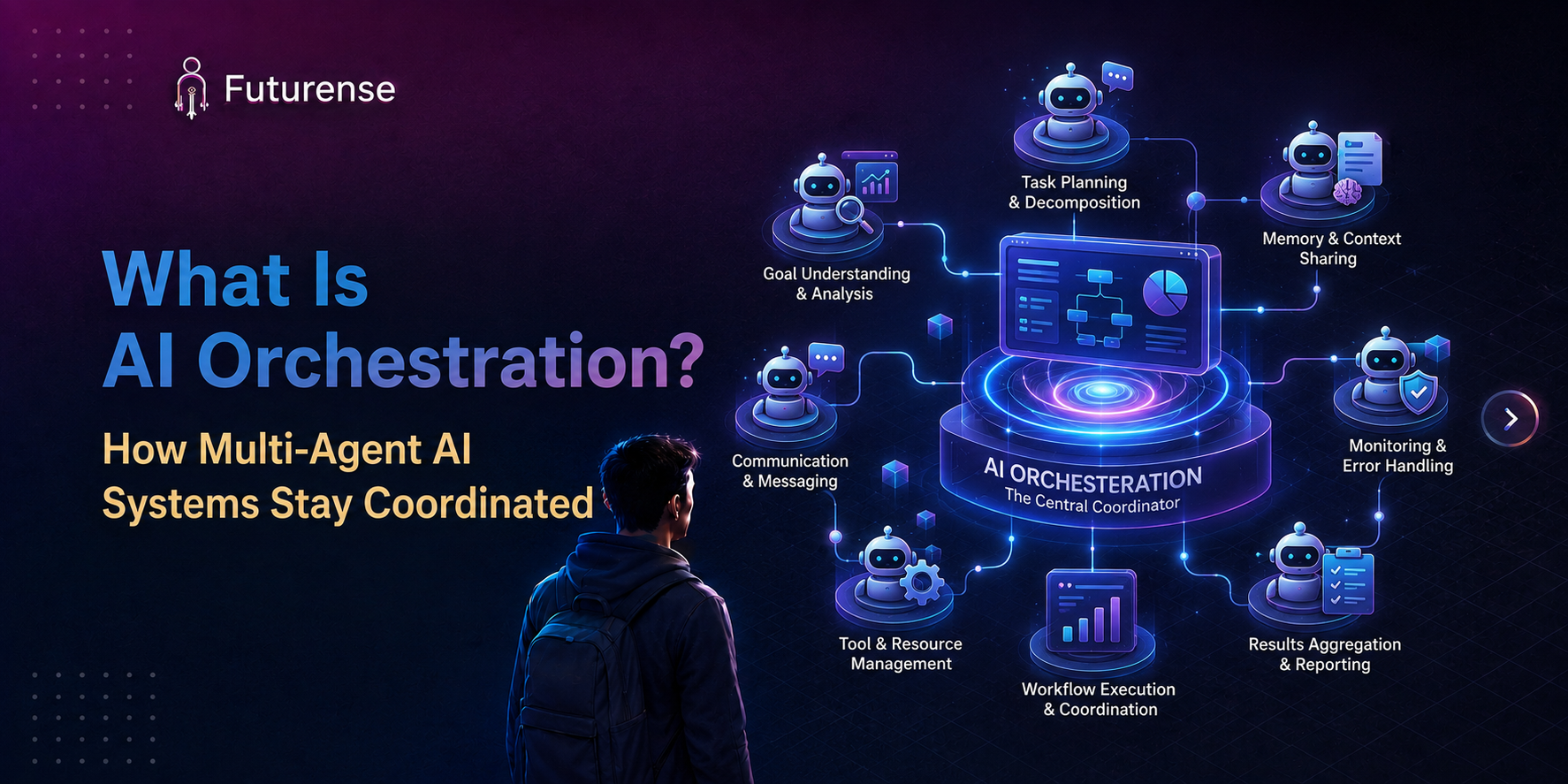
A coordination mechanism. Something has to decide which agent acts when and how their outputs combine into a final result. This is the layer our companion guide on AI Orchestration covers in depth, the specific patterns (manager-worker, peer-to-peer, hybrid) that govern how agents actually stay coordinated once a system has more than one of them.
Real-World Applications Across Industries
Multi-agent systems have moved well beyond academic research into genuine production use across several industries.
Customer service and support: A triage agent routes incoming requests, specialized agents handle billing, technical support, or account questions respectively, and an escalation agent identifies when a case genuinely needs human review, rather than one general-purpose support bot handling everything with mixed results. This structure also makes it easier to measure and improve performance on each specific category independently, a company can see exactly where the billing agent underperforms without that signal getting diluted across a single agent's mixed overall accuracy.
Supply chain and logistics: Multiple agents can independently optimize different parts of a complex logistics network, inventory forecasting, route planning, demand prediction, coordinating with each other to produce a more globally efficient outcome than any single, monolithic optimization system managing every variable at once. Because these sub-problems have genuinely different mathematical structures and data requirements, specialized agents built and tuned for each one tend to outperform a single system attempting to jointly optimize everything simultaneously.
Drug discovery and scientific research: Specialized agents handling literature review, molecular property prediction, and experimental design coordination allow research teams to parallelize different stages of a genuinely complex, multi-disciplinary discovery process. A literature-review agent can continuously scan new publications while a separate prediction agent runs computational modeling on candidate compounds, with results feeding into a coordination layer that surfaces the most promising combinations for human researchers to evaluate further.
Financial trading and risk management. Different agents can specialize in market analysis, risk assessment, and execution strategy respectively, each bringing focused expertise to its specific slice of a decision that would be difficult for one generalist system to handle well across every dimension simultaneously. The separation also creates a natural checks-and-balances structure, a risk-assessment agent explicitly designed to be conservative can flag concerns a purely execution-focused agent might otherwise miss in pursuit of speed.
Autonomous vehicle coordination. In contexts involving multiple vehicles or robots, individual agents managing perception, path planning, and inter-vehicle communication need to coordinate genuinely in real time, a canonical, high-stakes example of true multi-agent coordination rather than simple task-splitting. Unlike the other examples here, this category often involves agents that are physically distributed across different vehicles entirely, adding real-world latency and communication-reliability constraints on top of the usual coordination challenges.
The Tradeoffs Nobody Mentions
Multi-agent systems aren't a free upgrade over single-agent approaches, and treating them as automatically better is a common, costly mistake. More agents mean more coordination overhead, more potential points of failure, and genuinely more complexity to design, test, and debug. A single mistake made by one agent early in a pipeline can cascade through every downstream agent that depends on its output, sometimes producing a confidently wrong final result that's harder to trace back to its actual source than a comparable error in a single-agent system would be.
Latency is a real, practical cost too. Each additional agent typically means an additional model call, and those calls add up, a multi-agent workflow that takes five sequential steps will generally feel slower to an end user than a single, well-designed agent handling the same task in one pass, even if the multi-agent version produces a somewhat higher-quality result.
The practical decision rule: use a multi-agent system when a task genuinely requires distinct specialized reasoning at different stages that a single agent's prompt can't cleanly handle, not by default because multi-agent architectures sound more sophisticated or modern.
How This Relates to Orchestration
It's worth being precise about a distinction that's easy to blur: multi-agent systems are the what, the architecture of using multiple specialized agents together. Orchestration is the how, the specific coordination layer and patterns that make that architecture actually function reliably. You can understand what a multi-agent system is, and why you'd want one, without yet knowing the specific mechanics of how agents actually hand off work to each other.
Our companion guide, What Is AI Orchestration? How Multi-Agent AI Systems Stay Coordinated, picks up exactly where this piece leaves off, covering the three core coordination patterns (manager-worker, peer-to-peer, and hybrid approaches), the specific technical challenges orchestration has to solve, and the tools commonly used to build it. If you've read this far and are now wondering specifically how agents actually stay coordinated in practice, that's the natural next read.
TL;DR
- A multi-agent system = multiple specialized AI agents working together, each handling a distinct part of a larger task
- The core reason to use one: specialization beats generalization for complex tasks, a focused agent typically performs better on its specific piece than one agent trying to do everything
- Real applications span customer service routing, supply chain optimization, drug discovery, financial trading, and autonomous vehicle coordination
- The real tradeoff: multi-agent systems add genuine coordination overhead, more moving parts means more can go wrong, so they should be used when task complexity actually earns that cost
- For how these agents actually stay coordinated once you've decided to use multiple, see our companion guide, What Is AI Orchestration?
What is a multi-agent system in simple terms?
A setup where multiple specialized AI agents, each with a distinct role, work together to accomplish a task too complex or broad for a single agent to handle well alone, rather than one generalist AI trying to do everything itself.
Why use multiple AI agents instead of just one more powerful agent?
Specialization tends to outperform generalization on complex, multi-dimensional tasks. A dedicated agent focused on one specific job, research, fact-checking, or execution, typically performs better on that job than a single agent trying to handle every dimension simultaneously.
What industries actually use multi-agent systems in production?
Customer service and support routing, supply chain and logistics optimization, drug discovery and scientific research, financial trading and risk management, and autonomous vehicle coordination are all active, real-world application areas.
What's the difference between a multi-agent system and AI orchestration?
A multi-agent system is the architecture itself, using multiple specialized agents together. Orchestration is the coordination layer and specific patterns that make that architecture actually function reliably. See our AI Orchestration guide for the coordination mechanics specifically.
Are multi-agent systems always better than single-agent systems?
No. They add genuine coordination overhead, latency, and more potential points of failure. They're the better choice when a task genuinely requires distinct specialized reasoning at different stages, not by default just because the architecture sounds more advanced.
What's the most common mistake when building a multi-agent system?
Reaching for multiple agents when a single, well-designed agent with the right tool access would handle the task just as well, adding unnecessary complexity, latency, and failure points without a corresponding gain in output quality.


B.S/B.Sc in Applied AI & Data Science
IIT Jodhpur
Be a Part of India’s First Advanced AI Regular Degree with the Best Minds at IIT