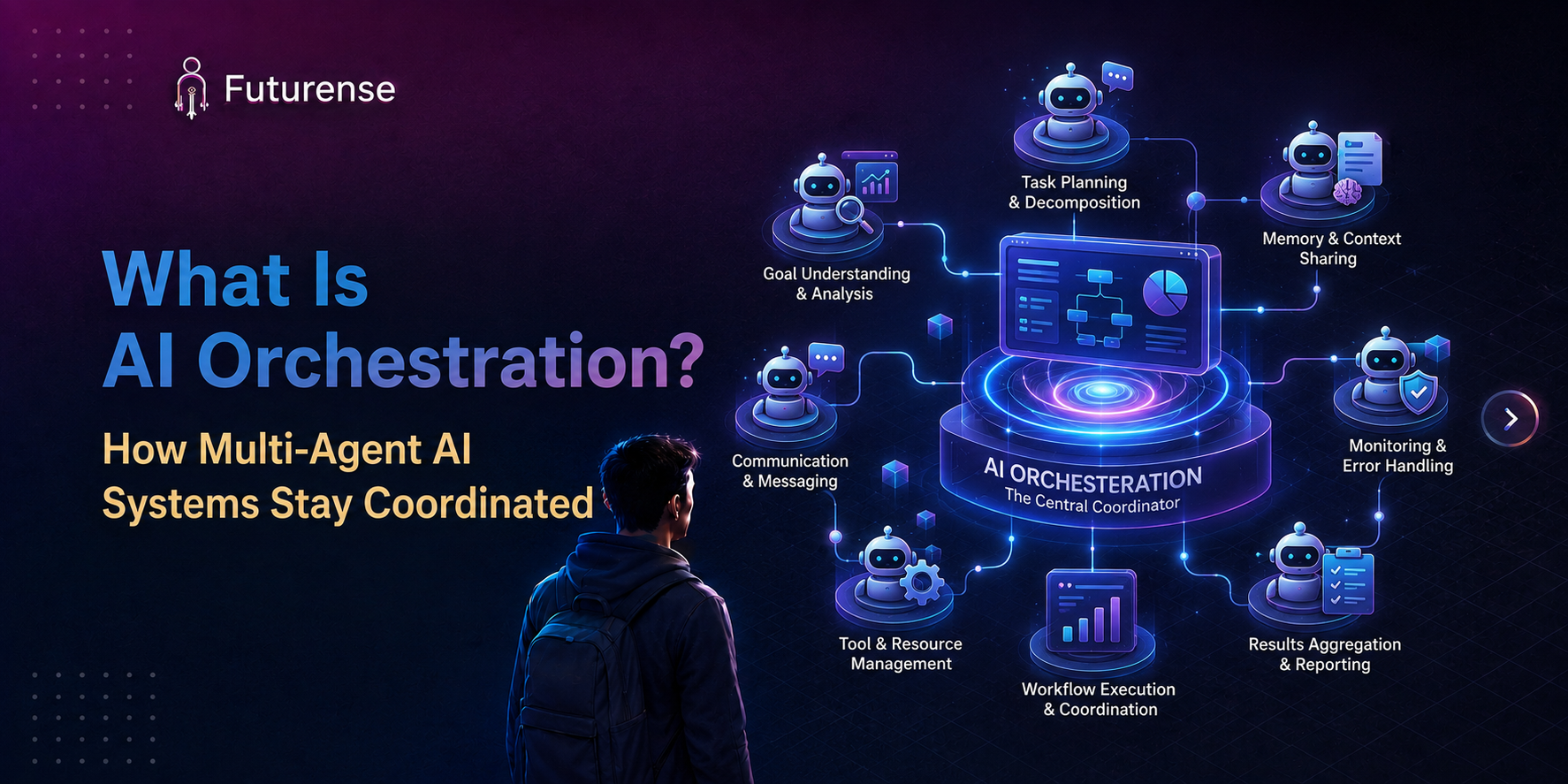


What Is AI Orchestration? AI orchestration is the layer that decides which AI agent does what, in what order, and how information passes between them when a task is too complex for a single agent to handle alone. Without it, a multi-agent system is just a collection of independent models with no way to actually work together. This guide covers the three core coordination patterns that show up across real systems, the specific challenges orchestration has to solve, and the tools currently used to build it.
What Is AI Orchestration?
A single AI agent working alone doesn't need orchestration, it perceives, reasons, and acts in its own loop. Orchestration becomes necessary the moment a task is broken into pieces handled by different specialized agents, and something has to manage how those pieces fit together: which agent runs when, what information one agent's output passes to the next, and what happens when a step fails.
Think of it less as a technical add-on and more as the coordination logic that turns a set of individually capable agents into an actual working system. A content pipeline might use one agent to research a topic, another to draft the content, and a third to fact-check it, orchestration is what sequences those three agents correctly and makes sure each one has the context it needs from the step before it.
The distinction matters because it's easy to conflate orchestration with the agents themselves. The research agent, the drafting agent, and the fact-checking agent in that example are each doing genuine reasoning work on their own. Orchestration doesn't do that reasoning, it decides when each agent's reasoning happens, what gets handed to it, and what happens to the result. A well-designed orchestration layer is often invisible when everything works correctly, and painfully obvious the moment it doesn't, since a coordination failure can produce a confidently wrong final output even when every individual agent performed its own task correctly.
The Three Core Coordination Patterns
Most real-world multi-agent systems use one of three coordination patterns, or a combination of them.
Manager-worker: A central manager agent breaks a task into subtasks, assigns them to specialized worker agents, and synthesizes their results into a final output. This pattern fits workflows where the right next step genuinely depends on the specifics of the task, since the manager can route work dynamically rather than following one fixed sequence.
A customer support system might use a manager agent to read an incoming ticket and route it to a billing specialist agent, a technical support agent, or a human escalation path depending on what the ticket actually contains. The tradeoff: the manager's routing decision becomes a point of potential failure, and debugging why a task went to the wrong worker requires inspecting the manager's own reasoning, not just the worker's output.
Peer-to-peer: Agents communicate and pass work directly to each other without a central coordinator, each agent decides when its part is done and which agent should take over next. This pattern scales better than manager-worker as the number of possible next steps grows, since no single agent becomes a coordination bottleneck, but it demands more careful context management, since information has to travel cleanly across every handoff without any agent losing track of what's already happened.
A claims-processing workflow might use this pattern: an intake agent hands off to a verification agent, which hands off to either an approval agent or a human reviewer depending on the case's risk profile.
Hybrid: Most production systems end up combining elements of both, a manager agent for high-level routing, with peer-to-peer handoffs for specific sub-workflows that don't need centralized oversight. This tends to be the pattern of choice for genuinely complex enterprise workflows, where some parts of the process benefit from centralized control and other parts benefit from more flexible, direct coordination.
What Actually Gets Coordinated
Orchestration isn't just about task sequencing, it's managing several distinct things at once across a multi-agent system.
The Real Challenges Orchestration Has to Solve
Building orchestration logic that works in a demo is very different from building orchestration that survives real, production usage. Three challenges show up consistently.
Coordination complexity: More agents and more handoffs mean more points of potential failure. Every additional layer of coordination adds overhead that has to be deliberately managed, not just assumed away because the individual agents work well on their own. A system with five well-tested agents can still fail in production if the coordination logic between them was never tested against realistic, messy inputs, the individual agents passing their own tests says nothing about whether the handoffs between them are reliable.
Latency: Multi-step workflows involve multiple LLM calls and API requests, and each one adds time. In a user-facing product, this compounds quickly, a workflow that takes five sequential agent calls can feel sluggish even if each individual call is fast. This is one of the clearest arguments for the peer-to-peer or hybrid patterns over a purely centralized manager-worker approach in latency-sensitive contexts, since parallel handoffs can reduce total wait time compared to funneling every decision through one central routing step.
Error propagation: A mistake in an early step can cascade through the entire pipeline. If an early agent misclassifies an input, every downstream agent inherits that mistake, and by the time the final output reaches a user, the root cause can be difficult to trace back to where it actually started. Building in observability, some way to see exactly which agent's output introduced an error, is essential for debugging, and it's frequently missing from early-stage systems built for speed rather than production reliability.
The Tools Behind Orchestration
A handful of frameworks and platforms have become the default building blocks for AI orchestration. LangChain and its graph-based extension LangGraph are commonly used for building explicit, inspectable coordination logic, particularly useful when a workflow has genuinely complex branching that needs precise control over how state moves between agents.
Zapier and similar automation platforms are frequently used for lighter-weight orchestration, connecting AI agents to existing business tools and APIs without requiring custom coordination code for every integration.
The right tool depends heavily on how complex the actual coordination logic needs to be. A simple, mostly-sequential workflow rarely needs the same level of framework sophistication as a system with genuinely dynamic, manager-worker routing across many possible paths.
AI Orchestration vs Single-Agent Systems: When You Need It
Not every AI system needs orchestration, and reaching for multi-agent coordination when a single, well-designed agent with the right tool access would work is one of the most common over-engineering mistakes in early AI system design. Our AI Agent Architecture guide covers this distinction directly: a single-agent system handles an entire task itself, while a multi-agent system uses multiple specialist agents coordinated by an orchestration layer, and the second option should be earned by genuine task complexity, not added by default because it sounds more sophisticated.
Orchestration becomes genuinely necessary when a task requires specialized reasoning at different stages that a single agent's prompt can't cleanly handle, or when routing logic needs to be dynamic based on the specifics of each request rather than following one fixed path. If the workflow can be expressed as a simple, fixed sequence, a single well-designed agent, or simple sequential logic without a full orchestration framework, is usually the right call.
TL;DR
- AI orchestration = the coordination layer that manages how multiple AI agents interact, sequence their work, and share context
- Three core patterns show up repeatedly: manager-worker, peer-to-peer, and hybrid coordination
- The real challenges aren't conceptual, they're practical: coordination complexity, latency from multiple LLM calls, and error propagation across steps
- Common tools include LangChain, LangGraph, and Zapier for workflow orchestration, though the right choice depends on how complex the coordination logic actually needs to be
- Related reading: our AI Agent Architecture guide covers orchestration as one component within the full agent system; this piece goes deep on orchestration specifically.
What is AI orchestration in simple terms?
The coordination layer that manages how multiple AI agents work together: which agent acts when, how information passes between them, and what happens when a step fails or needs human review. Without it, a group of AI agents has no way to actually function as one coordinated system.
What are the main AI orchestration patterns?
Three patterns show up most often: manager-worker (a central agent assigns and synthesizes work from specialist agents), peer-to-peer (agents hand off work directly to each other without a central coordinator), and hybrid approaches that combine both for different parts of a workflow.
Do I need orchestration if I'm only using one AI agent?
No. Orchestration is only necessary once a task is split across multiple specialized agents that need to coordinate. A single, well-designed agent handling an entire task doesn't need a coordination layer.
What's the difference between AI orchestration and AI agent architecture?
Agent architecture describes the full internal structure of how an individual agent perceives, reasons, and acts. Orchestration is specifically the coordination layer that manages how multiple agents work together, one component within the broader architecture of a multi-agent system.
What tools are commonly used for AI orchestration?
LangChain and LangGraph are common choices for building explicit, inspectable coordination logic, particularly for complex branching workflows. Zapier and similar automation platforms are often used for lighter-weight orchestration connecting agents to existing business tools.
What's the biggest technical challenge in AI orchestration?
Error propagation is often the most consequential: a mistake in an early agent's output can cascade through the rest of the pipeline, and tracing the root cause back through multiple coordinated steps is genuinely harder than debugging a single-agent system.


B.S/B.Sc in Applied AI & Data Science
IIT Jodhpur
Be a Part of India’s First Advanced AI Regular Degree with the Best Minds at IIT