

For the last decade, DevOps has run on a simple, comforting promise: determinism. You write a YAML configuration, outline a step-by-step shell script, and if the input remains identical, the output should theoretically be exactly the same.
But anyone working in production software knows the reality. Jenkins pipelines hang due to ephemeral network blips. A microservice deployment breaks because of a subtle third-party dependency update.
A Kubernetes pod crashes, and your on-call engineer spends three hours parsing text files just to find a misplaced environment variable.
Traditional CI/CD automation is fast, but it is fundamentally brittle. It follows a fixed path and breaks the moment it hits an unexpected error.
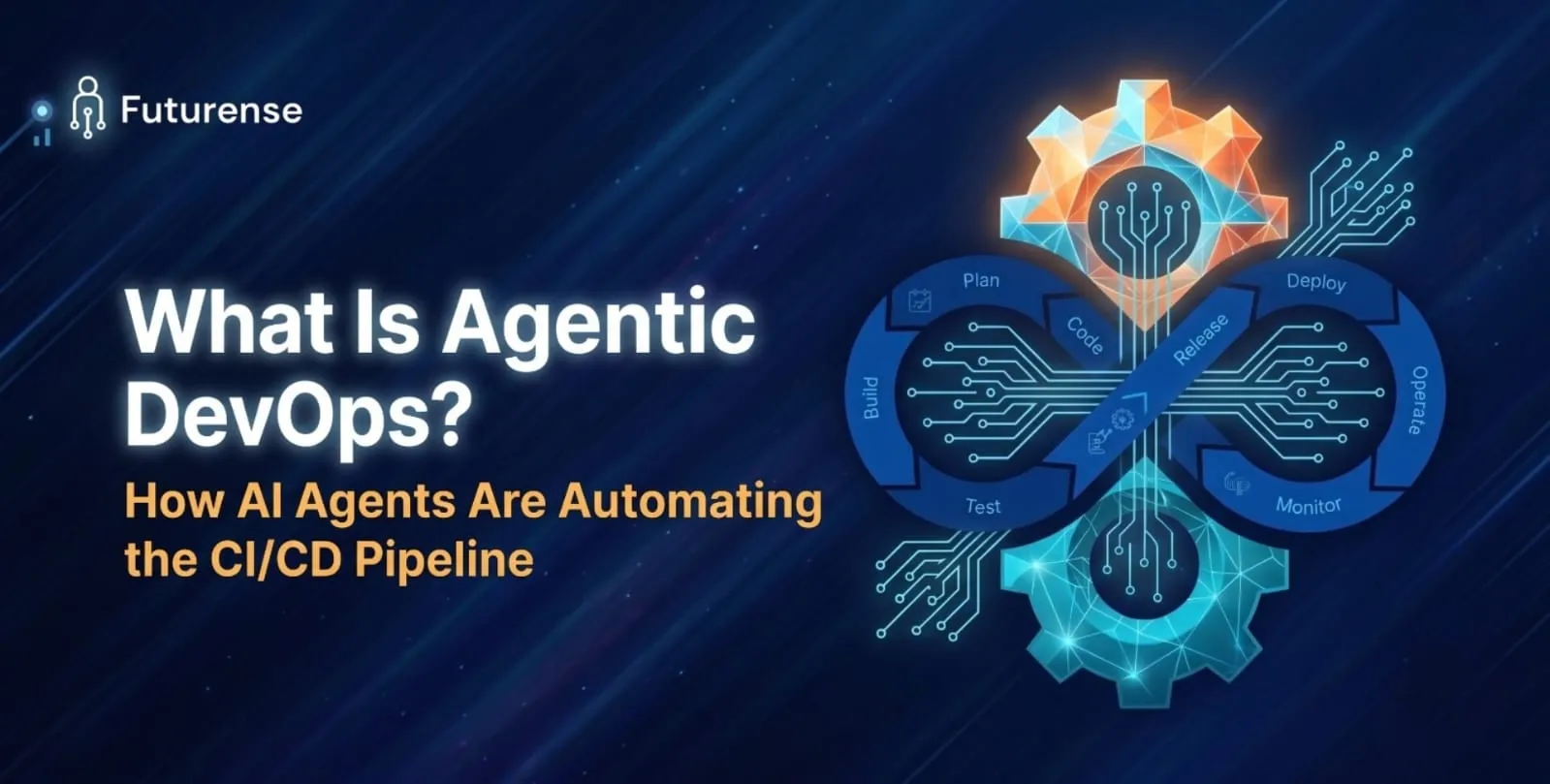
In 2026, the industry is shifting from static, human-managed scripts to Agentic DevOps. By replacing hardcoded pipelines with autonomous AI agents capable of reasoning, self-reflection, and real-time execution, software teams are transitioning from simple automated workflows to truly self-healing operational systems.
1. What Is Agentic DevOps?
Agentic DevOps is the evolutionary leap from predictive AI assistants (like standalone code completion tools) to autonomous multi-agent systems that can plan, execute, monitor, and correct the entire software delivery lifecycle (SDLC) with minimal human supervision.
To understand why this is a massive paradigm shift, we need to look at how we got here:
- Traditional DevOps (Deterministic): Rigid shell scripts, YAML pipelines, and manual triage. Everything depends on pre-defined paths.
- Copilot Era (Assistive AI): Inline autocomplete and human-triggered chat prompts. The AI is passive; it lacks the authority or capability to verify if that code compiles, passes tests, or safely provisions an AWS environment.
- Agentic DevOps (Autonomous Cloud): Goal-driven loops, self-correction, and native tool integration. You give the system a high-level goal: "Upgrade this microservice's framework version, resolve any broken dependencies, and ensure the test suite achieves 85% coverage." The AI agent designs its own multi-step workflow, executes the steps, encounters errors, dynamically modifies its approach, verifies the code against active test suites, and drafts a pristine Pull Request (PR).
The Core Philosophy: Traditional automation executes a task. Agentic DevOps accomplishes a goal.
2. The Core Architecture of Agentic DevOps
Agentic DevOps systems do not rely on a single, massive LLM attempting to manage your entire infrastructure. Instead, the modern 2026 stack is built around a microservices architecture for AI using multi-agent coordination frameworks like LangGraph, CrewAI, and AutoGen.
A production-grade agentic pipeline relies on three foundational architectural components:
A. The Agentic Loop (ReAct Framework)
Agents operate using Reasoning and Action (ReAct) loops. When a pipeline failure occurs, the agent does not just output text. It follows a cycle:
- Observe: Read the build error logs from the CI pipeline.
- Analyze: Reason through the stack trace to find the root cause (e.g., a broken database migration).
- Plan: Formulate a multi-step strategy to resolve the problem.
- Act: Execute commands natively via standardized protocols.
- Reflect: Verify if the action fixed the issue. If it failed, it analyzes the new error and retries with a modified approach.
B. Standardized Tool Connections: Model Context Protocol (MCP)
Historically, giving an LLM access to your cloud infrastructure required writing custom, brittle API wrappers. The breakout architectural advancement of recent months is the widespread adoption of the Model Context Protocol (MCP), an open standard introduced by Anthropic.
MCP acts like the "USB-C of AI." It provides a secure, unified way for AI models to connect directly to external dev tools (Jenkins, GitHub Actions, Terraform, Kubernetes, or Jira) out of the box.
Through an MCP server, an agent can securely inspect infrastructure drift, fetch production telemetry data, and issue commands within explicit boundary parameters.
C. Multi-Agent Orchestration
Instead of a single generalist model, specialized agents are daisy-chained together to handle complex workflows safely:
- Triage Agent: Detects CI build failures and analyzes log dumps to isolate the failure.
- Coding Agent: Generates a git patch, resolves code defects, or updates package schemas.
- Security Agent: Scans newly generated code blocks for vulnerabilities, secret leaks, and security compliance.
- Infrastructure Agent: Deploys code to a sandbox environment and verifies system telemetry before calling for a final human review gate.
3. How AI Agents Automate the CI/CD Pipeline
Let's look at exactly how autonomous agents transform the traditional continuous integration and continuous deployment phases.
Phase 1: Automated Pull Request Triage and Review
When a developer pushes code, a specialized code-review agent parses the git diff. Unlike old-school static analyzers (linters) that flag stylistic issues or generic false positives, an agent reasons through the actual data flow of the code.
For example, a dedicated SQL security agent can analyze whether an updated database query securely manages inputs or introduces a subtle SQL injection vulnerability based on your broader architectural context.
The agent assigns a risk score, flags vulnerabilities, drafts corrected code blocks, and slacks the team lead if it detects a high-profile risk.
Phase 2: Self-Healing Build Pipelines
In a standard CI pipeline, if a test fails or a Docker build crashes, the pipeline stops dead. In an Agentic DevOps environment, a failure triggers a triage loop:
- Log Parsing: The agent extracts the exact failure from standard output.
- Context Gathering: It queries the project's structure, configuration files, and recent commit history.
- Autonomous Modification: If the failure is caused by a missing peer dependency or an outdated package version, the agent writes a fix, updates the configuration, and restarts the specific build stage.
- Result: The developer returns to a green pipeline with an accompanying note explaining the automatic hotfix.
Phase 3: Drift Detection and Self-Healing Infrastructure
When using Infrastructure as Code (IaC) tools like Terraform or OpenTofu, human operators frequently contend with "configuration drift"—where the actual state of the cloud provider diverges from the declared code.
A self-healing infrastructure agent runs continuously via localized schedulers. When it detects an undocumented change in your production cluster, it evaluates the risk profile.
If the change is minor and low-risk, the agent updates the underlying Terraform code to align with the actual state (or reverts the manual cloud modification) and commits the change back to the main branch via GitOps. If it detects a critical drift, it acts as an incident responder, collecting logs and drafting an automated Jira ticket with full diagnostic context before humans are even paged.
4. The Real-World Business Impact
The shift toward autonomous cloud operations is delivering massive, quantifiable advantages to enterprise engineering teams:
5. Security, Guardrails, and Governance: The Rules of Agency
Giving an autonomous system access to production infrastructure introduces significant security risks. If an AI agent goes into an infinite loop or falls victim to a prompt-injection attack, it could theoretically delete critical production databases or spin up expensive, unauthorized cloud clusters.
To prevent these failure modes, organizations must enforce rigid operational boundaries:
Least-Privilege Execution (RBAC)
AI agents must be treated exactly like non-human system identities. An agent tasked with investigating an application crash should possess read-only permissions for logs, but must explicitly lack the authority to drop database tables, delete Kubernetes namespaces, or modify identity and access management (IAM) roles.
Tool Sandboxing
When an agent needs to execute code or build containers to test a pipeline fix, that execution must take place within an isolated, ephemeral runtime environment (such as microVMs or sandboxed containers using tools like Falco or eBPF). This prevents an unverified agent behavior from altering the host system.
The Immutable Rule: Human-in-the-Loop (HITL)
Agentic DevOps is not a black box operating completely in the dark. For high-stakes modifications such as merging code to production, applying heavy cloud infrastructure modifications, or initiating large-scale rollbacks the agent must present its clear reasoning, visual diffs, and risk assessments to a human gatekeeper via tools like Slack or an internal engineering portal, requiring explicit authorization before proceeding.
6. A 90-Day Enterprise Implementation Roadmap
Transitioning to Agentic DevOps requires a phased approach designed to establish institutional trust while minimizing operational risk.
Phase 1: Assessment and Governance (Days 1–30)
- Objective: Identify the operational workflows suffering from the highest manual toll (e.g., flaky automated test suites or L1 support tickets).
- Execution: Establish your non-human AI identity governance framework, configure secure API routing via managed platforms (like AWS Bedrock or Azure OpenAI), and deploy your initial Model Context Protocol (MCP) connections to internal developer sandboxes.
Phase 2: The "Read-Only" Pilot (Days 31–60)
- Objective: Allow agents to analyze production ecosystems without granting them active modification permissions.
- Execution: Deploy AI agents entirely in observability mode. When a CI/CD build fails, let the agent analyze the logs, search documentation, and format a recommended fix within a Slack notification or Jira issue. Human engineers execute the suggestions manually, tracking the accuracy and usefulness of the agent's insights.
Phase 3: Controlled Autonomy (Days 61–90)
- Objective: Remove human bottlenecks from routine engineering procedures.
- Execution: Enable human-in-the-loop auto-execution for low-risk, deterministic actions. Allow the agent to automatically clear dead Docker caches, generate unit tests for untested branches, or restart pods showing memory leak anomalies. As performance matrices validate the system's reliability, slowly open the boundaries to automate more complex operational paths.
Conclusion: The New Mandate for DevOps Engineers
Agentic DevOps does not make human cloud engineers obsolete. Instead, it redefines their responsibilities.
The traditional role of manually writing repetitive YAML pipelines, writing basic boilerplate shell scripts, and debugging routine cloud infrastructure errors is shrinking.
The DevOps engineer of the future is an Architect of Intelligent Agents. Your job will shift from managing infrastructure directly to designing the workflows, writing the deterministic guardrails, and managing the security perimeters within which autonomous agents operate.
By moving past rigid automation and adopting adaptive, goal-oriented agent networks, engineering teams can eliminate manual toil, collapse their MTTR, and build an environment where software safely moves from a developer's machine to the production cloud in minutes.
Q1: How does Agentic DevOps differ from standard AIOps?
While they sound similar, they solve different parts of the lifecycle. AIOps (Artificial Intelligence for IT Operations) is primarily reactive and analytical—it monitors massive streams of logs and telemetry data to detect anomalies and alert humans. Agentic DevOps is proactive and action-oriented. Instead of just alerting an engineer that a pipeline broke, an Agentic system uses reasoning loops and code generation tools to automatically write a fix, test it, and deploy it without waiting for human intervention.
Q2: Will Agentic DevOps replace human DevOps engineers?
No. It shifts the engineer's role from low-level manual toil (like debugging syntax errors in YAML scripts or manually clearing disk space) to high-level architecture. Instead of writing rigid, step-by-step automation code, human engineers will act as Agent Architects—defining the rules, setting up security boundaries (RBAC), and monitoring the governance frameworks that dictate what actions the AI agents are allowed to take.
Q3: What is the Model Context Protocol (MCP) and why does it matter?
Introduced as an open standard, the Model Context Protocol (MCP) is an architectural standard that serves as the "universal connector" between AI models and development environments. Instead of building complex, custom API connections for every development tool (like GitHub, Jira, or Terraform), developers use MCP to securely expose logs, files, and terminal execution commands to AI agents through a unified framework.
Q4: How do you prevent an AI agent from breaking production systems?
Security in an Agentic DevOps ecosystem is built entirely on three pillars: Least-Privilege Roles: Agents use non-human identities restricted to read-only access for core infrastructure. Execution Sandboxing: Any code or patch generated by an agent must be built and evaluated inside an isolated container (like a microVM) before deployment. Human-in-the-Loop (HITL): Crucial infrastructure alterations or main-branch merges require a human engineer to review and explicitly click "Approve" before execution.
Q5: Can AI agents handle infrastructure code drift automatically?
Yes. Autonomous agents can be scheduled to run continuous checks comparing the declared configuration files (e.g., Terraform or OpenTofu scripts) against the real-time cloud provider state. If drift is detected, the agent evaluates the safety profile. For low-risk anomalies, it automatically updates the Git repository to reflect the change or reverts the manual shift, keeping the infrastructure state clean and synchronized.


Advanced PG Certificate in AI Engineering on Cloud and AIOps
IIT Roorkee
Engineer AI Systems for Top Enterprises, with the Most Critical Skills of the Decade

.avif)