

DevSecOps integrates security practices directly into the DevOps pipeline, so that security isn't a final checkpoint before release but a continuous responsibility shared across development, security, and operations teams from the very first line of code.
For cloud engineers specifically, DevSecOps isn't optional anymore. Cloud environments are dynamic, provisioned and reconfigured constantly through code, and that constant change means security gaps can be introduced just as fast as new features ship, if security isn't built into the pipeline itself.
If you're newer to this space, it helps to understand what DevOps actually means before layering security into the picture, since DevSecOps is best understood as an evolution of DevOps rather than a separate, competing methodology.
This guide covers what DevSecOps actually is, how it differs from traditional DevOps and traditional security, why it matters specifically for cloud engineers, and what the practical building blocks (tools, practices, and pipeline stages) look like in a real DevSecOps setup.
What Is DevSecOps?
DevSecOps stands for Development, Security, and Operations. It's a methodology and cultural shift that embeds security practices into every stage of the software development lifecycle, rather than treating security as a separate phase that happens right before deployment.
The core idea is often summarized as "shifting security left," meaning security checks move earlier in the pipeline, closer to where code is actually written, instead of being bolted on at the end.
The DevSecOps meaning goes beyond just adding a security scan to an existing pipeline. It represents a shared-responsibility model where developers, security teams, and operations engineers collaborate continuously, using automated tooling to catch vulnerabilities, misconfigurations, and compliance issues as code moves through planning, building, testing, and deployment.
DevSecOps vs DevOps: Key Differences Explained
DevOps focuses on breaking down silos between development and operations teams to ship software faster and more reliably, using automation, continuous integration, and continuous delivery. Security, in a traditional DevOps setup, often still lives with a separate team that reviews code or infrastructure near the end of the release cycle.
DevSecOps takes that same DevOps foundation and adds security as a first-class, continuous concern rather than a late-stage gate. The practical difference shows up in where and when security work happens.
In DevOps without an explicit security practice, vulnerabilities are frequently caught in a pre-release audit, which is expensive to fix that late and often creates release bottlenecks.
In DevSecOps, automated security scanning runs continuously, inside the same CI/CD pipeline used for builds and tests, so vulnerabilities get caught and fixed while the code is still fresh in a developer's mind, not weeks later during a compliance review.
This is also why DevOps engineer vs software engineer confusion often extends into DevSecOps role definitions too. A DevSecOps engineer isn't simply a DevOps engineer with a security certification bolted on.
It's a role that requires genuine fluency in security principles, cloud infrastructure, and automation, working across what used to be three separate team boundaries.
Why Cloud Engineers Specifically Need DevSecOps
Cloud environments change the security equation in ways that make DevSecOps close to essential, not just a nice-to-have practice.
Infrastructure is defined in code, and code can have vulnerabilities: Cloud engineers provision servers, networks, and storage through infrastructure-as-code tools like Terraform and CloudFormation. That means infrastructure misconfigurations, an overly permissive storage bucket, an exposed API endpoint, a missing encryption setting, are now software bugs, and they need to be caught the same way application code bugs are: through automated scanning integrated into the pipeline, not manual review after deployment.
Cloud environments change constantly: Unlike a traditional on-premise data center where infrastructure changes happen relatively slowly, cloud environments are provisioned, scaled, and torn down dynamically, often multiple times a day through auto-scaling and continuous deployment.
A security review process built for infrequent, scheduled changes simply can't keep pace with that rate of change, which is exactly the gap DevSecOps automation is built to close.
The shared responsibility model demands it: Every major cloud provider operates on a shared responsibility model, where the provider secures the underlying infrastructure but the customer is responsible for securing what they build on top of it.
Understanding cloud computing models and where that responsibility line sits is fundamental to grasping why cloud engineers, not just dedicated security teams, need to own security practices directly.
Compliance and data protection requirements are only getting stricter: Cloud engineers working in regulated industries (finance, healthcare, government) increasingly need to demonstrate continuous compliance, not point-in-time compliance, which is much easier to achieve when security checks run automatically on every deployment rather than during periodic audits.
Core DevSecOps Practices
A handful of practices show up consistently across mature DevSecOps implementations, regardless of the specific tools or cloud provider involved.
Shift-left security testing: Running static application security testing (SAST) and software composition analysis on code as it's written and committed, not after it's merged and deployed.
Infrastructure-as-code scanning: Automatically scanning Terraform, CloudFormation, or other IaC templates for misconfigurations before that infrastructure is ever provisioned.
Continuous vulnerability scanning: Scanning container images, dependencies, and running workloads on an ongoing basis, not just at build time, since new vulnerabilities in existing dependencies get disclosed constantly.
Automated compliance checks: Building compliance validation directly into the pipeline so deployments that violate security or regulatory policy get flagged or blocked automatically, rather than discovered during a later audit.
Secrets management: Ensuring credentials, API keys, and certificates are never hardcoded into source code or configuration files, and are instead pulled securely from a dedicated secrets management system at runtime.
Security as shared ownership: Perhaps the most important practice isn't a tool at all. It's the cultural shift where security becomes every engineer's responsibility, not a gate owned exclusively by a separate security team.
DevSecOps Tools Cloud Engineers Should Know
DevSecOps tooling generally builds directly on top of the standard DevOps toolchain, adding a security layer at each stage rather than requiring an entirely separate set of tools. If you're already familiar with common DevOps tooling, most DevSecOps additions will feel like a natural extension rather than a completely new stack to learn.
Common categories include static and dynamic application security testing tools that scan code for vulnerabilities, container and image scanning tools that check for known vulnerabilities in container dependencies before deployment, infrastructure-as-code scanners that catch cloud misconfigurations before they're provisioned, and secrets management platforms that keep credentials out of source code entirely.
Most major cloud providers (AWS, Azure, GCP) also offer native security tooling designed to integrate directly into their own CI/CD services, which is often the fastest starting point for cloud engineers already working within a specific cloud ecosystem.
DevSecOps Pipeline: How Security Integrates With CI/CD
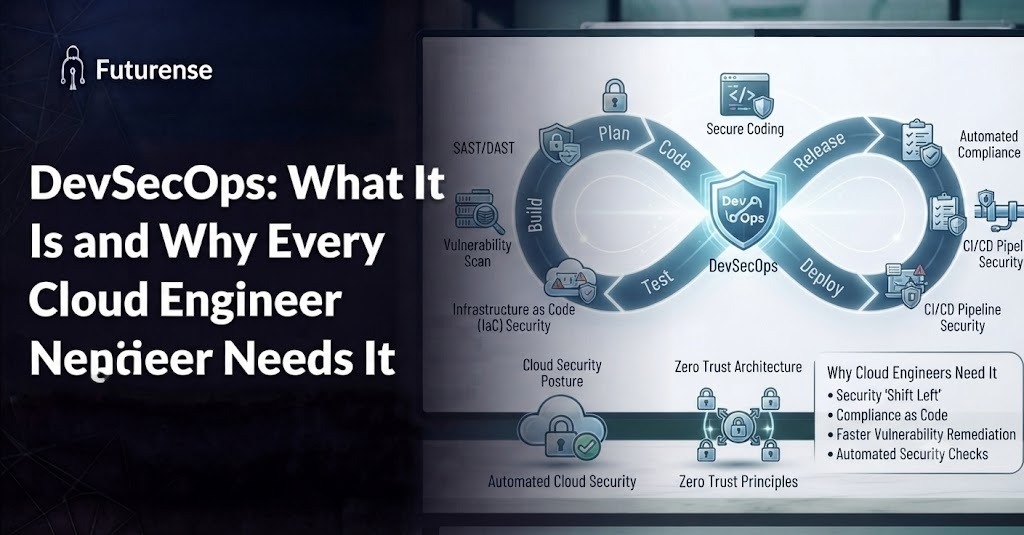
A typical DevSecOps pipeline layers security checks at nearly every stage rather than concentrating them at one gate:
- Plan: Security requirements and threat modeling get considered alongside feature requirements, not after them.
- Code: Developers get real-time security feedback in their IDE or through pre-commit hooks, catching issues before code is even pushed.
- Build: Static analysis and dependency scanning run automatically as part of the build process.
- Test: Dynamic application security testing and infrastructure-as-code scanning run alongside functional tests.
- Release: Automated compliance checks validate the release against security and regulatory policy before deployment proceeds.
- Deploy: Container and image scanning confirms no known vulnerabilities are present in what's actually being deployed.
- Operate and Monitor: Continuous monitoring and vulnerability scanning run against live infrastructure, feeding findings back into the planning stage for the next cycle.
This closed loop, security findings from production feeding back into planning, is what separates a mature DevSecOps practice from simply running a security scanner once during the build stage and calling it done.
How to Become a DevSecOps Engineer: Skills and Career Path
Cloud engineers are often naturally well-positioned to move into DevSecOps roles, since they already work daily with the infrastructure-as-code, CI/CD pipelines, and cloud-native tooling that DevSecOps builds directly on top of.
The additional skills that matter most are a genuine working knowledge of security fundamentals, understanding the CIA triad in cybersecurity (confidentiality, integrity, and availability) is a good starting point, familiarity with common vulnerability classes and how they show up in cloud infrastructure specifically, and hands-on experience with security scanning tools integrated into a CI/CD pipeline rather than run as a standalone, manual process.
Compensation reflects this cross-functional skill demand. Cloud engineer salaries in India and other major markets have climbed steadily as cloud adoption has grown, and DevSecOps skills specifically tend to command a premium on top of standard cloud engineering compensation, since the role sits at the intersection of two in-demand skill sets rather than just one.
Looking ahead, AI-assisted security scanning and automated remediation are becoming a bigger part of how mature DevSecOps pipelines operate, extending the same automation principles behind how a DevOps team can take advantage of artificial intelligence into the security layer specifically, catching and even auto-remediating certain classes of vulnerabilities faster than manual review ever could.
TL;DR
DevSecOps integrates security into every stage of the DevOps lifecycle instead of treating security as a final checkpoint before deployment. For cloud engineers, this is especially important because cloud infrastructure changes rapidly through infrastructure-as-code, CI/CD, and automated deployments.
DevSecOps helps teams identify vulnerabilities, cloud misconfigurations, compliance issues, and exposed secrets earlier through practices such as shift-left security, IaC scanning, continuous vulnerability scanning, automated compliance checks, and secrets management.
For cloud engineers looking to move into DevSecOps, the key skills are cloud infrastructure, CI/CD, security fundamentals, infrastructure-as-code, automation, and security tooling.
Bottom line: DevSecOps is essentially DevOps with security built into the entire development and deployment process, making it an increasingly important skill set for modern cloud engineers.
DevSecOps FAQs
What does DevSecOps mean in simple terms?
DevSecOps means building security checks directly into the software development pipeline, so security is tested continuously alongside code, rather than reviewed separately right before a release.
What is the difference between DevOps and DevSecOps?
DevOps focuses on automating and speeding up development and deployment through collaboration between development and operations teams. DevSecOps adds security as an equal, continuous concern throughout that same pipeline, rather than leaving it as a separate, late-stage review process.
Why do cloud engineers specifically need DevSecOps?
Cloud environments are provisioned and changed constantly through infrastructure-as-code, which means misconfigurations and vulnerabilities can be introduced just as fast as new features ship. DevSecOps automation is built to catch these issues at the same pace infrastructure actually changes, which manual, periodic security reviews can't keep up with.
What tools are used in DevSecOps?
Common DevSecOps tools include static and dynamic application security testing tools, container and image vulnerability scanners, infrastructure-as-code scanners, and secrets management platforms, most of which integrate directly into existing CI/CD pipelines.
Is DevSecOps a job title or a methodology?
Both. DevSecOps is primarily a methodology and cultural practice, but "DevSecOps Engineer" has also become a distinct, increasingly common job title for professionals who specialize in implementing and maintaining these security-integrated pipelines.
Do I need a cybersecurity background to work in DevSecOps?
Not necessarily a formal background, but you do need a genuine working knowledge of security fundamentals and vulnerability classes. Many DevSecOps professionals come from a DevOps or cloud engineering background and build security expertise on top, rather than starting from a dedicated cybersecurity career track.


Advanced PG Certificate in AI Engineering on Cloud and AIOps
IIT Roorkee
Engineer AI Systems for Top Enterprises, with the Most Critical Skills of the Decade.

.avif)