



What Is Multimodal AI?
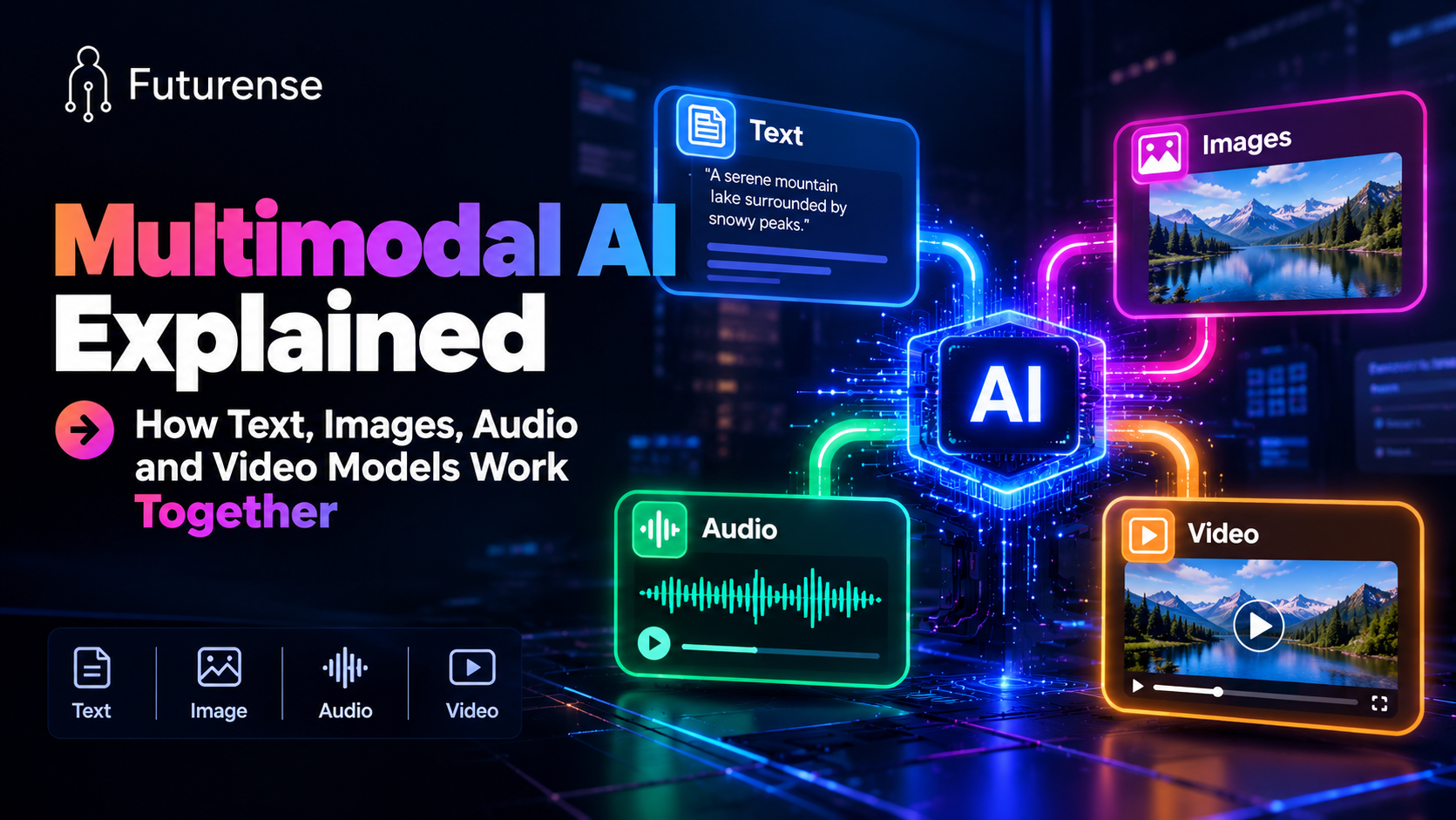
Multimodal AI is a class of artificial intelligence systems that can take in, relate and sometimes generate more than one type of data, called modalities, within the same model or pipeline. Common modalities are text, images, audio and video, and also sensor readings, tables and code.
The word that matters is relate. A pipeline that runs a speech-to-text tool and then feeds the text into a language model touches two modalities, but the model itself only ever sees text. Systems built to connect modalities more directly can answer questions such as "What is the person in this video pointing at?", which needs vision, language and time understanding together.
Unimodal vs Multimodal AI
Healthcare and other high-stakes uses need especially strict human oversight. For more on applications, see our list of generative AI use cases. Agents that see screens and hear voice are an extension of AI agents.
A Worked Scenario (Hypothetical)
An insurance company wants to speed up simple mobile-phone damage claims.
Today a customer fills a form, uploads photos and records a voice note. An adjuster reads everything and decides. In the new design, a speech model transcribes the voice note, a vision model examines the photos, and a language model compares the claimed damage with the policy terms. It drafts a summary and suggests an outcome.
The team sets rules. Low-value, clear-cut claims get a suggestion that the adjuster approves in a click. Anything with inconsistent photos, a mismatch between story and images or a high value goes to a person with the model's reasoning attached. They test on a few hundred past claims and measure agreement with human decisions, including cases where the model sounded confident but was wrong. Blurry photos and heavy accents cause errors, so those get a "needs review" path.
The lesson: the value came from combining modalities, but trust came from the review rules and the testing. This scenario is illustrative, not a real company.
Limits and Risks of Multimodal AI
- Hallucination. The multimodal LLM survey lists multimodal hallucination as a research challenge: models can describe things that are not in the image or audio.
- Cost and latency. Images, audio and especially video use many more tokens or compute than short text.
- Evaluation is harder. You have to test text, vision, audio and their combinations, including mismatches.
- Alignment gaps. A model may read text in an image well but misjudge spatial relationships or small details.
- Bias and fairness. Image and speech models can perform differently across accents, skin tones and conditions.
- Privacy. Faces, voices and documents are sensitive personal data and need careful handling and legal review.
- Security. Hidden instructions in images or audio can manipulate models, a variant of the risks we cover in our guide to prompt injection.
Treat outputs as suggestions that need verification, not facts.
Building With Multimodal Models: Practical Tips
- Start with the task, not the modality. Use multiple modalities only if they add accuracy or save effort.
- Use the simplest pipeline that works. Sometimes transcription plus a text model beats a full multimodal model.
- Retrieve before you generate. Combine retrieval with images and documents in a RAG pipeline so answers cite sources.
- Route by need. Send easy requests to cheaper models and hard ones to stronger ones, as in LLM routing.
- Build a test set with hard cases. Include blurry images, noisy audio and conflicting inputs.
- Keep humans in the loop for high-stakes decisions.
Skills and Careers
Multimodal work sits across machine learning, computer vision, speech, data engineering and product design. Useful skills include Python and deep learning frameworks, understanding of embeddings and Transformers, data handling for large media files, evaluation design and an eye for failure cases. If you are starting out, read how to become an AI engineer and build a small project, such as a photo question-answering app. Job titles and pay vary by company, so check current listings.
Common Mistakes
- Assuming the model "sees" like a person. It processes patterns and can miss obvious things.
- Skipping evaluation on messy inputs. Real photos and calls are noisier than demos.
- Ignoring cost. Video and long audio can grow bills quickly.
- Mixing up a pipeline with a native multimodal model. They behave differently.
- Neglecting consent and privacy for voice and images.
TL;DR:
Multimodal AI is artificial intelligence that can process and relate more than one type of data, such as text, images, audio and video, in a single system. It works by converting each type into numerical representations (embeddings) with specialised encoders, aligning those representations in a shared space, and then letting a model reason across them or generate new content. The result is assistants that can describe a photo, transcribe and summarise a meeting, or answer questions about a chart. The main limits are hallucination, cost and the difficulty of testing across data types, so real projects need careful evaluation and human review.
What is multimodal AI?
Multimodal AI is artificial intelligence that can process and relate more than one type of data, such as text, images, audio and video, within a single system. It lets one assistant describe a photo, transcribe speech or answer questions that span several data types.
How do multimodal models work?
They use encoders to convert each data type into vectors, align those vectors in a shared space through training, combine them in a central model, often a large language model, and then produce text, speech, images or actions as output.
What is the difference between unimodal and multimodal AI?
Unimodal AI handles one data type, like text only or images only. Multimodal AI handles two or more and can cross-reference them, for example answering a question about an image or summarising a video with its audio.
What are examples of multimodal AI?
Examples include assistants that answer questions about photos or charts, meeting tools that transcribe and summarise audio, visual search that finds products from a picture, text-to-image generators and agents that read screens to complete tasks.
What are the limitations of multimodal AI?
Key limits are hallucination across modalities, higher cost and latency, harder evaluation, uneven performance across accents and image conditions, and privacy and security risks. Outputs should be checked, especially for high-stakes decisions.
Is multimodal AI a good career skill?
It is a useful specialisation for AI engineers because products increasingly combine text, vision and voice. Strong fundamentals in machine learning, data handling and evaluation matter most, and demand and pay vary by employer, so check current job listings


PG Certificate in AI-Driven LLM, SLM & Agentic RAG Development
IIT Jammu
Learn to Build Domain-Specific LLMs, SLMs & Production-Ready RAG Systems