


The narrative surrounding Generative AI has shifted dramatically. For years, the industry operated under a single unwritten rule: bigger is always better. Models expanded rapidly from billions to hundreds of billions and eventually trillions of parameters, prompting tech leaders to rush to wire heavy cloud API endpoints like GPT-4, Gemini Ultra, and Claude Opus straight into their production stacks.
However, as these deployments scaled from pilot projects to core operations, enterprise teams hit a hard reality check. Relying entirely on monolithic cloud models exposed four major operational bottlenecks:
- Astronomical Cloud API Costs: High token prices made scaling user-facing applications financially unsustainable.
- Unacceptable Latency: Network round-trips and massive compute overhead created painful delays for real-time applications.
- Data Privacy & Compliance Risks: Transmitting sensitive customer data or intellectual property through external APIs clashed with strict GDPR, HIPAA, and corporate security policies.
- Unpredictable Output Behavior: Massive generalist models often proved overly verbose or prone to hallucinations when asked to execute simple, highly structured business tasks.
Enter Small Language Models (SLMs)
Ranging from 1 billion to 14 billion parameters, Small Language Models represent a fundamental paradigm shift in enterprise AI architecture. Instead of routing every single query to a multi-billion-parameter generalist sitting in a remote datacenter, organizations are pivoting toward lightweight, hyper-focused models that run on-premise, in private clouds, or directly at the edge.
In this comprehensive guide, we examine why Small Language Models (SLMs) are shaping the future of enterprise AI, unpack the technical breakthroughs making them so effective, and outline how tech leaders can deploy them to maximize performance, security, and Return on AI Investment (ROAI).
What Are Small Language Models (SLMs)?
A Small Language Model (SLM) is a compact generative AI model, typically parameter-sized between 1B and 14B parameters. Unlike generalist Large Language Models (LLMs) that attempt to store broad human knowledge spanning everything from creative writing to advanced astrophysics, SLMs are designed for structural efficiency and focused domain mastery.
AI Overview Summary: What is an SLM?
A Small Language Model (SLM) is a lightweight neural network (1B–14B parameters) optimized for high efficiency, speed, and privacy. Built using techniques like knowledge distillation and quantization, SLMs match or exceed LLM capabilities on targeted domain tasks while consuming up to 90% less compute power.
Recent releases such as Microsoft’s Phi-4 (14B), Meta’s Llama 3.2 (1B & 3B), Google’s Gemma 2 (2B & 9B), and Mistral Small (7B & 22B)—have proven that parameter count alone does not dictate intelligence. High-quality synthetic datasets, improved token filtering, and architectural optimizations allow modern SLMs to match or surpass 100B+ parameter models on specific logical, coding, and document analysis tasks.
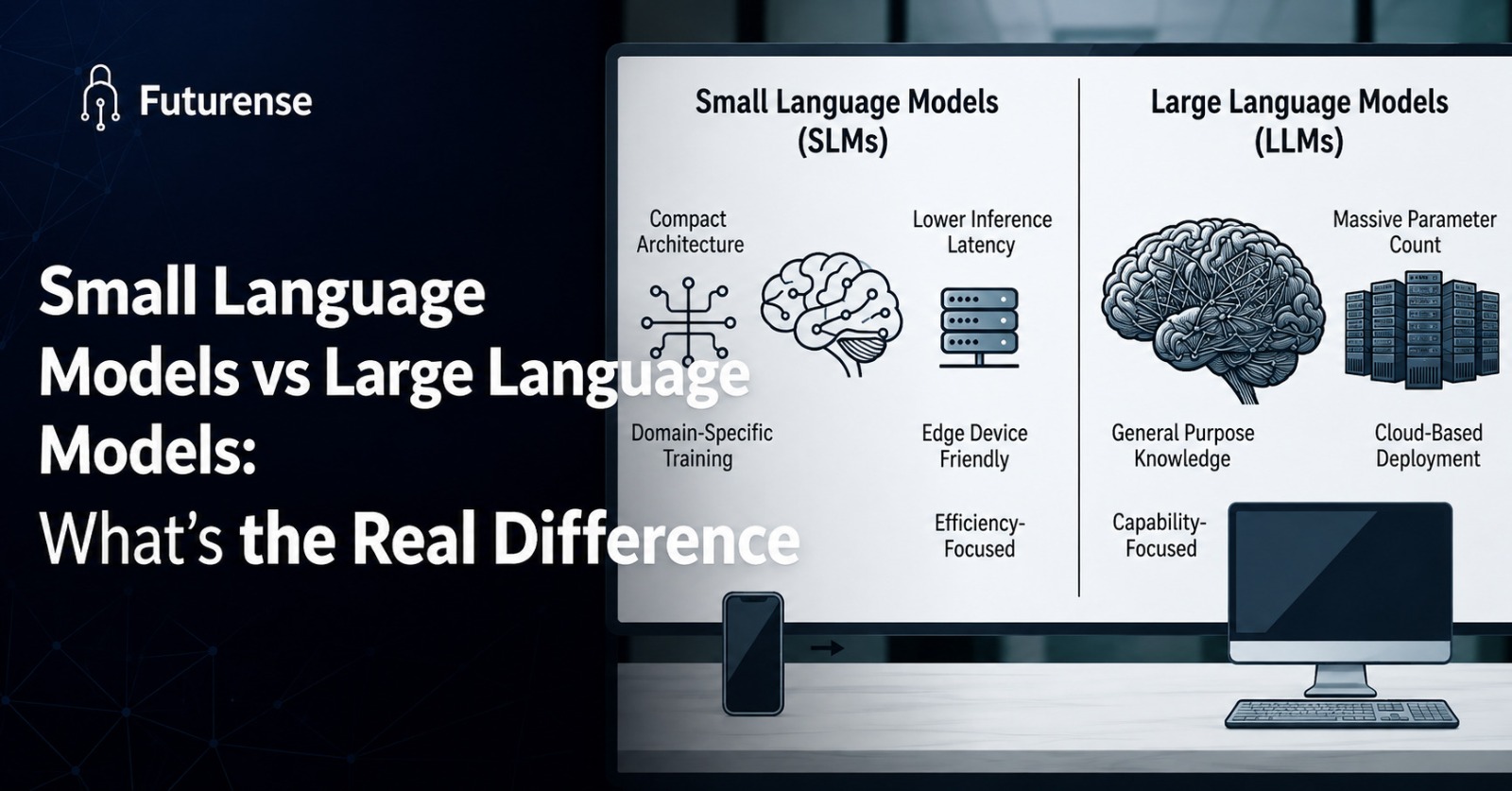
Small Language Models vs. Large Language Models (LLMs)
To choose the right model strategy, enterprise architects must evaluate how SLMs stack up against legacy LLM cloud infrastructure across key operational metrics.
The Core Drivers Behind Enterprise SLM Adoption
Why are Fortune 500 decision-makers and high-growth engineering teams pivoting toward SLMs? Four distinct operational advantages are accelerating this migration.
1. Drastic Reduction in Inferencing & Token Costs
Cloud LLM pricing models charge per thousand or million tokens. When scaling an enterprise AI assistant across thousands of employees or millions of end-users, these API expenses grow exponentially.
SLMs invert this financial dynamic. Because an SLM can run on private cloud instances or existing corporate hardware, the marginal cost per query drops toward near zero. Organizations exchange variable, unpredictable cloud bills for predictable, flat infrastructure costs.
2. Absolute Data Privacy & Regulatory Compliance
In heavily regulated domains such as banking, insurance, defense, and healthcare, transmitting customer Personally Identifiable Information (PII), proprietary source code, or confidential records over public cloud API routes introduces major legal liabilities.
By leveraging open-weight SLMs (like Llama 3.2 or Phi-4), enterprises can execute complete on-premise AI deployments within an air-gapped Virtual Private Cloud (VPC) or local data center. No proprietary data ever leaves the organizational security perimeter, simplifying compliance with GDPR, HIPAA, and SOC2 regulations.
3. Low-Latency Performance & Edge Computing
Real-time interaction demands sub-second latency. A customer support voice bot or an industrial quality-control sensor cannot wait 1.5 seconds for a cloud LLM response over a remote network call.
SLMs optimized with frameworks like vLLM, llama.cpp, or Ollama deliver responses in as little as 20 to 100 milliseconds. Furthermore, their tiny memory footprints allow them to operate directly on smartphones, laptops, and edge IoT hardware without requiring an active internet connection.
4. Precision Fine-Tuning for Specialized Workflows
An LLM possesses general knowledge about almost everything, but it lacks deep, context-specific mastery of your enterprise’s internal database schemas, proprietary ticket systems, or industry-specific terminology.
Because SLMs are small, fine-tuning them using Parameter-Efficient Fine-Tuning (PEFT) techniques like LoRA (Low-Rank Adaptation) or QLoRA is remarkably fast and inexpensive. A fine-tuned 3B or 7B model trained on your company’s historical tickets will consistently outperform GPT-4 on those exact tasks—at a fraction of the operational footprint.
Technical Breakthroughs Powering Modern SLMs
Small Language Models do not compromise on intelligence by luck; they rely on advanced model compression, architectural innovations, and context handling techniques.
Knowledge Distillation
In knowledge distillation, a large, highly capable model (the "Teacher") generates structured reasoning outputs and synthetic training sets that train a compact model (the "Student"). The student model absorbs the reasoning patterns and logic of the teacher without needing the massive parameter weight layers required to store general trivia.
Quantization and Model Pruning
Quantization compresses the mathematical precision of a model’s weights—typically lowering them from 16-bit floating-point format (FP16) down to 8-bit (INT8) or 4-bit (INT4). This drastically reduces VRAM consumption by 50% to 75% with virtually unnoticeable loss in accuracy, allowing an enterprise-grade 8B model to run smoothly on standard consumer hardware or developer workstations.
Grouped Query Attention (GQA) & Sliding Window Attention
Modern SLMs utilize Grouped Query Attention (GQA) to reduce the Key-Value (KV) cache memory footprint during inference. This architectural upgrade allows small models to handle extended context windows (up to 128k tokens) without suffering performance degradation or exhausting hardware memory.
Real-World Enterprise SLM Use Cases
Organizations across industries are moving SLMs into core production systems:
- Financial Document Extraction: Bank automated workflows utilize fine-tuned 3B parameter SLMs to parse complex PDF invoices, financial statements, and loan applications, extracting key tabular data directly into internal ERP systems without exposing financial records to third-party APIs.
- Clinical Summarization in Healthcare: Hospitals deploy air-gapped SLMs directly on local clinical workstation terminals. The model transcribes doctor-patient interactions and drafts structured clinical notes locally, enforcing HIPAA security requirements.
- Software Engineering & Private Codebases: Tech enterprises deploy self-hosted 7B coding models inside local developer environments (IDEs) to auto-complete proprietary code without risking internal Intellectual Property exposure.
- Edge IoT & Industrial Manufacturing: Manufacturing plants embed quantized SLMs directly onto edge computing gateways along assembly lines to monitor machinery sensor telemetry, instantly diagnosing faults without relying on cloud availability.
The Strategic Hybrid AI Pattern: Router Architecture
To visually understand how leading solution architects deploy SLMs in enterprise environments without sacrificing frontier LLM capabilities, the flow chart below outlines the Hybrid AI Router Architecture:
- The AI Router Step: An incoming query is evaluated by a lightweight classifier model.
- The SLM Pathway (80% of Workloads): Routine customer service requests, structured JSON formatting, document summaries, and internal KB queries are routed to an internal, fine-tuned SLM. Processing costs are minimal, and execution speeds are extremely fast.
- The LLM Escalation Pathway (20% of Workloads): If the query demands complex multi-step reasoning, ambiguous creative synthesis, or open-ended analytical tasks, it is escalated to a frontier cloud LLM.
This hybrid pattern allows enterprises to slash overall Generative AI cloud infrastructure costs by up to 70% while preserving frontier reasoning capabilities whenever they are genuinely required.
How Engineers and Leaders Can Master the SLM Era
As industry demand shifts from simple prompt creation to full-stack model deployment, engineers must master the technical layers surrounding compact models including model quantization, localized inference orchestration (vLLM, TGI), RAG systems, and context management.
Building real-world AI systems requires moving past basic API integration toward true end-to-end AI engineering. Professionals looking to elevate their careers and master modern model architectures can explore hands-on specialized programs, such as the Advanced PG Certificate in AI Engineering on Cloud & AIOps offered by IIT Roorkee in collaboration with Futurense.
For developers seeking to design scalable, production-grade applications that combine context routing with local model execution, understanding modern workflow design is critical. You can explore curated learning paths through top online AI courses in India that cover applied AI, machine learning, and advanced context engineering.
Similarly, engineers looking to master end-to-end model implementation from model evaluation to live deployment can benefit from the industry-aligned curriculum in the Futurense AI Master Course, designed to give engineers practical experience building resilient, scalable agentic systems.
Furthermore, corporate tech organizations aiming to upskill entire engineering cohorts on fine-tuning, RAG pipelines, and local model infrastructure can explore dedicated Enterprise AI skilling solutions tailored for real-world enterprise transformation.
TL;DR: Small Language Models (SLMs) in Enterprise AI
- The Problem: Massive cloud LLMs (like GPT-4) cause high token costs, sub-optimal latency, data privacy risks, and verbose outputs for basic enterprise tasks.
- The Solution: Small Language Models (1B–14B parameters) offer compact, domain-focused intelligence that can run on-premise, in private clouds, or on edge devices at up to 90% lower operational cost.
- Key Advantages: Ultra-low latency (20–100ms), zero-data-leakage compliance (GDPR/HIPAA), and cheap, precision fine-tuning on company data using PEFT (LoRA/QLoRA).
- The Winning Architecture: A Hybrid AI Router Pattern where local SLMs handle 80% of routine, structured subtasks, escalating only 20% of complex reasoning queries to cloud LLMs—cutting overall AI compute costs by up to 70%.
What is the difference between an SLM and an LLM?
An LLM (Large Language Model) typically contains tens or hundreds of billions of parameters (e.g., 70B to 1T+) and runs in massive cloud datacenters. An SLM (Small Language Model) has between 1B and 14B parameters, requiring far less computational power, which allows it to run locally on enterprise servers, laptops, or edge devices with lower latency and higher data privacy.
Can a Small Language Model outperform an LLM?
Yes! While an LLM excels at general knowledge and broad open-ended tasks, a fine-tuned SLM trained on specialized, domain-specific data (e.g., medical coding, internal legal contracts, or customer service logs) will frequently outperform general-purpose LLMs on those exact workflows at a fraction of the operational cost.
What hardware is required to run a Small Language Model locally?
Quantized 3B to 8B parameter models can run on modest consumer hardware, including single commercial GPUs (like an NVIDIA RTX 4090), Apple Silicon Macs (M-series with Unified Memory), or modern edge AI chipsets. Larger 14B SLMs run efficiently on single enterprise GPU nodes rather than complex GPU clusters.
How do SLMs protect data privacy in enterprise applications?
Because SLMs have low compute requirements, they can be deployed entirely inside an organization’s air-gapped data center or Virtual Private Cloud (VPC). No corporate data, customer records, or internal source code is ever transmitted over third-party APIs or public cloud networks.


PG Certificate in AI-Driven LLM, SLM & Agentic RAG Development
IIT Jammu
Learn to Build Domain-Specific LLMs, SLMs & Production-Ready RAG Systems

.avif)
%20in%20AI.png)