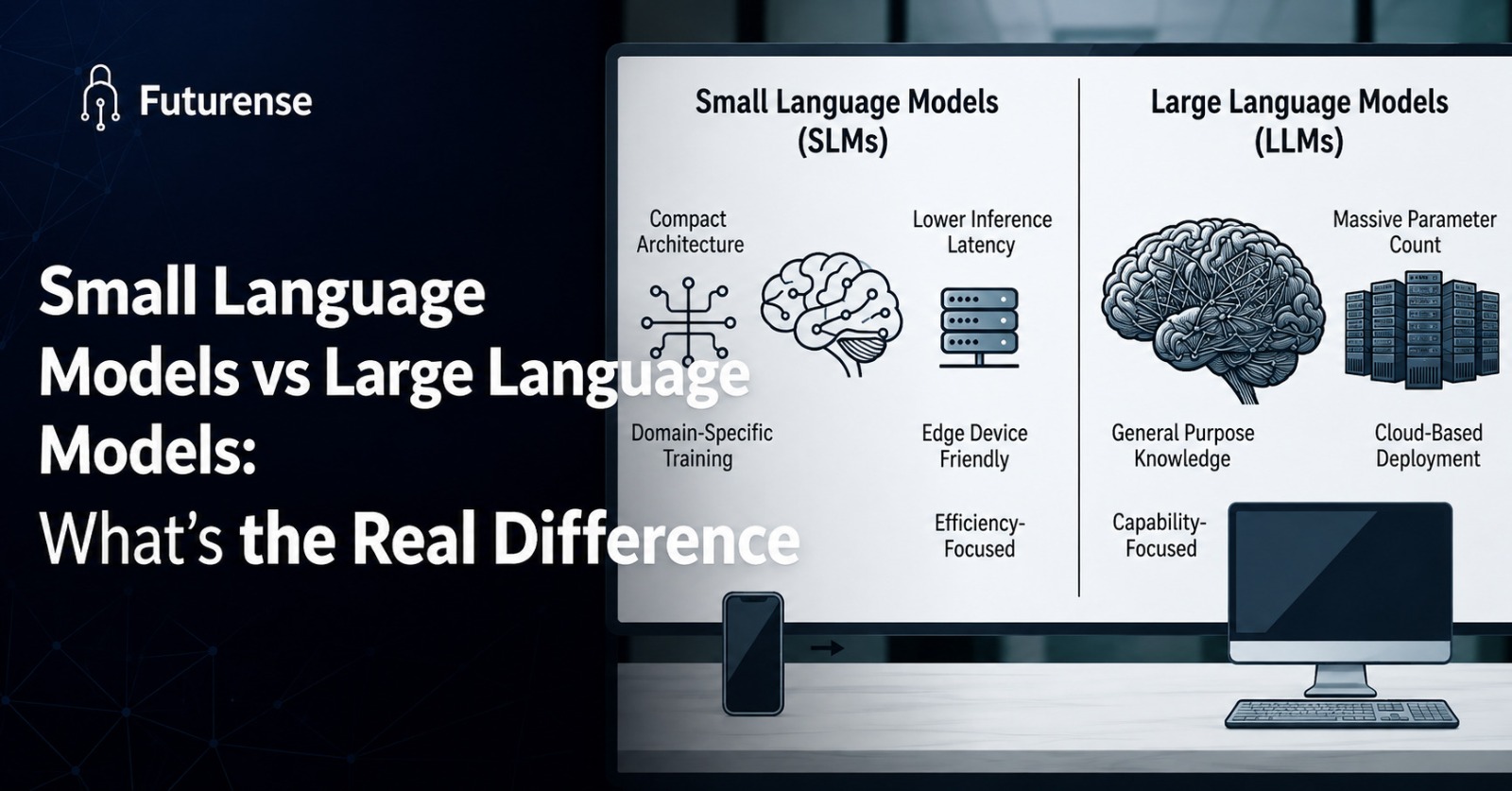


The real difference between small language models (SLMs) and large language models (LLMs) isn't just parameter count, it's what each one is built to do well. LLMs, typically ranging from tens of billions to over a trillion parameters, are built for broad reasoning, creativity, and handling almost any task you throw at them. SLMs, usually under 10 billion parameters, are built to do a narrower set of tasks fast, cheap, and often on-device, without needing a data center behind every query.
Parameter count is the easiest number to point to, but it's a proxy, not the real story. The real story is a tradeoff between generality and efficiency. If you want a deeper technical picture of how these models are built in the first place, it helps to understand what a large language model actually is before comparing the small and large ends of the spectrum.
This guide breaks down what actually separates SLMs from LLMs, where each one wins, what they cost to run, and how to decide which one your use case actually needs.
What Is a Small Language Model (SLM)?
A small language model is a language model built with a deliberately constrained parameter count, generally under 10 billion parameters, though the exact cutoff is fuzzy and shifts as the field evolves. SLMs are trained the same fundamental way LLMs are, using the same core deep learning vs machine learning principles, but with a training approach and architecture optimized for efficiency rather than raw breadth of capability.
The point of an SLM isn't that it's a worse LLM. It's a model purpose-built to run faster, cost less per query, and often deploy directly on a laptop, phone, or edge device, instead of requiring cloud GPU infrastructure for every single request. Google's Gemma, Microsoft's Phi series, and Meta's smaller Llama variants are commonly cited examples of modern SLMs.
What Is a Large Language Model (LLM)?
A large language model is trained on massive datasets with parameter counts that now regularly exceed 100 billion, and in some cases cross a trillion. That scale is what gives LLMs their broad, flexible reasoning ability, the capacity to handle open-ended questions, complex multi-step tasks, and a huge range of subject matter without needing task-specific retraining.
This breadth comes at a real cost. LLMs need significant compute to run, which means higher latency, higher inference cost per query, and infrastructure that's usually cloud-based rather than something you can run locally on consumer hardware. GPT-class models, Claude, and Gemini's largest variants are the models most people mean when they say "LLM."
Small Language Models vs Large Language Models: Key Differences at a Glance
Why Parameter Count Isn't the Whole Story
It's tempting to treat "small vs large" purely as a number, but two models with similar parameter counts can perform very differently depending on training data quality, architecture choices, and how narrowly the model was optimized for its target task.
A well-trained 7-billion-parameter SLM fine-tuned tightly for customer support ticket classification can outperform a general-purpose LLM on that exact task, even though the LLM has ten times the parameters.
This is why the more useful framing isn't "how big is the model" but "how well does the model's design match the task." SLMs trade generality for efficiency and precision within a scope. LLMs trade efficiency for the ability to handle almost anything you throw at them, including tasks nobody specifically trained them for.
When to Use a Small Language Model
SLMs are the better choice when:
- You need low latency and high query volume, like real-time chat support, autocomplete, or on-device voice assistants, where waiting on a cloud round-trip isn't acceptable.
- You're deploying on hardware with limited compute, like mobile devices, IoT sensors, or edge servers, where running a trillion-parameter model simply isn't physically possible.
- Data privacy or offline capability matters, since an on-device SLM doesn't need to send user data to an external API to generate a response.
- The task is narrow and well-defined, like sentiment classification, intent detection, or domain-specific document summarization, where an LLM's broad general knowledge is mostly unused overhead.
- Cost per query at scale matters more than handling every possible edge case, which is common in high-volume production systems processing millions of requests a day.
SLMs are also increasingly used as specialized components inside larger agentic AI systems, where a lightweight model handles a narrow, well-defined subtask (like routing or classification) while a larger model handles the parts of the workflow that genuinely need broad reasoning.
When to Use a Large Language Model
LLMs are the better choice when:
- The task is open-ended or unpredictable, and you can't fully anticipate every type of query a user might send.
- You need strong reasoning across multiple domains in the same conversation, like a general-purpose assistant that might be asked about code, writing, and analysis in the same session.
- Creative or nuanced language generation matters, since larger models generally produce more coherent, contextually rich output on tasks like long-form writing or complex summarization.
- You're building a RAG pipeline where the model itself needs to synthesize retrieved information from multiple, possibly conflicting sources into a coherent answer, not just look up and repeat a fact.
- Query volume is low to moderate, and the higher per-query cost of an LLM is outweighed by not needing to build and maintain multiple narrow, task-specific models.
Can SLMs and LLMs Work Together?
Yes, and this hybrid pattern is becoming one of the more practical architectures in production AI systems. A common setup routes most incoming queries to a fast, cheap SLM, and only escalates to a larger LLM when the query is genuinely complex, ambiguous, or falls outside the SLM's trained scope.
This keeps average cost and latency low while still preserving LLM-level capability for the harder cases that actually need it.
This pattern shows up frequently in customer support systems (SLM handles routine questions, LLM handles escalations), in agentic AI systems (SLMs as fast specialized sub-agents, an LLM as the orchestrator), and in mobile applications (SLM runs on-device for common tasks, LLM handles anything requiring deeper reasoning via an API call).
The context engineering discipline, deciding what information each model actually needs to see, matters a lot in these hybrid setups, since routing the wrong context to the wrong model wastes both the cost savings and the capability benefits the architecture is supposed to deliver.
Cost Comparison: SLM vs LLM
Cost is often the deciding factor once teams move past the proof-of-concept stage.
SLM costs are dominated by lower inference costs per query and, in many cases, no per-query API cost at all if the model runs on-device or on owned infrastructure. Fine-tuning an SLM is also considerably cheaper, since smaller models require less compute and less training data to reach strong performance on a narrow task.
LLM costs scale with usage in a way that adds up fast at high query volumes, since most teams access frontier LLMs through metered APIs priced per token. Fine-tuning an LLM is possible but requires meaningfully more computation, and running your own LLM infrastructure instead of using an API is a significant infrastructure investment most teams don't take on unless they have a strong reason to.
For most teams comparing small vs large language models purely on cost, SLMs win decisively at scale, provided the task actually fits within an SLM's narrower capability range.
Small Language Models vs Large Language Models: A Decision Framework
If you're still not sure which fits your use case, work through these questions in order:
- Is the task narrow and well-defined, or open-ended and unpredictable - Narrow and well-defined points toward an SLM. Open-ended points toward an LLM.
- Does latency or on-device deployment matter - If yes, an SLM is very likely the right call, since most LLMs simply can't run in those environments.
- What's your expected query volume - High volume favors SLMs on cost. Low to moderate volume makes an LLM's higher per-query cost easier to absorb.
- Does the task require broad, cross-domain reasoning in a single interaction - If yes, lean LLM. If the task stays within one clear domain, an SLM, possibly fine-tuned specifically for that domain, will likely perform just as well for a fraction of the cost.
- Could a hybrid setup work better than picking just one - If your system handles a mix of routine and complex queries, route the routine volume to an SLM and reserve the LLM for genuine edge cases.
TL;DR
- Small Language Models (SLMs) are designed for speed, lower cost, and efficiency, making them ideal for focused tasks, on-device AI, and high-volume applications.
- Large Language Models (LLMs) offer stronger reasoning, creativity, and broader knowledge, making them better for complex, open-ended, and multi-domain tasks.
- Model size isn't everything—a well-trained SLM can outperform an LLM on specific, domain-focused tasks while using far fewer resources.
- Choose an SLM if you need fast responses, lower infrastructure costs, offline capability, or better data privacy.
- Choose an LLM when your application requires advanced reasoning, long-form content generation, or handling unpredictable user queries.
- Many modern AI systems combine SLMs and LLMs, using SLMs for routine requests and routing only complex queries to LLMs to balance performance and cost.
What is the main difference between SLM and LLM?
The main difference is parameter count and scope: SLMs are typically under 10 billion parameters and optimized for narrow, efficient tasks, while LLMs range from tens of billions to over a trillion parameters and are built for broad, general-purpose reasoning.
What are the advantages of SLM over LLM?
SLMs offer lower inference cost, faster response times, the ability to run on-device without cloud infrastructure, easier and cheaper fine-tuning, and better data privacy since queries don't always need to leave the device.
Is a small language model less accurate than a large language model?
Not necessarily, and only within the scope it was designed for. A well-trained SLM can match or outperform a general-purpose LLM on a narrow, specific task, but it will typically fall short of an LLM's performance on broad, open-ended, or cross-domain reasoning tasks it wasn't optimized for.
Can small language models run on a phone or laptop?
Yes. This is one of the core advantages of SLMs. Many modern SLMs, including models like Microsoft's Phi series and Google's Gemma, are specifically designed to run efficiently on consumer-grade hardware without needing cloud GPU infrastructure.
When should a business choose an SLM instead of an LLM?
A business should lean toward an SLM when the task is narrow and repeatable, query volume is high, latency or offline capability matters, or data privacy requirements make sending data to an external API undesirable.
Are SLMs and LLMs used together in the same system?
Yes, increasingly so. A common hybrid architecture routes routine, well-defined queries to a fast SLM and escalates only complex or ambiguous queries to a larger LLM, balancing cost and capability rather than picking one model type for everything.


PG Certificate in AI-Driven LLM, SLM & Agentic RAG Development
IIT Jammu
Learn to Build Domain-Specific LLMs, SLMs & Production-Ready RAG Systems

.avif)