

Agentic Retrieval-Augmented Generation is retrieval-augmented generation with an AI agent placed in charge of the retrieval process. Instead of running a single fixed search and handing the results to a language model, an agentic RAG system decides what to search for, checks whether the results are actually useful, searches again if they aren't, and pulls from more than one source when a question calls for it. It turns retrieval from a one-shot lookup into a reasoning loop.
What Is Agentic RAG?
Agentic RAG is an approach to retrieval-augmented generation that embeds autonomous AI agents into the retrieval pipeline, giving the system the ability to plan multi-step searches, evaluate its own results, and use external tools before generating a final answer. It's distinct from standard RAG, which retrieves once and generates once, with no mechanism to notice or correct a bad retrieval.
The distinction matters because most real questions aren't single-hop. "Compare our Q3 2025 revenue with Q1 2026 and flag the risk factors from our latest SEC filing" needs at least three separate lookups and a synthesis step. A standard RAG pipeline fires one query, retrieves whatever is most similar to that combined sentence, and generates an incomplete picture. An agentic RAG system breaks the question apart first, retrieves each piece separately, and only then answers.
How Agentic RAG Differs From a Traditional RAG Pipeline
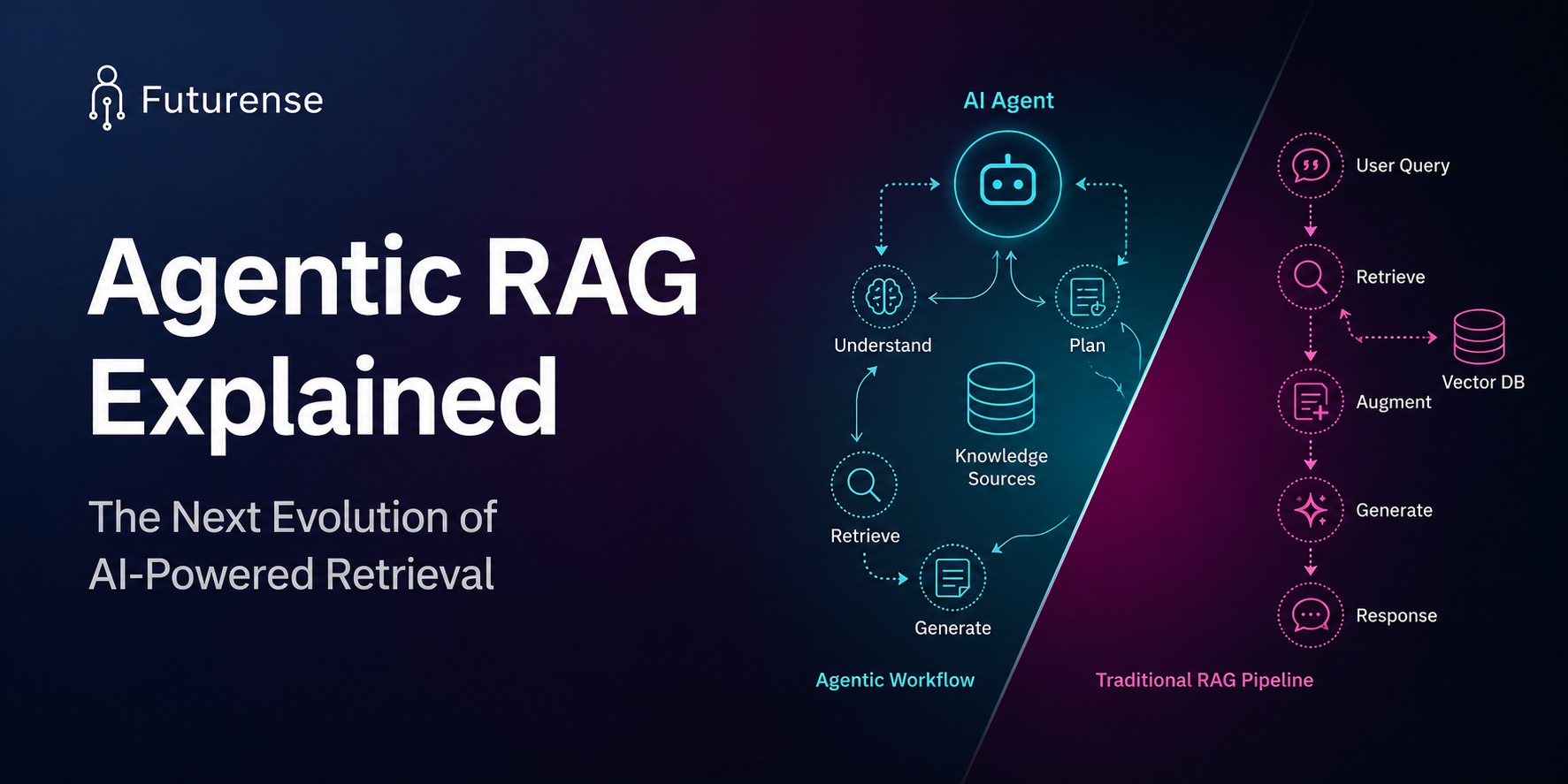
A traditional RAG pipeline follows a fixed sequence: embed the query, retrieve the nearest chunks from a vector store, stuff them into the prompt, and generate a response. There's no step where the system asks "was that retrieval actually good enough?" If the vector search misses the mark, the model generates a confident answer from irrelevant context which is one of the more common causes of hallucination in production RAG systems.
Agentic Retrieval-Augmented Generation replaces that fixed sequence with a decision loop. The agent typically an LLM given a specific role and a set of tools evaluates the query before retrieving anything, decides which source or sources are relevant, checks the quality of what comes back, and can re-query, reformulate, or escalate to a different tool if the first attempt fails.
The table isn't a case for always choosing agentic RAG. A well-scoped FAQ bot answering "what's our return policy" doesn't need an agent deciding whether to re-query; it needs a fast, cheap, single-hop lookup. Agentic RAG earns its complexity on multi-hop, multi-source, or ambiguous queries.
The Core Components of an Agentic RAG System
Every agentic RAG system, regardless of the specific framework used to build it, is assembled from the same functional pieces.
The decision-making agent. Usually an LLM operating with a defined role, a system prompt describing its responsibilities, and access to a set of tools. This is the component that decides what to retrieve and when the retrieval is sufficient.
Retrieval tools. Not limited to a single vector database. A production agentic RAG system typically has access to a vector store for unstructured documents, a SQL or API connection for structured data, and sometimes live web search for information that changes faster than the internal knowledge base is updated.
Memory. Short-term memory holds the state of the current multi-step task, what's already been retrieved, what's still missing. Some systems add long-term memory so the agent can reference prior interactions or previously validated facts.
Orchestration layer. The routing logic that decides which agent or tool handles which sub-task. In single-agent systems this is built into the agent's own reasoning loop. In multi-agent systems, a dedicated orchestrator or "supervisor" agent assigns sub-tasks to specialist agents and merges their outputs.
Validation and reflection step. The mechanism that checks retrieved content against the original question before it's allowed to reach the generation step is often the same LLM, prompted specifically to critique the retrieval rather than answer the question.
Frameworks like LangChain (and its LangGraph extension), LlamaIndex, and CrewAI provide pre-built scaffolding for most of these components, which is why they've become the default starting point for teams building agentic RAG rather than assembling the loop from scratch.
How the Agentic Retrieval Loop Actually Works
Take a query apart step by step and the loop looks like this:
- Query decomposition. The agent reads the incoming question and identifies the distinct information needed inside it; a query about "Q3 vs Q1 performance and risk factors" becomes at least two sub-queries: a numbers lookup and a document search.
- Retrieval planning. For each sub-query, the agent decides which source is the right fit: a vector search for unstructured text, a SQL query for structured revenue data, an API call for anything live.
- Retrieval execution. The relevant tools run. This can happen sequentially or in parallel, depending on whether later steps depend on earlier results.
- Self-evaluation. The agent checks the retrieved content against the sub-query it was meant to answer. Low relevance or low confidence triggers a re-query often with a reformulated search term or a different source entirely.
- Synthesis. Once every sub-query has a satisfactory answer, the agent combines the pieces and generates the final response, typically with the original sources still attached for traceability.
This is why agentic RAG is sometimes described as turning retrieval from a database lookup into a research process; the system behaves less like a search bar and more like an analyst who checks their own work before reporting back.
Agentic RAG Architectures Worth Knowing
Not every agentic RAG system is built the same way. Three patterns show up most often in production:
Single-agent router. One LLM agent has access to multiple retrieval tools and decides, per query, which tool or combination of tools to use. This is the simplest agentic upgrade over standard RAG and is often enough for internal knowledge assistants that need to pull from a handful of known sources.
Multi-agent RAG. A supervisor agent breaks a complex task into sub-tasks and delegates each one to a specialist agent. One agent handles structured data, another handles document search, another handles web lookups then merges the results. This pattern scales better for enterprise systems with many disconnected data sources, at the cost of more orchestration overhead and higher latency.
Corrective and self-reflective RAG. The agent explicitly grades its own retrieval quality before generation and re-retrieves when the grade is low, sometimes falling back to a web search if the internal knowledge base has nothing relevant. This pattern is specifically aimed at reducing hallucination in cases where the internal data genuinely doesn't cover the question.
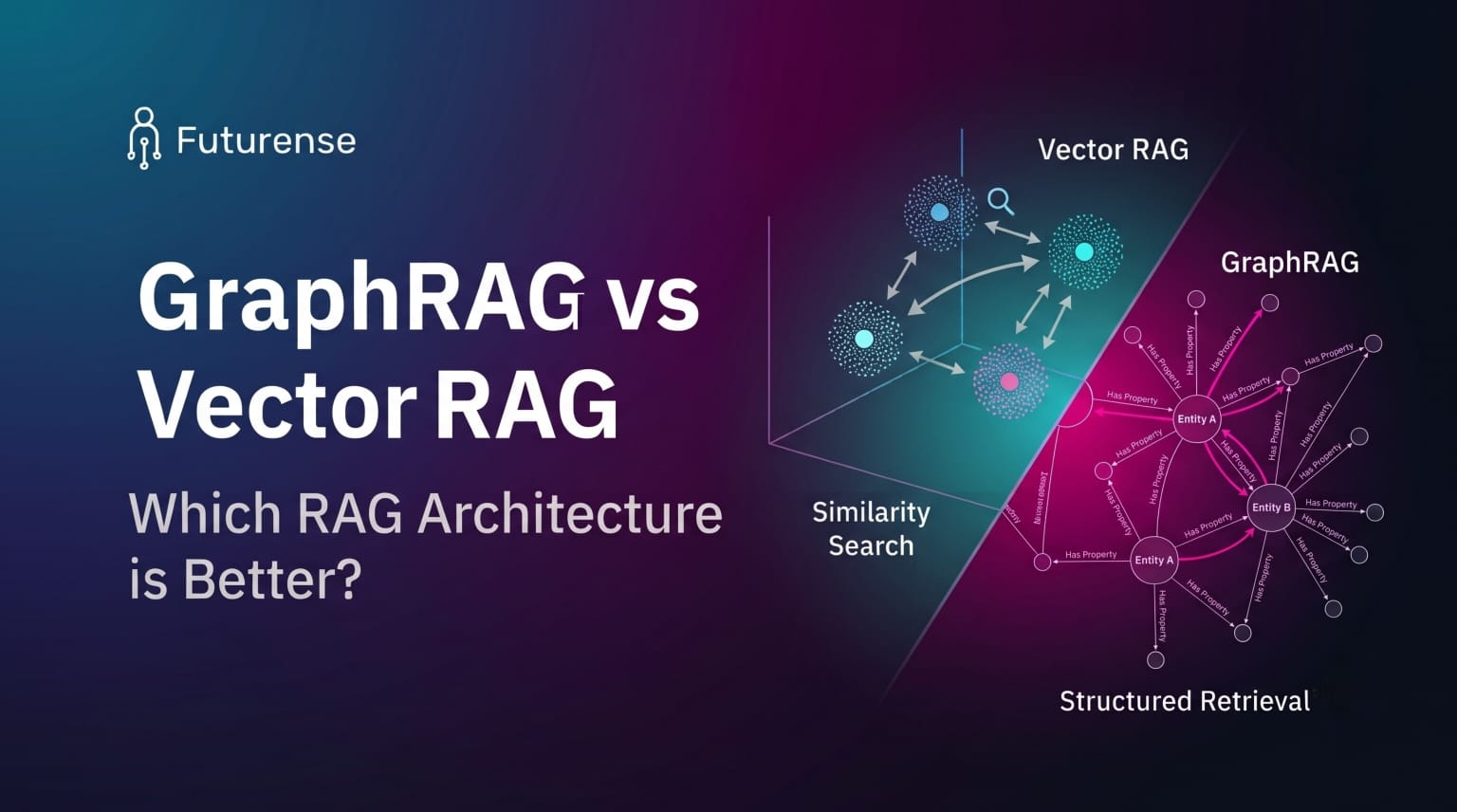
Graph RAG. Retrieval runs over a knowledge graph instead of, or in addition to, a vector store, which helps with questions that depend on relationships between entities rather than semantic similarity alone "which suppliers are connected to both Vendor A and the Q3 delay" is a graph question, not a similarity-search question.
None of these are mutually exclusive. Production systems frequently combine a multi-agent structure with a corrective reflection step and a graph store for relationship-heavy data.
Real-World Use Cases Where Agentic RAG Outperforms Standard RAG
Agentic RAG earns its extra complexity in scenarios where a single retrieval step genuinely isn't enough:
Enterprise knowledge assistants that need to answer questions spanning HR policy documents, live ticketing data, and internal wikis in a single response no single vector store covers all three.
Financial and business analytics, where a question like "how did marketing spend correlate with pipeline growth last quarter" requires pulling structured numbers from a data warehouse and unstructured context from reports, then reasoning across both.
Customer support at scale, where the agent needs to check a knowledge base, look up the specific customer's account status via an API, and only then generate a personalized, accurate response instead of a generic one.
Research and due-diligence workflows, where the task is closer to "find everything relevant and synthesize it" than "answer this one lookup" legal research, competitive analysis, and technical literature reviews all fit this shape.
In each case, the common thread is the same: the question can't be answered from a single retrieval pass, and getting it wrong is expensive enough that the extra latency and cost of an agentic loop is worth paying.
Challenges and Tradeoffs of Building Agentic RAG Systems
Agentic RAG isn't a strictly-better upgrade; it comes with real costs that teams underestimate before they build one.
Latency. Every retrieval, evaluation, and re-query is an additional LLM call. A single-hop RAG answer might take a second; a multi-agent agentic RAG answer with two re-retrieval cycles can take ten seconds or more. For latency-sensitive applications, that's a real product constraint.
Cost. More LLM calls means more token spend. A system that re-queries on every low-confidence retrieval can multiply inference cost several times over compared to a single-shot pipeline.
Orchestration complexity. Multi-agent systems introduce failure modes that don't exist in single-agent RAG agents disagreeing, an orchestrator routing to the wrong specialist, or a sub-task silently failing without the supervisor noticing. Debugging these systems requires proper tracing, not just logging the final output.
Evaluation. Standard RAG evaluation (did the retrieved chunk contain the answer?) doesn't fully capture agentic RAG quality. Teams also need to evaluate whether the agent decomposed the query correctly, chose the right tools, and stopped re-querying at the right point instead of looping unnecessarily.
The practical takeaway: start with standard RAG, and add agentic capability only for the specific query types that a single-hop pipeline demonstrably fails on. Agentic RAG applied everywhere is usually a sign the team skipped the "do we actually need this" question.
Who Builds Agentic RAG Systems and How to Get Started
Agentic RAG sits squarely in the applied AI engineering skill set: prompt design for the agent's decision logic, tool and API integration, vector database and knowledge graph setup, and orchestration frameworks like LangChain, LangGraph, or LlamaIndex. It's also one of the concrete systems that AI agent architecture work increasingly involves, since production agents rarely operate without some retrieval layer behind them.
For engineers moving from a traditional RAG or LLM-application background, the fastest path is usually hands-on: start with a single-agent router over two data sources, add self-evaluation before touching multi-agent orchestration, and measure retrieval quality at every step rather than only the final answer. Futurense's PG Certificate in AI-Driven LLM, SLM & Agentic RAG Development with IIT Jammu is built around exactly this progression from LLM and SLM fundamentals through to building and deploying agentic RAG systems for engineers who want structured, practitioner-led depth rather than piecing it together from scattered tutorials.
TL;DR
- Agentic RAG puts an autonomous AI agent in charge of retrieval, instead of running one fixed search and generating from whatever comes back.
- Traditional RAG retrieves once, from one source, with no way to check or correct a bad result. Agentic RAG decomposes complex queries, retrieves from multiple sources, evaluates its own results, and re-retrieves when needed.
- Core components: a decision-making agent, retrieval tools, memory, an orchestration layer, and a validation/reflection step.
- Common architectures: single-agent router, multi-agent RAG, corrective/self-reflective RAG, and Graph RAG often combined in production.
- Best suited to multi-hop, multi-source, or ambiguous questions (enterprise knowledge assistants, financial analytics, support, research). Adds latency and cost, so it's not a default upgrade for simple, single-source lookups.
What is agentic RAG in simple terms?
Agentic RAG is retrieval-augmented generation with an AI agent controlling the retrieval process, so the system can plan multi-step searches, check whether its own results are good enough, and try again if they aren't instead of retrieving once and generating from whatever it found.
How is agentic RAG different from traditional RAG?
Traditional RAG retrieves once, from one source, and generates from those results with no correction step. Agentic RAG can decompose a query into sub-questions, retrieve from multiple sources, evaluate the quality of what it finds, and re-retrieve when the first attempt falls short.
Is agentic RAG the same as agentic AI?
No. Agentic AI is the broader category of AI systems that plan and act autonomously toward a goal. Agentic RAG is a specific application of that idea, focused on making the retrieval step of a RAG pipeline autonomous rather than fixed.
What frameworks are used to build agentic RAG systems?
LangChain and its LangGraph extension, LlamaIndex, and CrewAI are the most commonly used frameworks, each providing pre-built scaffolding for agent orchestration, tool calling, and memory management so teams don't have to build the loop from scratch.
Does agentic RAG always perform better than standard RAG?
No. Agentic RAG adds latency and inference cost because it makes multiple LLM calls per query instead of one. It's the better choice for complex, multi-hop, or multi-source questions, but a well-scoped single-source lookup is usually faster and cheaper with standard RAG.


PG Certificate in Building Professional Agentic AI with AIOps
IIT Jammu
Design, Deploy, and Operate AI Agents that Actually Work in Production