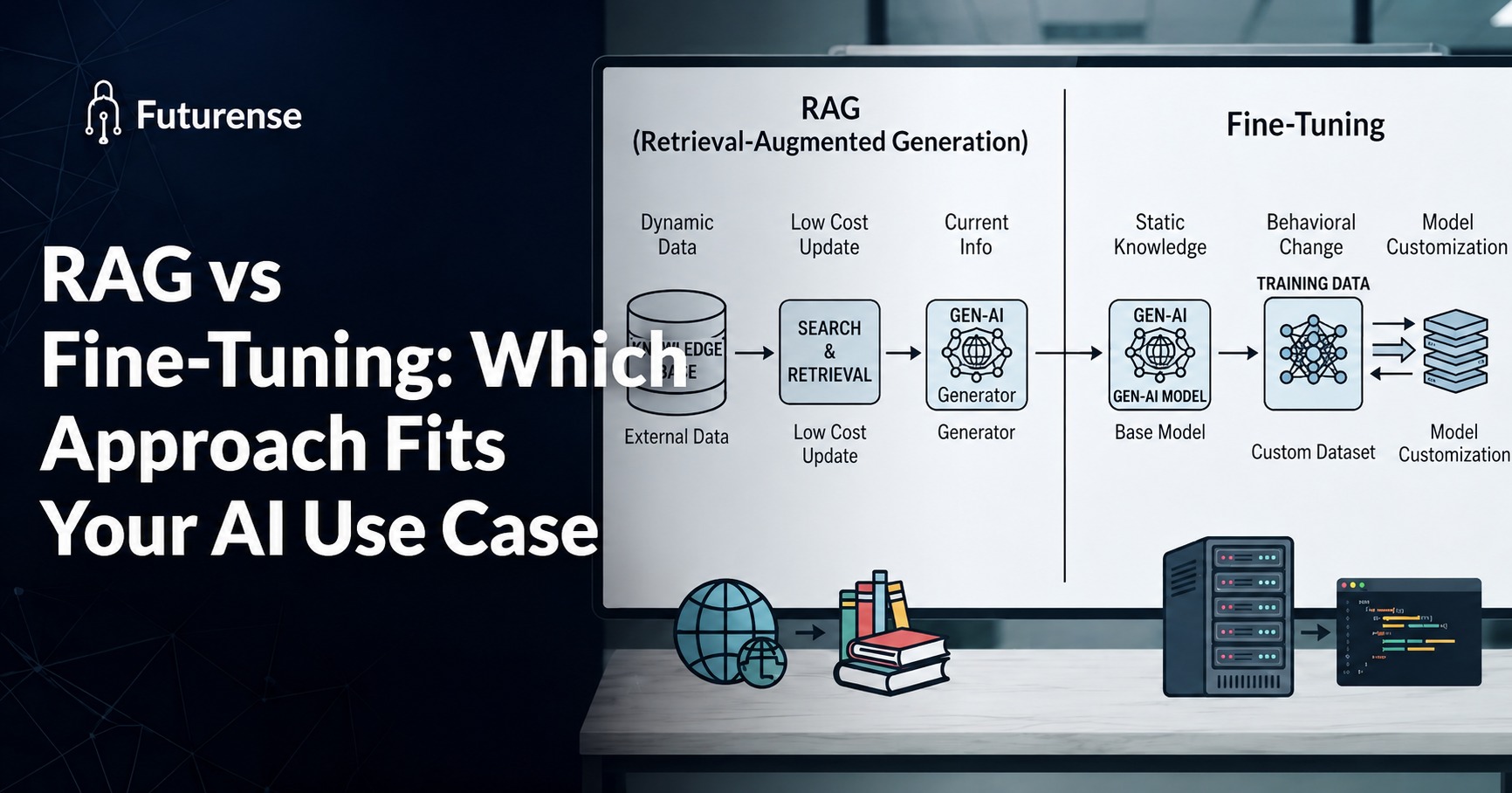


RAG (Retrieval-Augmented Generation) and fine-tuning solve two different problems, even though both get pitched as ways to "customize" a large language model. RAG connects a model to external, up-to-date data at query time without changing the model's weights.
Fine-tuning retrains the model itself on a custom dataset so the behavior, tone, or domain knowledge gets baked into the weights permanently. Most teams asking "RAG vs fine-tuning" actually need RAG first, and fine-tuning only if a narrower, more specific problem shows up later.
If you're new to the underlying technology, it helps to understand what a large language model actually is before comparing these two customization approaches, since RAG and fine-tuning are really just two different ways of shaping how an LLM responds.
This guide breaks down what each approach actually does, where each one wins, what they cost in practice, and how to decide between RAG, fine-tuning, or a combination of both for your specific use case.
What Is RAG and How Does It Work?
RAG retrieves relevant documents or data from an external knowledge source, like a vector database, and feeds that retrieved content into the model's prompt at the moment a query comes in. The model never gets retrained. It just gets handed better context right before it generates a response.
This is why RAG is the go-to approach when your data changes frequently, when you need the model to cite or ground its answers in specific documents, or when you can't afford to retrain a model every time your knowledge base updates.
If you want the full technical breakdown of how a RAG pipeline works end to end, including embedding, retrieval, and generation steps, that's worth a separate read, but the short version is: RAG treats your data as a lookup layer, not as training material.
RAG's biggest practical advantage is data freshness. Update your document store, and the model's answers reflect that update immediately, with no retraining cycle, no GPU bill for a training run, and no risk of catastrophic forgetting (a known failure mode where fine-tuning on new data degrades a model's performance on previously learned tasks).
What Is Fine-Tuning in AI?
Fine-tuning takes a pretrained model and continues training it on a smaller, task-specific or domain-specific dataset, adjusting the model's internal weights so the new behavior becomes part of how the model generates text by default.
Fine-tuning is the right tool when you need the model to consistently follow a specific format, tone, or style that's hard to reliably enforce through prompting alone, or when you need domain-specific reasoning patterns that go deeper than what retrieval alone can supply.
A customer support bot that needs to always respond in a very particular brand voice, or a legal-document classifier that needs domain-specific pattern recognition baked into its weights, are classic fine-tuning candidates.
The tradeoff is real: fine-tuning requires curated training data, compute for the training run itself, careful evaluation to catch regressions, and a repeat of that entire cycle every time you want to update the model's knowledge.
It also requires solid MLOps practices around versioning, evaluation, and rollback, since a fine-tuned model is now a distinct artifact you're responsible for maintaining, not just a prompt template you can edit in five minutes.
RAG vs Fine-Tuning: Key Differences Explained
Prompt Engineering vs RAG vs Fine-Tuning: Which Comes First?
There's a third option that often gets left out of this conversation entirely: prompt engineering. It's worth placing all three on the same spectrum, because most teams jump straight to RAG or fine-tuning when prompt engineering alone would have solved the problem.
Prompt engineering is the lightest-touch approach: crafting better instructions, examples, and structure within the prompt itself, with no external data retrieval and no retraining. It's cheap, fast to iterate on, and should almost always be the first thing you try before reaching for RAG or fine-tuning.
RAG is the next step up when prompt engineering alone can't supply the model with information it doesn't already know, particularly private, proprietary, or frequently changing data.
Fine-tuning is the heaviest-touch approach, reserved for cases where you need to change how the model behaves at a fundamental level, not just what information it has access to.
In practice, a lot of production AI systems use all three together: a well-engineered prompt, RAG for grounding in current data, and fine-tuning only for the specific behaviors that retrieval and prompting couldn't reliably fix.
When Should You Choose RAG?
RAG is the better choice when:
- Your data changes often (pricing, inventory, policy documents, news, support tickets) and retraining a model every time it updates isn't realistic.
- You need the model to cite sources or ground answers in specific documents, which matters a lot for regulated industries like healthcare, legal, and finance.
- You're working with proprietary or private data that shouldn't be baked into a model's weights, especially if that data has access-control requirements that need to persist at query time.
- You want to reduce hallucinations by anchoring generation in retrieved, verifiable content instead of relying purely on what the model memorized during pretraining.
- You have limited machine learning engineering resources, since a well-built RAG pipeline is generally faster to stand up and iterate on than a fine-tuning pipeline.
Internal knowledge-base search, customer support assistants pulling from a documentation library, and enterprise chatbots answering questions from internal wikis are all textbook RAG use cases.
When to Use Fine-Tuning
Fine-tuning is the better choice when:
- You need consistent tone, format, or structure that prompting alone can't reliably enforce across thousands of queries.
- The task requires domain-specific reasoning patterns that go beyond simply having access to the right facts, like classifying legal clauses by risk category or generating code in a niche internal framework.
- Latency matters more than data freshness, since fine-tuned models skip the retrieval step entirely at inference time.
- You're working with a narrower, well-defined task where you can realistically curate a high-quality training dataset, rather than a broad, open-ended question-answering scenario.
- Your data doesn't change often enough to make the retraining overhead a real drawback.
Sentiment classifiers tuned to a specific industry's language, coding assistants trained on a company's internal codebase conventions, and models fine-tuned to follow a strict output schema for downstream automation are common fine-tuning use cases.
If you want to build hands-on expertise across both approaches rather than piecing it together from blog posts, IIT Jammu's PG Certificate in AI-Driven LLM, SLM, Agentic & RAG Development covers RAG architecture, fine-tuning, and agentic system design as a structured program.
Can RAG and Fine-Tuning Work Together?
Yes, and in many production systems, this combination outperforms either approach used alone. A common pattern is fine-tuning a model to reliably follow a specific output format or reasoning style, while using RAG to supply the current, factual grounding that format needs. The fine-tuning handles "how the model behaves," and RAG handles "what the model knows right now."
This combined approach shows up often in enterprise AI Overviews and generative search products, where a model needs both a consistent, brand-safe response structure (fine-tuning's job) and access to constantly updated product or policy data (RAG's job).
Teams building toward this kind of hybrid architecture usually start with RAG, measure where prompting and retrieval alone fall short, and only then scope a fine-tuning effort around that specific, remaining gap.
RAG vs Fine-Tuning: Which Is More Cost-Effective?
Cost is often the deciding factor in practice, and the two approaches have very different cost shapes.
RAG costs are mostly infrastructure and inference: a vector database, embedding generation for your documents, and the retrieval step added to every query. These costs scale with usage and document volume, but they don't require GPU-heavy training runs, which makes RAG considerably cheaper to get started with.
Fine-tuning costs front-load into the training run itself: data curation and labeling, compute for training (which scales with model size and dataset size), and evaluation to catch regressions before deployment. Every time your underlying knowledge changes meaningfully, that cost recurs, since you're retraining rather than just updating a document store.
For most teams evaluating RAG vs fine-tuning cost comparison specifically, RAG wins on total cost of ownership unless the use case genuinely requires the behavioral consistency that only fine-tuning delivers.
How to Choose Between RAG and Fine-Tuning
If you're still not sure which approach fits, ask these questions in order:
- Does prompt engineering alone solve the problem? If yes, stop here. Don't reach for RAG or fine-tuning until you've genuinely exhausted what better prompting can do.
- Does the model need access to information it doesn't currently have, especially information that changes often? If yes, start with RAG.
- Does the model need to consistently behave, format, or reason in a way that retrieval and prompting can't reliably enforce? If yes, fine-tuning is worth the investment.
- Do you need both grounded, current facts and a specific behavioral pattern? Combine RAG and fine-tuning, starting with RAG and adding fine-tuning only around the specific gap it leaves.
TL;DR
- RAG retrieves relevant information from external sources in real time, making it ideal for applications that rely on frequently changing or proprietary data.
- Fine-tuning retrains a model on a custom dataset to permanently improve its tone, behavior, or domain-specific reasoning.
- For most AI applications, start with prompt engineering, then use RAG if the model needs current knowledge. Choose fine-tuning only when retrieval and prompting can't deliver consistent behavior.
- RAG is generally more cost-effective because updating data doesn't require retraining the model.
- Fine-tuning is better suited for specialized tasks where response quality, formatting, or reasoning must remain highly consistent.
- Many production AI systems combine RAG and fine-tuning RAG provides up-to-date information, while fine-tuning ensures consistent output and behavior.
Is RAG better than fine-tuning?
Neither is universally better. RAG is generally better for use cases involving frequently changing data, citation needs, and cost-sensitive deployments. Fine-tuning is better when you need consistent behavior, tone, or domain-specific reasoning that retrieval alone can't deliver.
Is fine-tuning debunked as an LLM customization approach?
No. Fine-tuning isn't obsolete, but it's often reached too early. Many problems that teams initially frame as fine-tuning problems turn out to be solvable with better prompting or RAG, which is why the recommended approach is to try lighter-touch methods first and reserve fine-tuning for genuine behavioral customization needs.
What is RAG and fine-tuning used together called?
There isn't one standardized industry term, but this hybrid approach is commonly described as combining retrieval-augmented generation with a fine-tuned base model, where fine-tuning shapes output behavior and RAG supplies current, grounded facts.
Which is cheaper, RAG or fine-tuning?
RAG is generally cheaper to build and maintain, since it avoids GPU-heavy training runs and lets you update your knowledge base without retraining. Fine-tuning costs recur every time you need to update the model's baked-in knowledge or behavior.
Do I need machine learning expertise to implement RAG?
Less than you'd need for fine-tuning, but RAG still requires solid engineering around embeddings, retrieval quality, and pipeline orchestration. Frameworks like LangChain have made this more accessible, but building a production-grade RAG system still benefits from real ML and data engineering experience.


PG Certificate in Building Professional Agentic AI with AIOps
IIT Jammu
Design, Deploy, and Operate AI Agents that Actually Work in Production