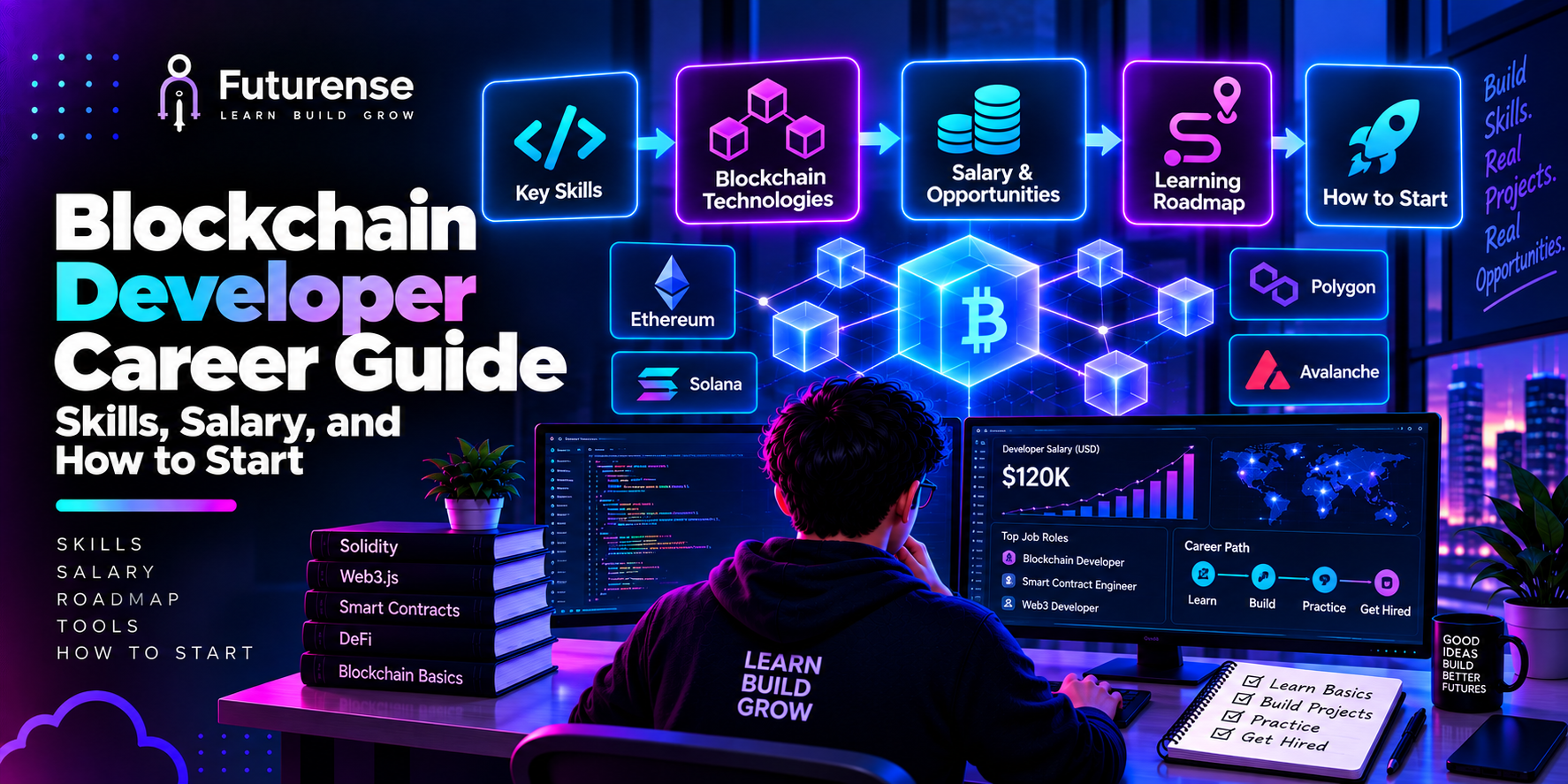


What a Blockchain Developer Actually Does
A blockchain developer builds and maintains applications and infrastructure on blockchain networks writing smart contracts that execute automatically under predefined conditions, building decentralized applications that interact with those contracts, and working on the underlying protocol or infrastructure layer itself in more specialized roles.
The field splits into two broad tracks worth understanding before you start learning: smart contract / dApp developers, who build applications on top of existing blockchains like Ethereum, Solana, or Polygon, and core/protocol developers, who work on the blockchain infrastructure itself consensus mechanisms, node software, and protocol-level features. Most people entering the field start on the smart contract/dApp side, since it has a shorter learning curve and significantly more entry-level opportunity than core protocol work, which tends to require deep distributed-systems expertise built over years.
The Skills You Need to Become a Blockchain Developer
Programming Fundamentals
Strong general programming ability is the foundation everything else builds on most blockchain roles expect solid proficiency in JavaScript/TypeScript (for dApp front-ends and tooling) and increasingly expect comfort with Rust or Go for newer, higher-performance blockchain ecosystems. If you're starting from scratch, building this foundation the same way you would for any software engineering role comes first, before specializing.
Smart Contract Development (Solidity and Beyond)
Solidity remains the dominant smart contract language, used across Ethereum and most Ethereum-compatible chains (Polygon, BNB Chain, Avalanche, and others). Learning Solidity well enough to write, test, and deploy a smart contract securely is usually the first genuinely blockchain-specific skill developers build, and it's the single most in-demand skill listed in blockchain developer job postings. Newer ecosystems like Solana use Rust instead, which is worth being aware of if you're choosing which blockchain ecosystem to specialize in early.
Blockchain Architecture and Consensus Mechanisms
Understanding how blockchains actually work under the hood how blocks are validated, how consensus mechanisms like Proof of Work and Proof of Stake keep a distributed network in agreement, and how transactions get finalized isn't optional theoretical knowledge. It directly informs how you design smart contracts and dApps to behave correctly and securely under the constraints a blockchain actually imposes (limited computation, transaction costs, irreversible execution).
Cryptography Fundamentals
You don't need to be a cryptographer, but a working understanding of public-key cryptography, hashing, and digital signatures is necessary to reason correctly about how blockchain security actually works and critically, to understand where and how it can fail if implemented carelessly.
Security-First Development
Smart contract bugs are uniquely costly because deployed contracts are often difficult or impossible to patch, and a single vulnerability can result in irreversible loss of funds this has happened publicly and expensively many times in the industry's history. Security isn't a nice-to-have skill for a blockchain developer; it's a core, load-bearing competency, closely related to the discipline covered in our guide on how to become a Cybersecurity Analyst. Learning common smart contract vulnerability patterns (reentrancy attacks, integer overflow, access control flaws) and how to test against them is essential, not optional polish.
Decentralized Application (dApp) Development
Beyond the smart contract itself, most real blockchain jobs involve building the full application around it a front-end that interacts with the contract via a library like ethers.js or web3.js, wallet integration, and often a traditional backend for anything that doesn't need to live on-chain. This full-stack dApp skill set is what most entry-level blockchain developer roles actually test for, more than deep protocol theory.
Infrastructure and Deployment
Running and interacting with blockchain nodes, using development frameworks like Hardhat or Foundry for testing and deployment, and understanding how to deploy smart contracts to testnets before mainnet all draw on infrastructure skills that overlap meaningfully with DevOps Engineering and Cloud Engineering a real, practical adjacency worth knowing about if you're coming from either of those backgrounds already.
A Realistic Path: From Where You Are to Blockchain Developer
If you're coming from general software/web development: Your programming and full-stack skills transfer almost directly. Focus your learning specifically on Solidity, smart contract security patterns, and the Web3 tooling ecosystem (Hardhat, ethers.js, MetaMask integration) this is usually the fastest transition path, often achievable in 3–6 months of focused, hands-on learning.
If you're starting from a general computer science background with limited practical coding experience: Build strong programming fundamentals first, ideally with real full-stack project experience, before layering in blockchain-specific skills trying to learn Solidity and smart contract security without a solid programming base first tends to produce fragile, insecure code.
If you're coming from a non-technical or partially technical background: This is a longer path, typically 12–18 months, and should start with genuine programming fundamentals rather than jumping straight into blockchain-specific courses, which assume a level of coding maturity you'll need to build first.
Across all paths, building and deploying real projects even small ones, like a simple token contract or a basic dApp matters far more for actually landing a role than credentials alone. Blockchain hiring, more than most tech fields, rewards demonstrable, inspectable work (open-source contributions, deployed testnet projects, a public GitHub) because smart contract code is inherently public and reviewable in a way most other software isn't.
What Blockchain Developers Earn in India and Globally
Blockchain developer compensation in India varies significantly based on specialization, experience, and whether you're working for a domestic company, a global Web3 startup, or a large enterprise exploring blockchain applications. Broadly, entry-level blockchain developers in India can expect roughly ₹6–12 LPA, mid-level smart contract developers with 2–4 years of specialized experience often earn ₹12–25 LPA, and senior smart contract engineers or specialists working for global-facing Web3 companies can earn considerably more, frequently in the range typically seen for senior software engineering roles at global tech companies, given how globally distributed and remote-friendly Web3 hiring tends to be.
It's worth noting the market has genuine volatility tied to broader crypto market cycles hiring demand and compensation in this field have historically fluctuated more than in more established software specializations, which is a real factor worth weighing alongside the skill set itself when evaluating this as a long-term career path.
Is Blockchain Development a Good Career Choice Right Now?
Blockchain development remains a genuinely specialized, in-demand skill set, but it's worth approaching with a clear-eyed view rather than hype-driven enthusiasm. The strongest, most durable opportunities tend to be in enterprise blockchain applications (supply chain, finance, identity verification) and established DeFi and infrastructure projects with real usage, rather than speculative new token projects. Developers who build genuinely strong smart contract security skills, in particular, tend to have the most consistently in-demand skill set in the field, since security expertise remains scarce relative to demand even during industry downturns.
For engineers considering where this fits into a longer career arc, some blockchain developers eventually move toward Web3 product roles see our guide on how to become a Product Manager if that broader trajectory interests you, while others move deeper into protocol-level engineering or security auditing as they specialize further.
TL;DR: Becoming a blockchain developer means combining strong programming fundamentals with blockchain-specific skills smart contract languages like Solidity, blockchain architecture and consensus mechanisms, cryptography basics, and hands-on experience building decentralized applications (dApps). Most developers transition in from general software engineering over 6–18 months of focused learning. In India, blockchain developer salaries typically range from ₹6–25 LPA depending on experience, with senior smart contract engineers and specialists at global Web3 companies earning considerably more.
What programming language should I learn first for blockchain development?
Solidity is the most widely used smart contract language and the best starting point for most people, since it's used across Ethereum and most Ethereum-compatible chains. Strong general JavaScript/TypeScript skills are also essential for building the dApp front-ends that interact with your contracts.
How long does it take to become a blockchain developer?
For developers coming from a software engineering background, 3–6 months of focused learning is realistic. Starting from scratch with limited programming experience typically takes 12–18 months, since general programming fundamentals need to come first.
What is the difference between a smart contract developer and a blockchain protocol developer?
Smart contract/dApp developers build applications on top of existing blockchains like Ethereum, which has a shorter learning curve and more entry-level opportunity. Protocol developers work on the underlying blockchain infrastructure itself and typically require deep distributed-systems expertise built over years.
Is blockchain developer a good career path in India?
Yes, with the caveat that demand and compensation fluctuate more with broader crypto market cycles than most established software fields. Developers who build strong smart contract security expertise tend to have the most consistently in-demand and resilient skill set.
Do I need a computer science degree to become a blockchain developer?
No. Blockchain hiring tends to weight demonstrable, inspectable project work deployed contracts, open-source contributions, a public GitHub more heavily than formal credentials, since smart contract code is inherently public and reviewable.
What's the earning potential for a blockchain developer in India?
Broadly, entry-level roles start around ₹6–12 LPA, mid-level specialized smart contract developers often earn ₹12–25 LPA, and senior engineers at global Web3 companies can earn significantly more, reflecting the globally distributed, remote-friendly nature of Web3 hiring.


Advanced Engineering Program in Applied AI, ML with Context Engineering
IITM Pravartak
Become the Context Engineer every AI & ML team needs to design scalable, business-driven workflows.