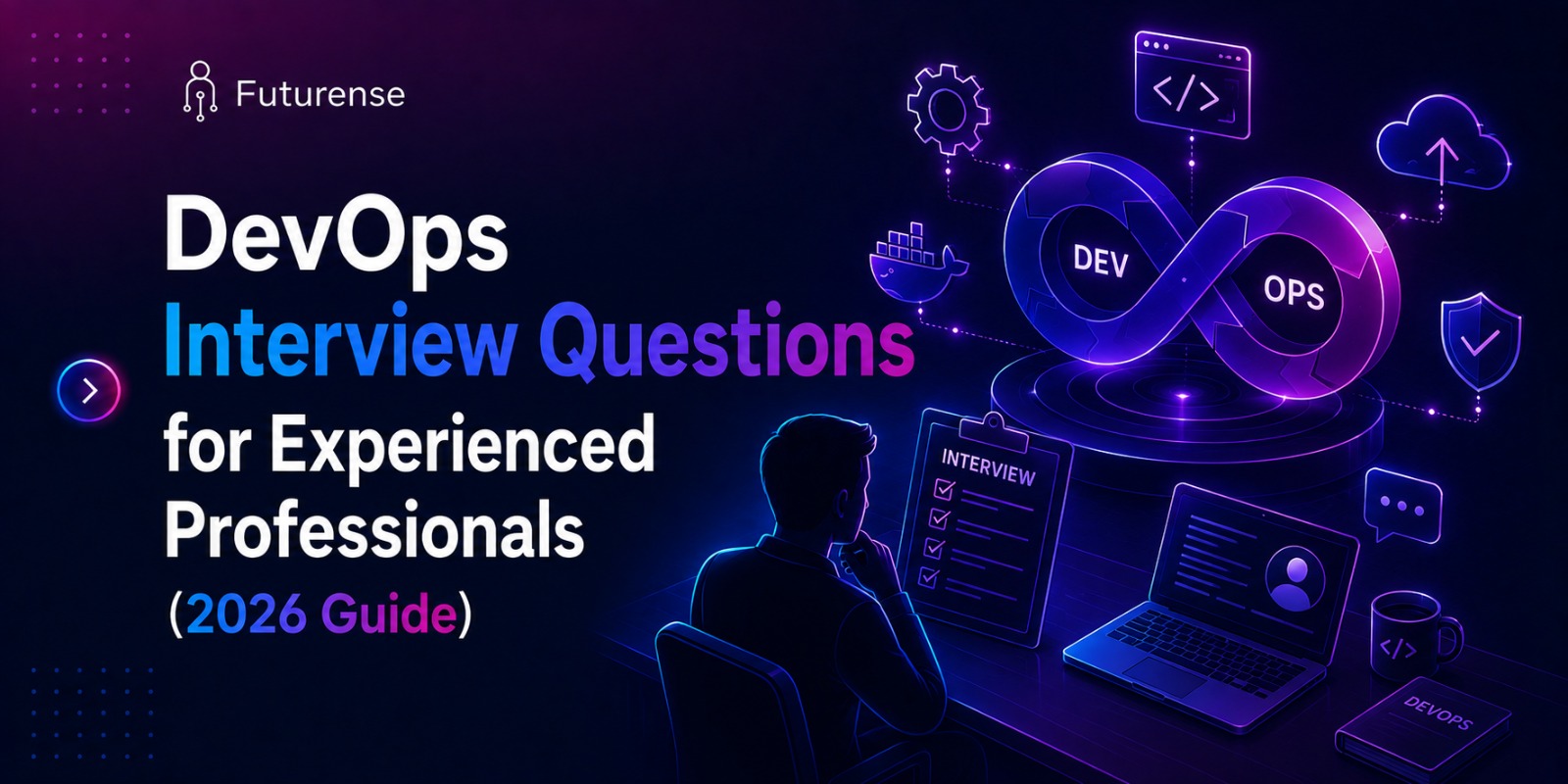


Landing a senior DevOps role isn't about reciting textbook definitions anymore. At the experienced level, interviewers expect you to reason through trade-offs, debug production incidents on the spot, and explain not just what a tool does but why you'd choose it over an alternative.
This guide compiles the most relevant DevOps interview questions for experienced professionals organized by topic, with the reasoning behind strong answers so you can walk into your next interview ready for depth, not just definitions.
What to Expect in a DevOps Interview at the Experienced Level
Interviews for experienced DevOps roles typically move through four layers: conceptual understanding, tool-specific depth, scenario-based troubleshooting, and behavioral/leadership fit.
Unlike entry-level interviews that test whether you know what CI/CD stands for, senior interviews test whether you've actually shipped, broken, and fixed pipelines under real production pressure. Expect whiteboard system design, live debugging exercises, and open-ended "how would you handle this incident" questions alongside standard technical Q&A.
Core DevOps Concepts Interview Questions
1. How do you define DevOps culture beyond just tools and automation?
A strong answer goes beyond naming tools; it emphasizes shared ownership between development and operations, fast feedback loops, blameless postmortems, and a culture where reliability is everyone's responsibility, not just an ops team's job.
2. What's the difference between continuous delivery and continuous deployment?
Continuous delivery means code is always in a deployable state, with a manual approval gate before release. Continuous deployment removes that gate every change that passes automated tests goes to production automatically.
Experienced candidates should be able to explain when manual gates are actually the safer, more mature choice, not just describe the technical difference.
3. How do you measure the success of a DevOps transformation?
Strong answers reference concrete metrics deployment frequency, lead time for changes, mean time to recovery (MTTR), and change failure rate, the four key metrics popularized by DORA's research on high-performing engineering teams.
CI/CD Pipeline Interview Questions
4. How would you design a CI/CD pipeline for a microservices-based application?
Look for candidates who discuss independent build and deployment per service, shared pipeline templates to avoid duplication, automated testing gates at each stage, and rollback strategies specific to each service rather than a single monolithic pipeline.
5. How do you handle secrets management in a CI/CD pipeline?
Solid answers mention dedicated secrets managers (like HashiCorp Vault or cloud-native equivalents), avoiding hardcoded credentials in pipeline scripts, and short-lived, scoped credentials over long-lived static keys.
6. What strategies do you use to reduce pipeline build times at scale?
Experienced candidates typically mention caching dependencies, parallelizing test suites, using incremental builds, and splitting monolithic pipelines into smaller, independently triggered jobs.
7. How do you implement rollback strategies in automated deployments?
Good answers cover blue-green deployments, canary releases, and feature flags as mechanisms to limit blast radius and enable fast, low-risk rollbacks without a full redeploy.
Containerization and Kubernetes Interview Questions
8. How does Kubernetes handle self-healing, and what are its limits?
Kubernetes restarts failed containers, reschedules pods on healthy nodes, and uses liveness/readiness probes to manage traffic but it can't fix application-level bugs or bad deployments, which is where proper monitoring and rollback strategy still matter. For deeper reference material, official documentation from Kubernetes is a useful resource to review before architecture-heavy interviews.
9. What's the difference between a Deployment, StatefulSet, and DaemonSet in Kubernetes?
Deployments manage stateless, interchangeable pods; StatefulSets manage pods that need stable identities and persistent storage (like databases); DaemonSets ensure a copy of a pod runs on every node, often used for logging or monitoring agents.
10. How do you handle resource limits and requests in Kubernetes, and why do they matter?
Strong candidates explain that requests guarantee a minimum resource allocation for scheduling, while limits cap usage to prevent one workload from starving others and that misconfigured limits are a common cause of unexpected pod evictions or throttling.
11. What's your approach to container image security?
Look for mentions of minimal base images, regular vulnerability scanning, avoiding root user execution inside containers, and signing images to verify provenance before deployment.
Infrastructure as Code (IaC) Interview Questions
12. How do you manage state drift in Terraform across a large team?
Strong answers cover remote state storage with locking (e.g., using a backend like S3 with DynamoDB locking), strict PR-based review workflows for infrastructure changes, and regular terraform plan checks in CI to catch drift early.
13. When would you choose configuration management tools like Ansible over Terraform, or vice versa?
Terraform excels at provisioning infrastructure (declarative, state-based), while Ansible is better suited for configuration management and orchestration on existing systems (procedural, agentless). Many mature environments use both together.
14. How do you structure IaC code for multi-environment deployments (dev, staging, production)?
Good answers reference reusable modules, environment-specific variable files, and strict separation of state files per environment to avoid accidental cross-environment changes.
Cloud Platform and Monitoring Interview Questions
15. How do you design for high availability across multiple cloud regions?
Expect discussion of multi-region deployments, load balancing with health checks, data replication strategies, and clearly defined failover procedures with realistic recovery time objectives (RTOs).
16. What's your approach to observability versus traditional monitoring?
Monitoring tells you that something is wrong (via predefined metrics and alerts); observability lets you ask why through logs, metrics, and traces together, especially critical in distributed, microservices-based systems where failures aren't always predictable in advance.
17. How do you control cloud costs without compromising reliability?
Strong answers mention right-sizing resources, using spot/reserved instances strategically, setting up cost alerting, and regularly auditing unused resources balanced against maintaining redundancy for critical systems.
Scenario-Based and Troubleshooting Interview Questions
18. A production deployment just caused a spike in error rates. Walk me through your response.
Interviewers want a structured process: check recent deployments/changes first, review dashboards and logs for the error pattern, decide between rollback vs. forward-fix based on severity, communicate status to stakeholders, and conduct a blameless postmortem afterward.
19. Your CI/CD pipeline suddenly starts failing intermittently with no code changes. How do you debug it?
Good candidates walk through isolating variables systematically checking for flaky tests, dependency version drift, infrastructure capacity issues, or external service instability rather than guessing randomly.
20. How would you handle a situation where a critical service is consistently missing its SLA?
Strong answers involve root-cause analysis using observability data, discussing capacity or architecture bottlenecks, and proposing both short-term mitigation and long-term architectural fixes.
Behavioral and Leadership Interview Questions
21. Describe a time you disagreed with a team's approach to an infrastructure decision.
This tests collaboration and technical communication interviewers want to see how you advocate for your position with data while remaining open to being wrong.
22. How do you mentor junior engineers on DevOps best practices?
For senior roles, this question evaluates leadership readiness and looks for structured answers involving pairing, documentation, and creating safe environments for junior engineers to make and learn from mistakes.
23. Tell me about a major production incident you handled and what you changed afterward.
Strong answers follow a clear structure: what happened, how it was resolved, and most importantly what systemic change was implemented afterward to prevent recurrence.
How to Prepare for a Senior DevOps Interview
Build Hands-On Proof, Not Just Theory
Interviewers at this level can tell the difference between memorized answers and real experience within a few follow-up questions. Having specific, detailed stories ready for pipeline failures, outages, and architecture decisions you've actually made vague, generic answers are the fastest way to lose credibility in a senior interview.
Practice Explaining Trade-Offs
Almost every strong senior-level answer involves a trade-off: speed vs. safety, cost vs. redundancy, simplicity vs. flexibility. Practice explicitly naming the trade-off in your answers rather than presenting a single "correct" solution; this is often what separates a mid-level answer from a senior one.
Stay Current With Tools and Industry Data
DevOps tooling and best practices shift quickly. Reviewing current industry research, such as the annual DORA State of DevOps Report, helps you speak to current benchmarks and trends rather than outdated assumptions a detailed interviewers notice.
It's also worth refreshing your understanding of DevOps tools commonly used across CI/CD, IaC, and monitoring stacks, since interviewers often probe your reasoning for preferring one tool over another. If you're earlier in your transition into the field, revisiting the fundamentals of what DevOps actually is and how to become a DevOps engineer can help you frame your experience more clearly during interviews.
What topics should experienced DevOps candidates focus on most?
CI/CD design, container orchestration (especially Kubernetes), infrastructure as code, observability, and scenario-based incident response tend to carry the most weight in senior interviews.
Are coding skills tested in DevOps interviews for experienced roles?
Yes, though usually scripting-focused (Python, Bash, or Go) rather than full software engineering expect automation scripts, pipeline logic, or small debugging exercises rather than algorithm-heavy coding rounds.
How important are behavioral questions in senior DevOps interviews?
Very important at the senior level, technical skill is often assumed to some degree, and behavioral questions are used to assess incident leadership, mentorship, and cross-team communication.
Should I expect system design questions in a DevOps interview?
Yes, especially for roles involving infrastructure architecture expect questions on designing scalable, highly available systems across cloud regions or services.
How do I answer scenario-based troubleshooting questions effectively?
Structure your answer as a clear process: identify, isolate, resolve, communicate, and prevent recurrence rather than jumping straight to a guessed solution.
What's a common mistake experienced candidates make in DevOps interviews?
Focusing only on tools and commands instead of explaining reasoning, trade-offs, and the "why" behind decisions which is exactly what senior-level interviews are designed to probe.


Advanced PG Certificate in AI Engineering on Cloud and AIOps
IIT Roorkee
Engineer AI Systems for Top Enterprises, with the Most Critical Skills of the Decade

.avif)