

Why AI Needs Specialised Chips
Neural networks are mostly matrix maths: multiply large grids of numbers, add them up, repeat billions of times. A general-purpose CPU can do this, but it is designed to run a few tens of operations in parallel at high speed, not thousands at once.
Specialised chips spend their transistors differently. NVIDIA's CUDA documentation explains that GPUs are built for thousands of parallel threads, trading lower single-thread performance for much greater total throughput, and that they devote more transistors to data processing while CPUs devote more to caching and flow control. If you are new to the underlying ideas, start with what deep learning is.
Everything below is a variation on the same theme: how to do more matrix maths, faster, using less energy.
What Is a GPU?
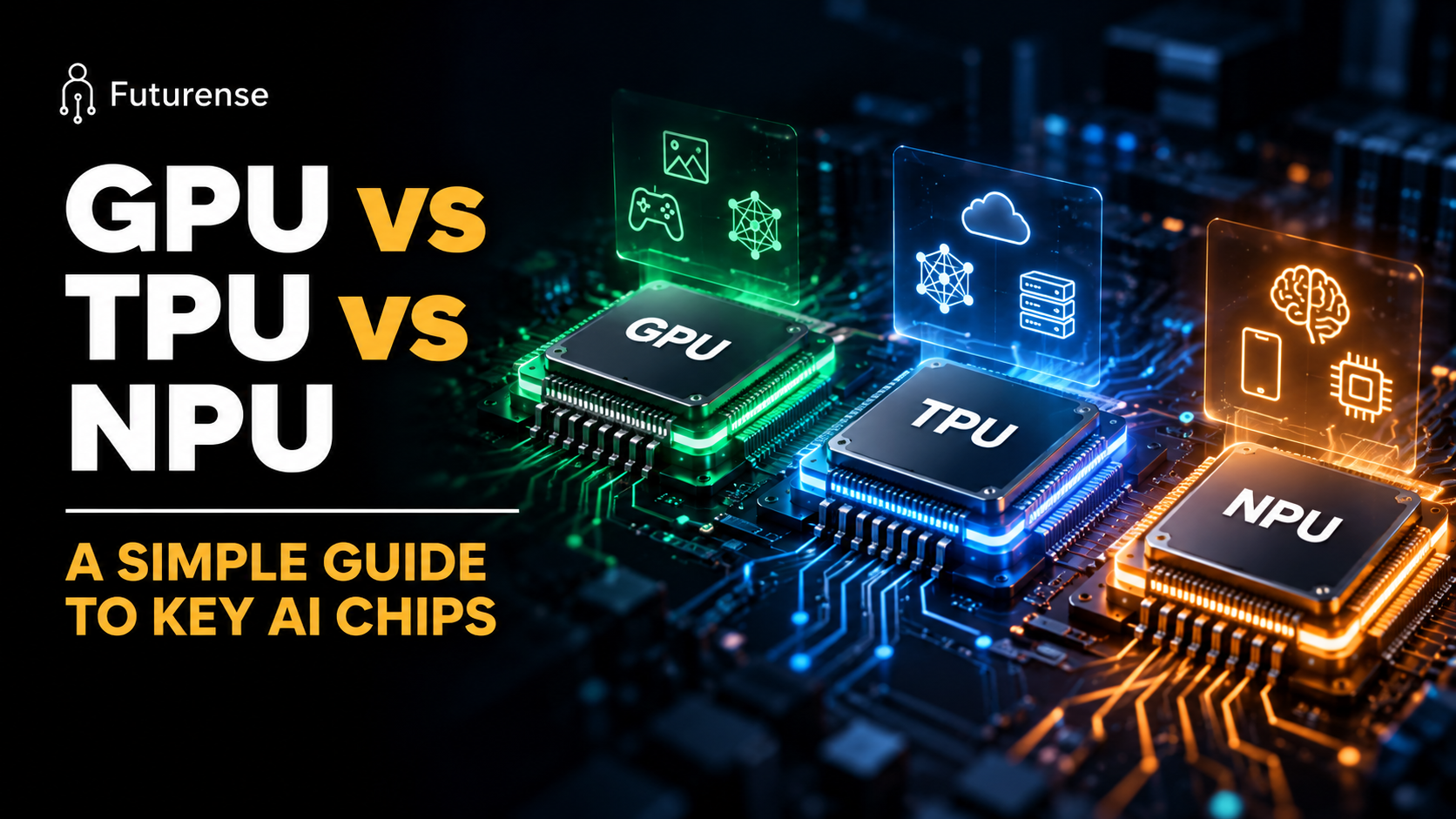
A GPU (graphics processing unit) is a processor with thousands of small cores designed to run many calculations in parallel. It began as hardware for rendering graphics, and the same parallelism suits AI.
NVIDIA describes CUDA as a parallel computing platform and programming model it developed, used in fields such as deep learning, scientific computing and high-performance computing. That software ecosystem is a large part of why GPUs became the default for AI.
Strengths
- Flexible: handles training, inference, graphics, simulation and scientific work.
- Mature software support across the major deep learning frameworks.
- Available in laptops, workstations, data centres and every major cloud.
Limits
- High power use at the top end.
- Cost and availability for the largest chips.
What Is a TPU?
A TPU (tensor processing unit) is a custom chip designed by Google to accelerate machine learning. Google describes TPUs as its custom-developed, application-specific integrated circuits (ASICs) for this purpose, built for the large matrix operations found in many ML algorithms.
The original design was described in a 2017 paper by Jouppi and colleagues: a datacentre chip deployed since 2015 for neural-network inference, built around a matrix multiply unit with 65,536 8-bit multiply-accumulate units and a peak of 92 trillion operations per second. The authors reported it ran their inference workloads roughly 15 to 30 times faster than a contemporary GPU or CPU, with 30 to 80 times better performance per watt. That comparison was against 2017 hardware (an Nvidia K80 and an Intel Haswell CPU), so read it as history, not a verdict on today's chips.
According to Google Cloud's documentation, the matrix unit is a 128 by 128 systolic array, and the XLA compiler converts a framework's computation graph into TPU machine code. TPUs are accessed through Google Cloud services such as Compute Engine and Google Kubernetes Engine.
Strengths
- Efficient on large, matrix-heavy models and long training runs.
- Scales across many chips connected together.
Limits (from Google's own guidance)
- Not recommended for branch-heavy or element-wise-heavy workloads, high-precision arithmetic, or custom operations inside the main training loop.
- Dynamic tensor shapes cause recompilation, so inputs should be fixed or padded.
- Tied mainly to Google Cloud.
What Is an NPU?
An NPU (neural processing unit) is a specialised AI engine built into a device's main chip, designed to run neural network operations efficiently on the device itself. Microsoft describes an NPU as a specialised chip for AI-intensive processes such as real-time translation and image generation, executing the deep learning maths that makes up AI models.
NPUs work alongside the CPU and GPU. Microsoft says the NPU can use energy on AI tasks more efficiently than a CPU or GPU, giving longer battery life, and that many new Windows AI features require an NPU able to run at 40 or more TOPS. TOPS stands for trillions of operations per second.
For developers, Microsoft's guidance says Windows ML detects the available hardware, picks a suitable execution provider and can fall back to the GPU or CPU. NPUs typically need lower-precision integer models such as INT8, so models trained in 32-bit floating point must be quantised first.
Strengths
- Low power, so it suits laptops, phones and other battery devices.
- Keeps data on the device, which helps privacy and latency.
- Always available without a cloud connection.
Limits
- Much smaller than data-centre accelerators.
- Best for inference, not large-scale training.
- Software support varies by vendor and platform.
GPU vs TPU vs NPU: Side-by-Side Comparison
When to Use Which
Use a GPU when
- You are learning machine learning or experimenting. A single GPU, local or rented, is the usual starting point.
- Your model uses custom operations or unusual architectures.
- You need the widest tooling and community support.
Consider a TPU when
- You train or serve large, matrix-heavy models and already work on Google Cloud.
- Your workload has fixed shapes and standard operations.
- Cost or efficiency at scale matters more than flexibility.
Rely on an NPU when
- The AI feature must run on the user's device: transcription, background blur, on-device search, small language models.
- Battery life, latency or privacy matter.
- You can quantise the model and accept a smaller size.
You do not usually choose just one. A typical product trains on GPUs or TPUs in the cloud, serves from cloud accelerators and runs a small version on an NPU on the device. Renting accelerators by the hour fits the on-demand model described in cloud computing models.
Software Matters As Much As Silicon
A fast chip is useless without software that can use it. Each ecosystem has its own path:
- GPUs: CUDA and the libraries built on it, plus support in every major framework.
- TPUs: the XLA compiler, reached through frameworks such as TensorFlow, PyTorch and JAX.
- NPUs: model conversion and quantisation, then runtimes such as ONNX Runtime and Windows ML.
When judging a platform, ask how much of your code and your team's skills transfer. For large models, see what an LLM is to understand why memory and bandwidth are as important as raw speed.
How to Read TOPS and Other Numbers
Vendors advertise TOPS, trillions of operations per second. It is a peak figure for a stated precision, such as 8-bit integers, and it assumes the chip is kept fully busy. Two chips' TOPS are not directly comparable if they use different precisions or architectures, and real speed also depends on memory bandwidth, software and the model itself. Treat TOPS as a rough guide to capability, then check benchmarks on your own workload. Performance per watt matters just as much as raw speed, especially on devices and at data-centre scale.
A Worked Scenario: A Startup Choosing Hardware
This is a hypothetical example to show the thinking; the company and choices are invented.
A Bengaluru startup builds an assistant that summarises documents for lawyers.
Experimentation. The team rents a cloud GPU by the hour to fine-tune a small open model. Flexibility and tooling matter most while they iterate.
Production in the cloud. Once demand grows, they compare options for serving. They benchmark the model on cloud GPUs and, because their stack is on Google Cloud, test a TPU with fixed input lengths. They decide using cost per thousand requests and latency measured on their own traffic, not vendor headline numbers.
On-device feature. Lawyers want a quick local search over files on their laptops. The team quantises a compact model and runs it through an NPU-aware runtime, so data stays on the laptop and battery drain is low. When no NPU is present, it falls back to the GPU or CPU.
Operations. They track cost, latency and accuracy together and revisit the choice as models and prices change. This is the work covered in MLOps.
Common Misconceptions
- "A TPU is always faster than a GPU." It depends on the model, batch size, software and generation. Benchmark your own workload.
- "More TOPS means a better chip." Peak numbers hide precision, memory and software differences.
- "NPUs will replace GPUs." They solve a different problem: efficient local inference, not large-scale training.
- "You need an expensive GPU to learn AI." Many beginner projects run on a modest machine or a rented cloud GPU.
- "Hardware choice is only for hardware engineers." ML engineers, MLOps teams and product teams all face these trade-offs.
Careers Connected to AI Hardware
Understanding accelerators helps in several roles. Machine learning engineers choose and optimise hardware for models; see how to become a machine learning engineer. MLOps engineers manage the infrastructure that runs them. Embedded and on-device AI engineers work with NPUs and constrained devices; read embedded systems vs VLSI for the difference. Chip designers build the accelerators themselves, a field covered in VLSI career in India and India Semiconductor Mission 2.0 and VLSI careers. AI is also changing how chips are designed, as explained in AI-driven chip design. We have not quoted salary figures here because published numbers vary widely; check current listings
What is the difference between a GPU, TPU and NPU?
A GPU is a flexible parallel processor used for graphics, AI training and inference. A TPU is Google's custom chip built for large matrix operations in machine learning. An NPU is a small, power-efficient AI engine built into devices to run AI locally.
Is a TPU faster than a GPU?
Not always. A 2017 Google paper reported its first-generation TPU running inference roughly 15 to 30 times faster than a contemporary GPU, but that compared older hardware. Today the result depends on the model, software and chip generation, so benchmark your own workload.
What does an NPU do?
An NPU runs neural network operations efficiently on a device such as a laptop or phone. It handles tasks like transcription, translation and image effects with low power use, working alongside the CPU and GPU.
Do I need a GPU to learn machine learning?
Not at the beginning. Many exercises run on a regular computer or a free or rented cloud GPU. A dedicated GPU becomes useful when you train larger models or work with images or language models.
Can PyTorch run on a TPU?
Google Cloud documents guides for running PyTorch, JAX and TensorFlow workloads on Cloud TPU. Support and performance depend on your model and setup, so check the current documentation.Can PyTorch run on a TPU?
What does TOPS mean?
TOPS means trillions of operations per second. It is a peak figure for a stated precision, often 8-bit integers, so it is useful as a rough guide but not a direct comparison between different chips.


Executive PG Certification in AI-Enabled VLSI Design
IIT Kharagpur
Architect the Silicon of Tomorrow: From Low-Power RTL to AI-Optimized GDSII.