


Quick Summary
- What it is: An explanation of how artificial intelligence is affecting jobs in the Indian tech industry.
- Primary concern: Whether AI will replace jobs or change how people work.
- Key insight: AI is automating some tasks but creating new technical roles.
- Best for: Indian IT professionals deciding how to adapt their careers.
With the increased dependency on AI, are you thinking that will AI replace jobs?
AI is embedded in daily tasks. AI systems write code, analyze data, generate content, and automate customer support. While these tools are robust, AI's impact on Indian IT Jobs is becoming prominent.
While India has abundant engineering graduates every year, the competition for tech roles is fierce. While AI is creating new opportunities, India is the fastest-growing AI industry worldwide. Hence, AI is hiring on a large scale. This article covers the details about how to stay relevant in the era of artificial intelligence jobs.
What “AI Replacing Jobs” Actually Means?
Many fear about the fact that AI will replace jobs and even imagine it wiping out all professionals overnight. But in reality, technology changes the tasks and roles in a company instead of whole careers.
Most of the jobs involve tasks like data analysis, communication, decision-making, documentation, and creative problem-solving. While AI does automate some of them, it cannot do it for all.
For example:
- AI is capable to generate code snippets
- AI summarizes reports
- AI can detect fraud patterns
But humans design systems that understand the context and then make a strategic decision. Research continually shows that automation influences particular tasks but not entire occupations.
Hence, AI jobs focus more about evolution instead of replacing jobs.
Impact of AI on Indian IT Jobs
The Indian IT sector is going through a lot of changes due to AI adoption. Like automation tools are decreasing the demand for repetitive tasks like:
- Basic coding
- Data entry
- Manual testing
- Daily customer support
Besides, studies also reveal that automation has greatly affected beginner roles that depend on structured-tasks. But the need for professionals isn't shrinking, rather its changing.
AI has changed the roles and responsibilities of professionals plus increased productivity instead of a massive job loss.
Thus, the demand has shifted towards professionals who specialize in:
- AI development
- Data engineering
- Cloud infrastructure
- Cybersecurity
- Product design for AI systems
Thus, the way of working has changed for the better.
Jobs Most Likely to Change Because of AI
Many technical roles are more prone to automation than others. These include:
- repetitive coding
- structured data analysis
- customer support scripts
- report generation
- documentation
This is because LLMs are capable to perform these tasks with better productivity. Programming, customer service and data entry roles have the highest exposure to automation. Yet, developers or analysts won't disappear; rather, their work will transition towards:
- system architecture
- complex problem solving
- AI tool integration
- product design
Thus, professionals who will specialize in these high-value skills will always thrive in their careers due to increased demand.
Jobs That AI Is Creating
Artificial intelligence has also created new job categories, and some of the emerging ones include:
- AI engineer
- Machine learning engineer
- AI product manager
- Prompt engineer
- AI cybersecurity analyst
- AI ethics specialist
The demand for these roles is increasing quickly. India had shown nearly 2.9 lakh AI-based jobs in 2025, and the demand will increase by 32% in 2026. So, as people say Ai will replace some jobs it would rather create newer ones as well.
It is evident from the fact that the World Economic Forum stated that while AI would displace 85 million jobs, it will also create 97 million new roles in AI-based fields.
Hence, the labor market is not collapsing rather its evolving.
Why AI Skills Are Becoming Necessary?
The major reason for division in the AI economy is between those professionals who will use AI effectively and those who will not. It was never about which jobs would survive and which might disappear.
Companies prefer candidates skilled in:
- Machine learning fundamentals
- Gen AI tools
- Data infrastructure
- AI system deployment
- Cloud platforms
This shift demonstrates a large-scale demonstration of digital work. Besides, AI has become a core layer of the modern technology stack, just like cloud computing became a necessity in recent years.
So, professionals who integrate AI in their work have a strong competitive advantage in the job market.
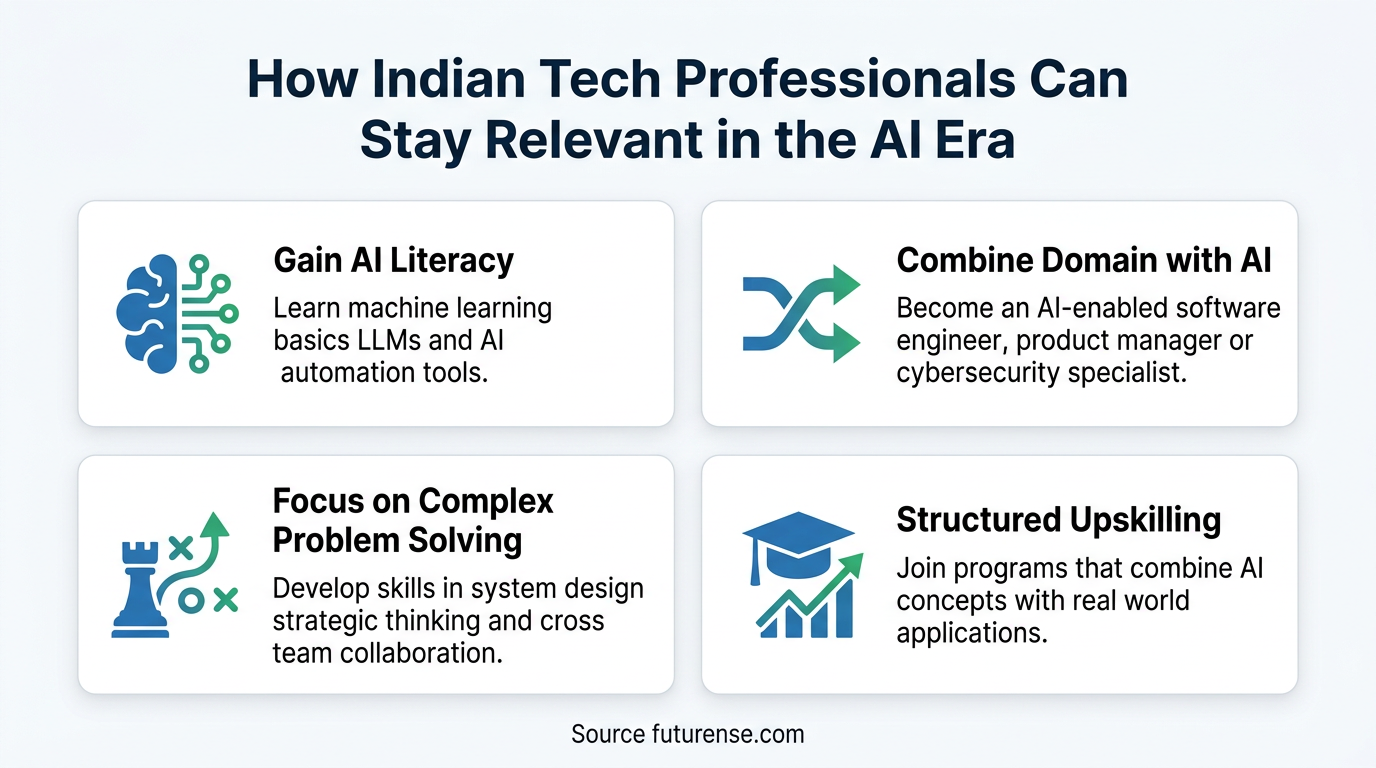
How Indian Tech Professionals Can Stay Relevant?
The right approach for professionals to stay relevant in the current era is by adaptation instead of fearing change.
The following are some of the approaches you can incorporate into your career:
- Gain AI literacy: Instead of becoming an AI researcher, you need to know and understand how AI systems work. Some concepts about which you should gain literacy include Machine learning basics, LLMs, AI automation tools, and data pipelines.
- Combine Domain Specialization with AI: Professionals who combine AI expertise with AI knowledge have a higher demand. For example, AI-enabled software engineers, AI product managers, AI cybersecurity specialists, etc. These hybrid roles are increasing rapidly.
- Focus on Complex Problem Solving: AI excels on structured tasks, and hence, humans should continue to gain expertise in strategic thinking, system design, cross-team collaboration, and creative problem solving. So becoming capability of it is necessary for long-term career resilience.
- Improve Through Structured Upskilling: The majority of professionals get AI expertise through structured learning programs that combine AI concepts and real-world applications. These include ML fundamentals, Gen AI systems, AI-based product development, data and cloud infrastructure, etc.
how indian tech professionals can stay relevant in the ai era through ai literacy domain specialization complex problem solving and structured upskilling
Hence, such training helps professionals shift into emerging AI-based technology roles.
The Future of AI and Jobs in India
The huge impact of AI is quite evident in the industry, yet several trends are becoming visible.
AI will greatly increase productivity across many industries, and it is expected to grow rapidly over the next two decades. This will increase AI adoption in India's digital economy.
Thus, government and industry initiatives will increase AI innovation and talent development across the country. Even career security will rely greatly on adaptability.
So, professionals who succeed in AI will be those who adapt technology to it. The right way is to follow a structured learning approach with the latest curriculum that helps with better packages.
TL;DR
AI is automating several tasks and is reshaping the job market. While some roles may decline, like those that focus on repetitive digital work, AI has created many new career opportunities.
Thus, those who upscale themselves with AI, data systems, and modern digital infrastructure will stay ahead. Hence, instead of worrying, upscale yourself to learn how to use it as a tool.
Professionals with the right skills will retain their jobs and will define the next generation of technology careers.
AI Summary
This page explains whether AI will replace jobs and how AI will affect IT professionals in India. It also details the impact of AI on work, lists emerging AI jobs, and explains the importance of upskilling in AI to stay relevant in future technology careers.
FAQs: Artificial Intelligence Replacing Jobs
Will AI replace software engineers in India?
Not entirely. AI tools are automating repetitive coding tasks like boilerplate code generation and basic debugging, but software engineers who focus on system design, architecture, and complex problem solving are not at risk. In fact demand for engineers who know how to build and work with AI systems is growing rapidly. The key is to evolve your skill set rather than worry about replacement.
Will AI replace data analysts?
AI is changing how data analysis is done but not eliminating the role. Tools can now automate data cleaning, basic reporting, and pattern detection. However interpreting results, making business decisions, and understanding the context behind data still requires human judgment. Data analysts who learn to work with AI tools will actually become more productive and more valuable.
Can artificial intelligence replace humans?
AI can replace humans in specific tasks but not as a whole. It excels at processing large amounts of data, identifying patterns, and automating repetitive work faster than any human can. However it completely lacks emotional intelligence, moral judgment, creativity, and the ability to navigate unpredictable real world situations. These are fundamentally human qualities that AI cannot replicate. So rather than replacing humans entirely, AI is more accurately described as a tool that amplifies what humans can do.
What jobs will be lost by 2050?
Jobs most at risk by 2050 are those built around predictable, repetitive, and structured tasks. These include data entry operators, basic customer support agents, manual testers, routine report writers, and entry level bookkeeping roles. The World Economic Forum estimates that AI could displace around 85 million jobs globally but simultaneously create 97 million new ones. So while certain roles will disappear, entirely new categories of work will emerge that do not even exist today.
How can Indian IT professionals future proof their careers against AI?
The most effective approach is to combine your existing domain expertise with AI knowledge. Learn the fundamentals of machine learning, get comfortable with Gen AI tools, understand data infrastructure, and work toward at least one cloud or AI certification. Professionals who can use AI as a tool rather than compete with it will always stay ahead in the job market.


Your Second Chance At the IIT Dream
IIT Program
Build an AI-first career with IIT-powered degrees, industry mentorship,and real-world learning.


.avif)
.avif)