

Why This Comparison Keeps Coming Up
As generative AI adoption has accelerated, MLOps and LLMOps increasingly get mentioned side by side in the same infrastructure conversations, and it's easy to assume they're just two names for the same discipline. They're not the workflows differ significantly because the models they manage behave very differently. Before comparing the two directly, it's worth being clear on the foundation: our guide to MLOps covers the machine learning operations discipline in depth. And if you're also weighing AIOps into this picture the third commonly confused "Ops" discipline our comparison of MLOps vs AIOps covers that adjacent pairing; this article completes the picture by adding LLMOps.
What Is MLOps?
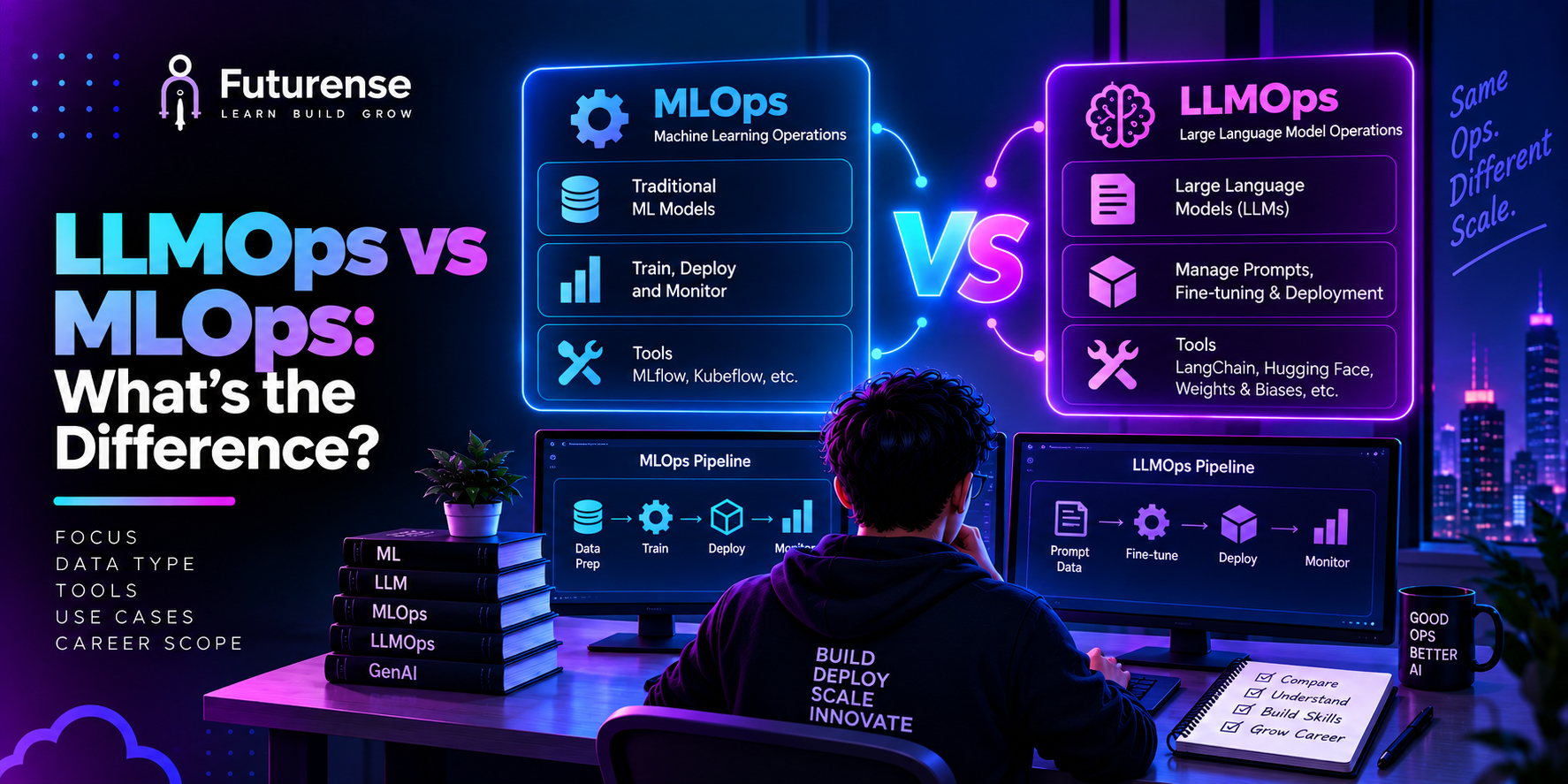
MLOps governs the lifecycle of models you trained on your own data feature engineering, training pipelines, model registries, deployment, drift monitoring, and retraining. The central asset in an MLOps system is the trained model itself, and quality is typically expressible as a clean, measurable number: accuracy, precision, recall, an AUC score. If a fraud-detection model's precision drops, that's a clear, quantifiable signal something has gone wrong.
What Is LLMOps?
LLMOps extends MLOps specifically for systems built on large language models whether using API-based models (OpenAI, Anthropic, Gemini) or open-source models (Llama, Mistral). The central asset isn't just a model; it's a model plus a prompt plus retrieved context plus guardrails, and quality has to be judged across relevance, groundedness, cost, and safety simultaneously, not reduced to a single accuracy number.
This is a meaningfully different governance problem. LLMOps treats prompts, embeddings, vector databases, and agent tools as first-class citizens, and while MLOps typically works with structured, tabular datasets, LLMOps works with unstructured text, where behavior is shaped by the prompt as much as by the underlying model weights. For a deeper grounding in the underlying technology, our explainer on what an LLM actually is is a useful starting point.
LLMOps vs MLOps: The Core Distinction
The cleanest framing, echoed consistently across current industry writing: LLMOps is not a replacement for MLOps it's an extension layer on top. MLOps asks whether the model predicts correctly. LLM systems ask whether the whole application model, prompt, retrieval, guardrails, and orchestration together behaves reliably under real operating conditions. Both questions matter, and increasingly, the same organization has to answer both.
A genuinely useful boundary test for deciding which discipline you're actually dealing with: if your core artifact is a custom-trained model, lead with MLOps; if your core artifact is a prompt-and-retrieval application over a foundation model, lead with LLMOps. The exception worth knowing: if you fine-tune open-weight models against your own data, that fine-tuning lifecycle is MLOps in everything but name data versioning, training pipelines, evaluation against held-out sets, and a model registry, all classic MLOps concerns applied to an LLM.
LLMOps vs MLOps: Side-by-Side Comparison
The Failure Mode That Makes This Distinction Concrete: Prompt Drift
Nothing illustrates why LLMOps needs its own discipline better than a failure mode classical MLOps monitoring simply cannot see. Prompt drift is the degradation of LLM output quality over time without any change in your code or prompts and the most common cause is a silent model update from your API provider, since OpenAI and Anthropic periodically update their models, and the new version may respond differently to the exact same system prompt. Unlike data drift in classical ML, prompt drift can happen overnight and be invisible to standard monitoring, which is precisely why a dashboard built for MLOps can stay green while users are quietly getting confidently wrong answers.
This single failure mode is a strong practical argument for why LLMOps tooling exists as its own category rather than being absorbed entirely into existing MLOps platforms the monitoring question itself is different, not just the model type.
Tools: LLMOps vs MLOps Compared
The tooling ecosystems overlap at the edges but diverge sharply once you look past experiment tracking. On the MLOps side, our breakdown of MLOps tools like Kubeflow, MLflow, and SageMaker covers the ecosystem handling training pipelines, model registries, and deployment.
On the LLMOps side, the most widely adopted tools as of 2026 include LangFuse or LangSmith for prompt tracing and observability, Ragas for RAG pipeline evaluation, Pydantic for output schema validation, Argilla for human-in-the-loop review, and vector databases like Qdrant or Pinecone for RAG storage with MLflow notably shared across both categories for experiment tracking specifically. Most teams stitching together LLMOps from MLOps tooling alone end up needing three or four separate LLM-specific tools layered on top one for evals, one for traces, one for the gateway, one for guardrails since MLOps platforms weren't originally built with prompt-level observability in mind.
When You Need MLOps, LLMOps, or Both
The honest, practical answer for most organizations building real AI products in 2026: probably both, applied to different parts of the system. If you don't train models, don't own a feature store, and don't retrain on a schedule, classical MLOps adds operational overhead without payoff in which case LLMOps alone may be the right starting point, and it's often the cheaper, faster entry point for companies just beginning to build production AI.
If you're fine-tuning open-weight models against your own data, or running traditional predictive models (fraud, ranking, recommendations) alongside your GenAI applications, you need MLOps discipline too. Most production LLM systems in mature organizations end up requiring MLOps discipline data versioning, experiment tracking, A/B testing infrastructure plus LLMOps specialization prompt versioning, token budgeting, latency SLAs running as genuinely complementary layers rather than competing frameworks.
Career Scope: LLMOps vs MLOps as Specializations
For engineers deciding between these as career specializations rather than organizations choosing what to adopt, the paths overlap in foundation but diverge in day-to-day focus. MLOps roles center on the classical ML lifecycle training pipelines, feature stores, drift monitoring for structured-data models. See our detailed MLOps Engineer salary in India guide for a full breakdown by experience level.
LLMOps roles center on the generative AI application layer specifically prompt engineering discipline, RAG pipeline reliability, and LLM-specific evaluation and observability. Our guide to LLMOps Engineer roles and responsibilities covers this specialization in depth, and our LLM Engineer salary in India data shows how compensation tracks for this fast-growing specialization. A working understanding of RAG vs fine-tuning is genuinely foundational for LLMOps work specifically, since choosing between those two techniques shapes almost every downstream operational decision an LLMOps engineer makes.
Neither specialization is a dead end if you want to pivot later the underlying MLOps discipline (versioning, monitoring, deployment rigor) transfers directly into LLMOps work, which is exactly why LLMOps is best understood as an extension of MLOps rather than a wholly separate career track.
TL;DR: LLMOps is not a replacement for MLOps it's an extension of it. MLOps governs systems where a trained model is the central asset and quality is a measurable number, like a fraud-detection or recommendation model. LLMOps governs systems where behavior emerges from a model plus a prompt plus retrieved context plus guardrails, and quality has to be judged across relevance, groundedness, cost, and safety at once. Most mature AI organizations in 2026 need both, running them as complementary disciplines rather than choosing one over the other.
Is LLMOps a subset of MLOps, or a completely separate discipline?
LLMOps is best understood as an extension of MLOps, not a replacement or a fully separate discipline. It builds on core MLOps concepts like versioning and monitoring while adding LLM-specific practices prompt management, RAG evaluation, and guardrails that classical MLOps tooling wasn't built to handle.
What is the main difference between LLMOps and MLOps?
MLOps governs the lifecycle of models trained on your own structured data, with quality measured as a single number like accuracy. LLMOps governs systems built around large language models, where quality depends on the model, prompt, retrieval, and guardrails together, judged across multiple dimensions like relevance, groundedness, and safety.
What is prompt drift, and why doesn't MLOps monitoring catch it?
Prompt drift is the silent degradation of LLM output quality over time without any change to your own code or prompts, most commonly caused by an AI provider updating their model in the background. Classical MLOps monitoring is built to catch data drift in structured models, not this kind of provider-side behavioral shift, so it can miss prompt drift entirely.
Which tools are used in LLMOps vs MLOps?
Common MLOps tools include MLflow, Kubeflow, SageMaker, and Weights & Biases. Common LLMOps tools include LangFuse or LangSmith for prompt tracing, Ragas for RAG evaluation, Pydantic for output validation, Argilla for human review, and vector databases like Qdrant or Pinecone.
Do I need both MLOps and LLMOps, or can I choose just one?
It depends on what you're building. If you don't train or fine-tune models and mainly build prompt-and-retrieval applications over foundation models, LLMOps alone may be sufficient. If you also fine-tune open-weight models or run traditional predictive ML models alongside your GenAI systems, you likely need both, applied to different parts of your stack.
Which career path pays more: MLOps or LLMOps?
Both are strong, growing specializations, and direct comparisons vary by company and region. LLMOps and LLM-specific roles have seen particularly fast salary growth given how quickly generative AI adoption has accelerated, though both fields benefit from the broader premium currently attached to AI infrastructure skills.


PG Certificate in AI-Driven LLM, SLM & Agentic RAG Development
IIT Jammu
Learn to Build Domain-Specific LLMs, SLMs & Production-Ready RAG Systems

%20in%20AI.png)