

Why These Two Get Confused So Often
Both names end in "Ops," both apply automation and AI to a operational problem, and both promise fewer late-night pages for the teams that adopt them which is exactly why people confuse the terms even though the disciplines solve genuinely different problems. Before comparing them directly, it's worth being clear on each individually: our guide to MLOps covers the machine learning operations discipline in depth, and our guide to AIOps covers the IT-operations-focused discipline this article compares it against.
What Is MLOps?
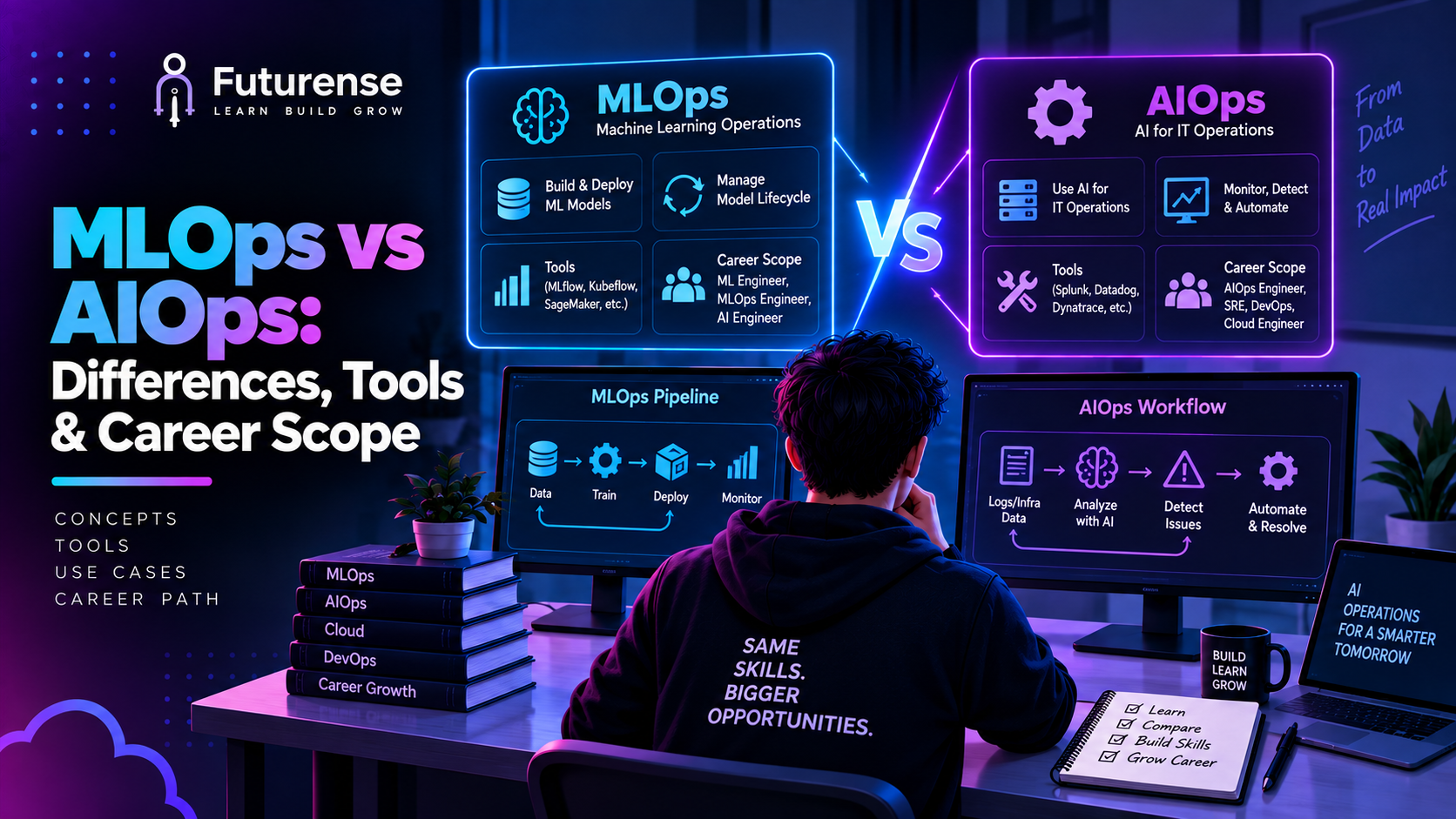
MLOps is a set of practices and tools to reliably develop, deploy, monitor, and govern machine learning models in production environments. It extends DevOps principles to handle challenges traditional DevOps was never built for versioning training data, tracking experiments, validating model accuracy, and managing model drift as real-world data shifts over time. MLOps combines data engineering, ML engineering, and software development, and the users are correspondingly technical: data scientists and ML engineers who need their models to keep performing reliably once they leave the notebook and enter production.
What Is AIOps?
AIOps artificial intelligence for IT operations applies AI and machine learning to automate and optimize IT operations themselves, not machine learning models. It focuses on automating incident detection, correlating fragmented alerts across a sprawling infrastructure estate, and reducing the mean time to resolution (MTTR) when something breaks. AIOps operates on observability data logs, metrics, and traces with the explicit goal of cutting through alert noise so IT and operations teams can focus on genuinely important issues rather than drowning in routine ones.
MLOps vs AIOps: The Core Distinction
The cleanest way to separate the two: MLOps vs AIOps comes down to what you're actually operating machine learning models and their behavior, versus IT services and incidents. That single distinction is why the two disciplines diverge on nearly every practical dimension that follows: who uses them, what data they consume, what "success" looks like, and even which team owns the budget.
The difference matters beyond terminology, because it changes budgets, owners, tooling, and success metrics. Confusing the two or worse, trying to solve an MLOps problem with AIOps tooling or vice versa is a common, costly mistake, since neither discipline's tooling solves the other's problem.
MLOps vs AIOps: Side-by-Side Comparison
Tools: MLOps vs AIOps Compared
The tooling ecosystems for these two disciplines barely overlap, which is itself a useful signal of how different the underlying problems are. On the MLOps side, our breakdown of MLOps tools like Kubeflow, MLflow, and SageMaker covers the ecosystem in depth these platforms handle experiment tracking, model versioning, artifact management, and deployment across the full model lifecycle, with newer platforms extending into LLMOps territory for teams operationalizing generative AI and LLM workflows specifically.
On the AIOps side, well-known tools include Dynatrace, Splunk ITSI, Moogsoft, BMC Helix, and IBM Watson AIOps platforms that take somewhat different approaches but share the common goal of applying machine learning to IT operations at scale, correlating cross-domain telemetry into prioritized, actionable insight rather than raw alert noise.
Failure Modes: What Goes Wrong in Each Discipline
Understanding how each discipline fails is one of the clearest ways to understand what it actually does. MLOps pipelines are vulnerable to silent failures model drift or stale data can go completely unnoticed by traditional CI/CD, because the pipeline itself completes successfully even while the model's real-world predictions have quietly degraded. This is precisely why dedicated model monitoring and drift detection, not just deployment automation, is a core MLOps concern.
AIOps systems face close to the opposite problem: alert storms. If correlation rules aren't tuned carefully, a single infrastructure event can trigger thousands of simultaneous alerts, creating exactly the kind of noise AIOps was built to eliminate in the first place. Getting AIOps tuning wrong doesn't just fail to help it can actively overwhelm the team it was meant to support.
Where MLOps and AIOps Actually Work Together
MLOps and AIOps are not competitors, and framing them as a choice between one or the other misses how they actually get used in mature organizations. AIOps commonly functions as the infrastructure monitoring layer underneath MLOps pipelines an ML model still runs on infrastructure, and that infrastructure still needs the observability and incident response AIOps provides. Most mature organizations end up running MLOps and AIOps together, since ML services still need stable underlying operations, and operations automation increasingly relies on machine learning itself.
This convergence is accelerating further as agentic AI reshapes both fields our explainer on agentic DevOps covers how autonomous AI agents are starting to take on operational tasks that once required direct human intervention, a trend touching both the MLOps and AIOps sides of this comparison. It's part of a broader family of adjacent "Ops" disciplines worth knowing about see our guide on DevSecOps and why cloud engineers need it for another closely related discipline in the same naming pattern.
How to Decide Which One to Prioritize
If you're an organization deciding where to invest first, the decision framework is genuinely simple: audit your current bottleneck rather than picking based on trend or budget availability alone. If your ML models are degrading in production without anyone noticing until a business metric suffers, prioritize MLOps. If your on-call engineers are overwhelmed by alert volume and your mean time to resolution keeps climbing, prioritize AIOps. Most organizations eventually need both, but the order in which you invest should follow your actual pain point, not the other way around.
Career Scope: MLOps vs AIOps as Career Paths
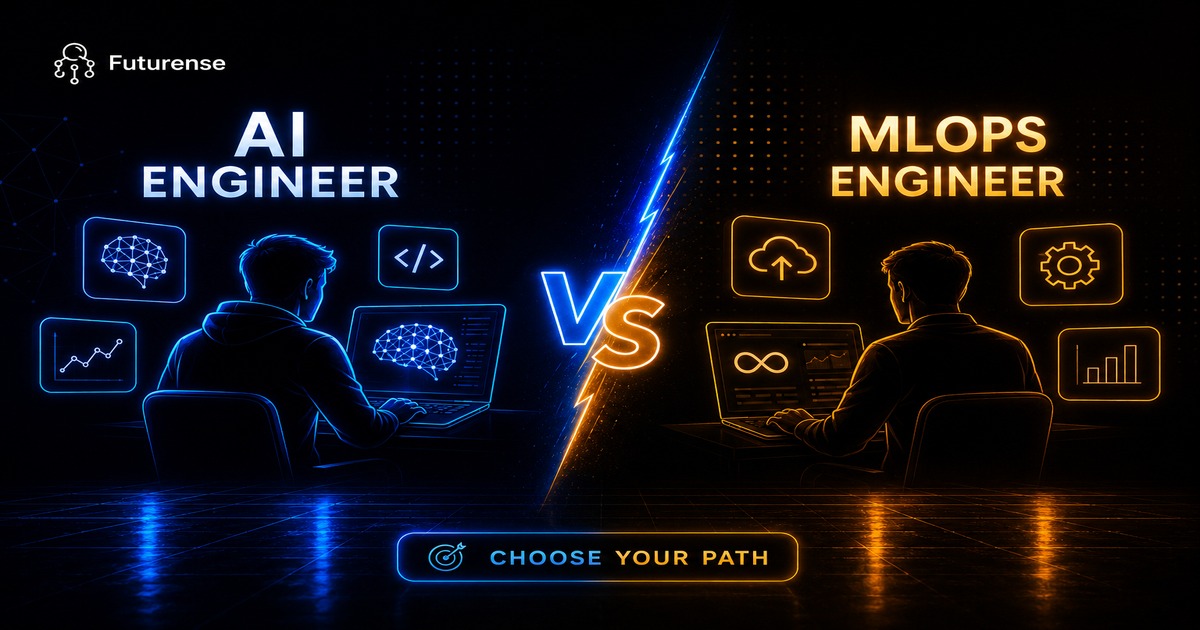
For engineers deciding between these as specializations rather than organizations deciding what to adopt, the career paths diverge as clearly as the disciplines themselves. MLOps roles sit closer to the data science and ML engineering track building and maintaining the pipelines that keep models reliable in production. See our detailed MLOps Engineer salary in India guide for a full breakdown by experience level and city. If you're also weighing this against a broader AI Engineer career path, our comparison of AI Engineer vs MLOps Engineer covers that adjacent decision in depth.
AIOps roles sit closer to the IT operations, SRE, and infrastructure track, generally requiring less machine learning modeling depth but more infrastructure, observability, and incident-response expertise. Both specializations are growing as organizations mature their AI and operations practices, and the underlying skill sets data pipeline literacy for MLOps, observability and infrastructure fluency for AIOps transfer only partially between the two, making this a genuine, meaningful specialization choice rather than a minor branding difference.
If you're specifically interested in where AIOps intersects with the fast-growing agentic AI space, Futurense's PG Certificate in Building Professional Agentic AI with AIOps with IIT Jammu is built around exactly that combination pairing agentic AI development with the operational discipline required to run it reliably in production.
TL;DR: MLOps manages the machine learning model lifecycle training, deployment, versioning, and drift monitoring. AIOps applies AI and machine learning to IT operations automating incident detection, correlating alerts, and reducing mean time to resolution (MTTR). They aren't competitors: in mature organizations, AIOps often functions as the infrastructure monitoring layer that supports MLOps pipelines. Which one to prioritize depends on your actual bottleneck if your models are silently degrading in production, that's an MLOps problem; if your on-call engineers are drowning in alert volume, that's an AIOps problem.
What is the main difference between MLOps and AIOps?
MLOps manages the machine learning model lifecycle training, deployment, versioning, and monitoring for drift while AIOps applies AI to IT operations, automating incident detection and reducing the time it takes to resolve issues. MLOps operates on model and training data; AIOps operates on IT observability data like logs, metrics, and traces.
Are MLOps and AIOps the same thing?
No, despite the similar names. They manage entirely different things MLOps manages machine learning models and their behavior, while AIOps manages IT services, infrastructure, and incidents. They are complementary disciplines, not interchangeable terms.
Which tools are used in MLOps vs AIOps?
Common MLOps tools include MLflow, Kubeflow, SageMaker, and Weights & Biases, focused on experiment tracking, model versioning, and deployment. Common AIOps tools include Dynatrace, Splunk ITSI, Moogsoft, BMC Helix, and IBM Watson AIOps, focused on observability and incident correlation.
Do MLOps and AIOps work together, or do I need to choose one?
They work together in most mature organizations rather than competing. AIOps often functions as the infrastructure monitoring layer that supports MLOps pipelines, since ML systems still run on infrastructure that needs reliable operations. Most organizations that scale AI adoption eventually invest in both.
Which career path pays more: MLOps or AIOps?
Compensation for both is strong and growing, and direct comparisons vary by company, region, and specialization depth. MLOps roles generally sit closer to the data science/ML engineering pay band, while AIOps roles track closer to IT operations and SRE compensation, with both benefiting from the broader AI skills premium currently affecting the market.
How is LLMOps different from both MLOps and AIOps?
LLMOps is a more specialized discipline focused specifically on the unique challenges of deploying and operating large language models prompt management, hallucination monitoring, and LLM-specific evaluation and is often considered a subset or extension of MLOps tailored to generative AI, rather than a fully separate discipline from either MLOps or AIOps.


Advanced PG Certificate in AI Engineering on Cloud and AIOps
IIT Roorkee
Engineer AI Systems for Top Enterprises, with the Most Critical Skills of the Decade.