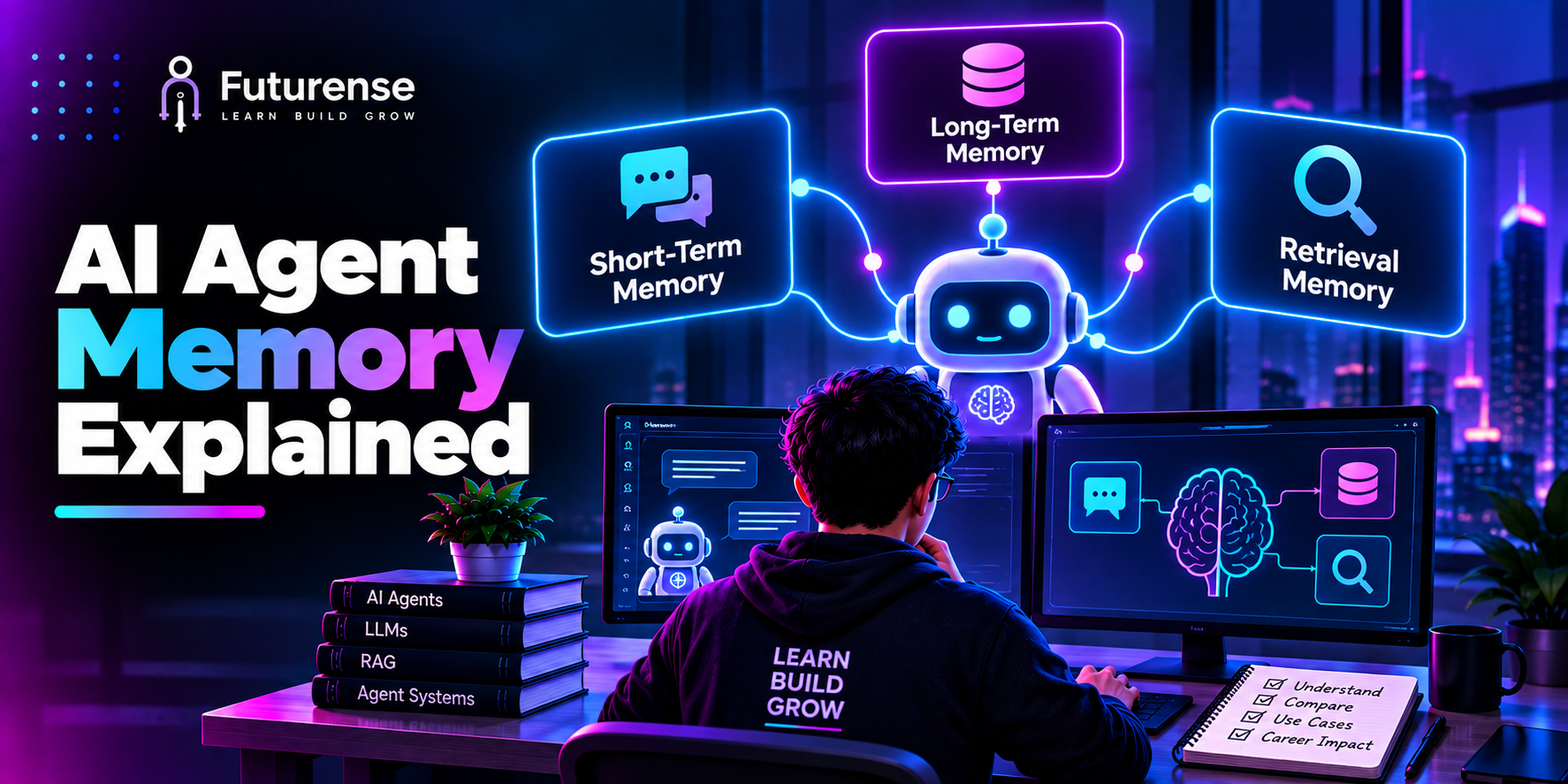


Why AI Agents Seem to Forget
A common frustration with early chatbot and agent experiences is that they lose track of things said only a few turns earlier, or have no idea who you are in a new session even after dozens of prior conversations. This isn't a mysterious limitation it's a direct consequence of how large language models actually work. An LLM has no persistent memory of its own between calls; every request is processed fresh, with the model only "knowing" whatever text is included in that specific call's context window.
What looks like memory in a well-built agent is actually an engineered system sitting around the model, not a capability the model has natively. That system typically has three distinct layers, each solving a different part of the memory problem, and understanding the difference is the foundation of good AI agent architecture.
Short-Term Memory: What the Agent Knows Right Now
Short-term memory is the information available to the model within its current context window the active conversation history, the current task state, and anything retrieved or generated earlier in the same session. It's fast, requires no external storage, and is exactly what a base LLM call already has access to without any additional engineering.
The catch is that short-term memory is bounded and temporary by design. Once a conversation exceeds the context window, or the session ends, that information is gone unless something outside the model has captured it. This is also where "context rot" becomes a real problem: a long-running session with a lot of accumulated history can fill the context window with low-relevance content, degrading the quality of the agent's responses even while technically still "remembering" everything in the raw sense. Managing what stays in short-term memory versus what gets summarized, dropped, or moved elsewhere is itself a design decision, not something that happens automatically this is a core part of what context engineering as a discipline actually does.
Long-Term Memory: What Persists Across Sessions
Long-term memory is information deliberately stored outside the model in a database, file, or dedicated memory store so it survives after a session ends and can be pulled back in during a future one. This is what makes an agent feel like it "remembers you": your stated preferences, past decisions, facts you've shared, or the outcome of a previous task.
Long-term memory typically comes in a few recognizable forms:
- Episodic memory records of specific past events or interactions ("last week you asked me to prioritize cost over latency")
- Semantic memory general facts and knowledge accumulated about a user, task, or domain, independent of when they were learned ("this user prefers Python over JavaScript")
- Procedural memory learned patterns about how to perform a task or workflow, refined over repeated interactions
The engineering challenge with long-term memory isn't just storing information it's deciding what's worth storing at all. Storing every detail of every interaction creates the same problem as an overloaded context window, just at a larger scale: too much low-relevance stored data makes it harder, not easier, to surface what actually matters later.
Retrieval Memory: Pulling in Only What's Relevant
Retrieval memory is the mechanism that makes long-term memory usable in practice. Rather than loading an agent's entire stored memory into context on every request which would be both expensive and counterproductive retrieval memory searches the stored memory for the specific pieces relevant to the current request and pulls in only those.
This is architecturally the same pattern used in a RAG pipeline: information is embedded and stored (often in a vector database), and a query triggers a similarity search that surfaces the most relevant stored items, which then get added to the model's context window for that specific call. The difference is what's being retrieved from a RAG system typically retrieves from external documents and knowledge bases, while an agent's retrieval memory retrieves from its own accumulated history and stored facts about the user or task. In more advanced systems, the two blend directly, which is the core idea behind agentic RAG an agent that decides, dynamically, what to retrieve and when, from both external knowledge and its own memory.
How the Three Layers Work Together
None of these three layers works well in isolation a production-grade agent memory system uses all three, handing off between them as a conversation or task progresses:
- Short-term memory holds the active conversation and immediate task context
- When something worth keeping happens a stated preference, a completed task, an important fact it gets written to long-term memory rather than just living in the current context window
- On future requests, retrieval memory searches long-term storage and pulls back only the relevant pieces, injecting them into the current short-term context
This handoff is what allows an agent to have what feels like a coherent, persistent relationship with a user across sessions, without ever loading an impossibly large amount of accumulated history into every single request. Frameworks like LangGraph vs LangChain provide built-in primitives for exactly this kind of memory management, rather than requiring teams to build the plumbing from scratch.
Why Memory Design Matters for Agent Reliability
Poorly designed memory is one of the most common root causes of agents that feel unreliable or inconsistent, even when the underlying model is capable:
- An agent with only short-term memory will repeat questions it was already answered, lose track of a multi-step task if the conversation runs long, and feel like it has amnesia between sessions
- An agent with long-term memory but no retrieval layer either has to load everything (expensive, and it degrades output quality through context clutter) or arbitrarily picks a subset (missing what's actually relevant)
- An agent with retrieval memory but a poor storage/write strategy can retrieve confidently from stale, contradictory, or low-quality stored data a subtler failure that's harder to catch than an agent simply forgetting something
This is precisely why memory design gets treated as a first-class architectural decision in serious agentic AI systems rather than an afterthought bolted on once an agent is already misbehaving in production. For systems with multiple cooperating agents, the challenge compounds further multi-agent systems need to decide what memory is shared across agents versus scoped to a single agent, since sharing everything creates the same clutter problem at a system-wide scale.
TL;DR: AI agent memory works across three layers: short-term memory holds the current conversation or task within the active context window and disappears when the session ends; long-term memory persists facts, preferences, and past interactions across sessions, usually stored outside the model itself; and retrieval memory pulls the specific, relevant slice of stored information into context only when it's needed, rather than loading everything at once. Agents that "forget" usually aren't failing they're relying on short-term memory alone, with no long-term or retrieval layer behind it.
What is the difference between short-term and long-term memory in AI agents?
Short-term memory is the information available within the agent's current context window during an active session it disappears once the session ends. Long-term memory is information deliberately stored outside the model so it persists across sessions and can be retrieved later.
What is retrieval memory in AI agents?
Retrieval memory is the mechanism that searches an agent's stored long-term memory for information relevant to the current request and pulls in only that relevant slice, rather than loading the agent's entire memory history into every context window.
Why do AI agents seem to forget things from earlier in a conversation?
This usually happens because the conversation has exceeded the model's context window, or because the agent only has short-term memory with no long-term storage layer behind it, so nothing outside the current session was ever saved.
How do you give an AI agent long-term memory?
By deliberately storing information outside the model in a database, file, or dedicated memory store after each session or interaction, then using a retrieval mechanism (often a vector database with similarity search) to pull relevant stored information back into context on future requests.
Is AI agent memory the same as a larger context window?
No. A larger context window increases how much short-term information an agent can hold in a single session, but it doesn't provide persistence across sessions or the ability to selectively retrieve only relevant information that requires a separate long-term and retrieval memory system.
What's the relationship between AI agent memory and RAG?
Retrieval memory uses the same underlying architecture as retrieval-augmented generation (RAG) embedding information and retrieving relevant pieces via similarity search. The difference is source: RAG typically retrieves from external documents, while an agent's retrieval memory retrieves from its own stored history and facts about the user or task.


Advanced PG Certificate in AI Engineering on Cloud and AIOps
IIT Roorkee
Engineer AI Systems for Top Enterprises, with the Most Critical Skills of the Decade.