

What Is Context Engineering in AI?
Context engineering is the practice of deliberately constructing everything a large language model sees before it produces an output system instructions, relevant retrieved documents, prior conversation turns, tool results, and long-term memory so that the model has exactly the information it needs, in the right order, at the right time.
The term was popularized in mid-2025 when OpenAI researcher Andrej Karpathy posted that "context engineering" was a more accurate description of serious LLM application work than "prompt engineering," describing it as "the delicate art and science of filling the context window with just the right information for the next step." That framing stuck because it named something practitioners were already doing but hadn't had a clean term for: managing an entire information pipeline, not just wordsmithing a single instruction.
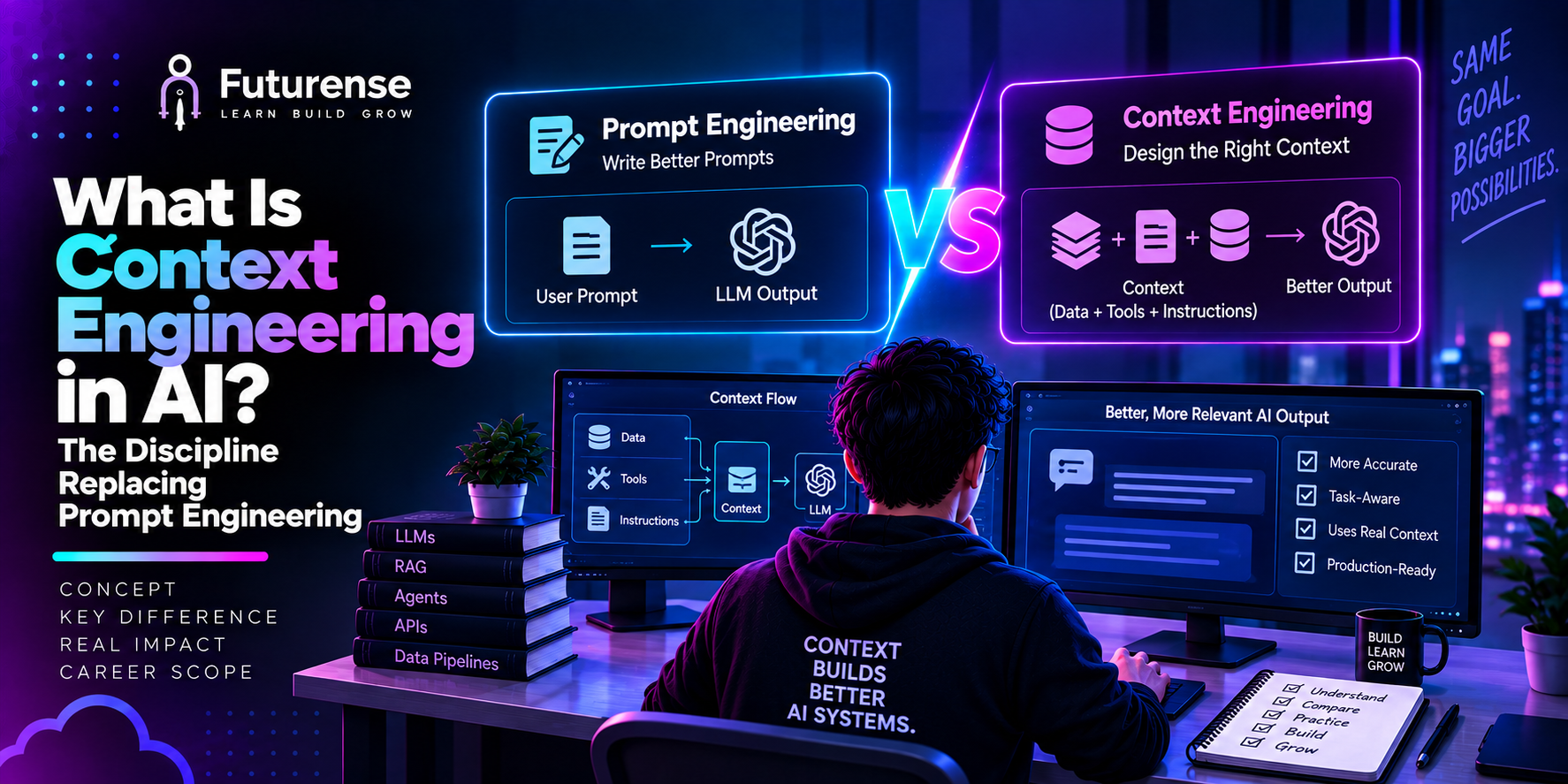
Context Engineering vs. Prompt Engineering
The two disciplines are related but not the same, and conflating them is the most common source of confusion for people new to the term.
A useful way to hold the distinction: prompt engineering asks "how do I phrase this instruction well?" Context engineering asks "what does the model need to know to execute this instruction well, and how do I get that information in front of it?" A perfectly worded prompt still fails if the model lacks the context to act on it which is exactly the failure mode context engineering exists to prevent.
What Goes Into "Context"?
When practitioners talk about engineering the context window, they mean assembling some combination of the following components for every request:
- System instructions the model's role, constraints, and behavioral guardrails, usually set once per application
- Retrieved knowledge documents, passages, or records pulled in via a RAG pipeline based on relevance to the current query
- Conversation history prior turns in the current session, often summarized or truncated to fit the context window
- Tool outputs results from function calls, API responses, database queries, or code execution the model triggered
- Long-term memory facts about the user or task persisted across sessions, distinct from the current conversation
- Few-shot examples sample input-output pairs that demonstrate the expected format or reasoning pattern
The engineering problem is that a context window is finite and expensive every token included is a token the model has to process, and irrelevant or poorly ordered context measurably degrades output quality even when the window has room to spare. This is sometimes called "context rot": long, cluttered context windows where the useful signal gets buried, causing the model to miss or misweight the information that actually matters.
Why Context Engineering Matters More for AI Agents Than Chatbots
A simple single-turn chatbot query can often get by on prompt engineering alone the user asks one question, the model answers, done. Agentic AI systems are a different problem entirely, because they run multi-step loops: plan a task, call a tool, read the result, decide the next action, call another tool, and repeat often dozens of times before returning a final answer.
At every one of those steps, the agent's context window has to be reassembled with exactly the right slice of information: not the entire conversation history, not every tool's raw output, but the specific facts relevant to the next decision. Get this wrong and agents degrade in predictable ways they repeat failed actions because the failure isn't in their visible context anymore, they hallucinate facts that were retrieved but got pushed out of the window, or they lose track of the original goal after several tool calls. This is the practical reason context engineering has become inseparable from serious agent-building work, and why teams building production agentic RAG systems treat context assembly as a first-class engineering problem rather than an afterthought.
How Context Engineering Works in Practice
A production context-engineering pipeline typically runs through a few repeatable steps for every request:
- Retrieve pull candidate information from documents, databases, or prior memory that's relevant to the current query, usually via semantic search or a hybrid retrieval method
- Filter and rank cut candidates down to what's actually useful, since including everything retrievable degrades quality rather than improving it
- Compress and summarize condense conversation history or long documents so they fit the available context budget without losing decision-relevant detail
- Order sequence the assembled context so the most decision-critical information isn't buried in the middle of a long window, since models attend unevenly across long contexts
- Inject assemble the final prompt from system instructions, ordered context, and the user's actual request
- Evaluate and iterate monitor where the model's outputs go wrong and trace it back to a context problem (missing information, poor ordering, stale data) versus a genuine reasoning failure
This is why context engineering sits closer to data engineering and information retrieval than to copywriting. It requires understanding what a model actually needs to reason well, not just what sounds like a clear instruction to a human reader.
Real-World Applications
- Customer support agents that pull a user's order history, past tickets, and product documentation into context before responding, rather than relying on the model's general training knowledge
- Coding assistants that assemble relevant file context, recent edits, and project conventions so suggestions match the actual codebase rather than generic patterns
- Enterprise search and internal Q&A tools that retrieve the right internal documents via RAG before answering a question about company policy or data
- Multi-agent workflows, where different agents pass carefully scoped context to each other rather than sharing an entire raw history, avoiding the compounding clutter that degrades long-running systems a pattern central to good AI orchestration
- Personal AI assistants that maintain long-term memory about a user's preferences and past interactions, selectively surfacing only what's relevant to the current request
Why Context Engineering Skills Are in High Demand
As more companies move from chatbot pilots to production AI agents, the bottleneck has shifted from "can we get a good response to one prompt" to "can we build a system that reliably has the right information at every step of a multi-step task." That shift is showing up directly in hiring: job postings for AI/LLM engineering roles increasingly list context management, retrieval system design, and memory architecture as core requirements rather than prompt-writing ability alone.
This mirrors a broader pattern already visible in how the prompt engineer vs AI engineer distinction has evolved the roles that command the strongest compensation and the most durable career paths are the ones doing systems-level work (retrieval, memory, orchestration), not prompt phrasing alone. Context engineering sits squarely inside that systems-level skill set, which is part of why it's increasingly treated as a core competency for AI/ML engineers and large language model application developers rather than a niche specialty.
How to Learn Context Engineering
Context engineering isn't taught as an isolated course in most curricula yet it's best learned as an extension of skills you'd need to build any serious LLM application:
- Start with the fundamentals of large language models and how context windows actually work token limits, attention patterns, and why position within the window affects how the model weighs information
- Learn retrieval-augmented generation hands-on build a basic RAG pipeline to understand retrieval, ranking, and chunking decisions from the inside
- Study agent architectures understanding how AI agents plan, call tools, and loop is what makes the context-assembly problem concrete rather than abstract
- Practice context debugging deliberately break a working system by injecting irrelevant or excessive context, and observe how output quality degrades; this builds the intuition that a "correct" prompt still fails without correct context
- Get structured, applied training for learners who want this taught systematically alongside the broader generative and agentic AI skill set rather than pieced together from blog posts, programs like the Generative AI and Agentic AI program at IIT Roorkee cover retrieval, agent design, and orchestration as an integrated curriculum rather than isolated topics
The Future of Context Engineering in AI
As context windows grow larger some models now support context windows in the millions of tokens it might seem like context engineering becomes less necessary, since there's simply more room to include everything. In practice, the opposite has held true so far: larger windows have made careful curation more important, not less, because "context rot" gets worse, not better, when there's more low-relevance content competing for the model's attention. The discipline is increasingly treated less as a temporary workaround for small context windows and more as a permanent architectural layer in any serious AI system closer in stature to how database schema design or API architecture is treated in traditional software engineering
What is context engineering in AI, in one sentence?
Context engineering is the practice of designing what information instructions, retrieved knowledge, memory, and tool outputs an AI model has access to before it generates a response, rather than focusing only on how a single instruction is worded.
Is context engineering the same as prompt engineering?
No. Prompt engineering focuses on wording a single instruction effectively. Context engineering is broader it covers the entire pipeline of information (retrieval, memory, tool outputs, conversation history) that gets assembled into the model's context window before that instruction is even processed.
Why is context engineering important for AI agents specifically?
AI agents run multi-step loops involving tool calls and decisions, and at each step the model needs exactly the right slice of information to act correctly. Poor context management causes agents to repeat failed actions, lose track of goals, or hallucinate failures that context engineering is specifically designed to prevent.
What skills do you need to learn context engineering?
A working understanding of how large language models and context windows function, hands-on experience building a retrieval-augmented generation (RAG) pipeline, familiarity with AI agent architectures, and practice diagnosing when a model failure is caused by missing or poorly ordered context rather than a reasoning error.
Does a bigger context window make context engineering unnecessary?
A working understanding of how large language models and context windows function, hands-on experience building a retrieval-augmented generation (RAG) pipeline, familiarity with AI agent architectures, and practice diagnosing when a model failure is caused by missing or poorly ordered context rather than a reasoning error.
The term gained widespread attention after AI researcher Andrej Karpathy described it on social media in 2025 as "the delicate art and science of filling the context window with just the right information," distinguishing it from the narrower scope of prompt engineering.


Advanced Certificate Program in AI-Powered Product Design and Management
IITM Pravartak
Become the AI-first product leader every company needs.